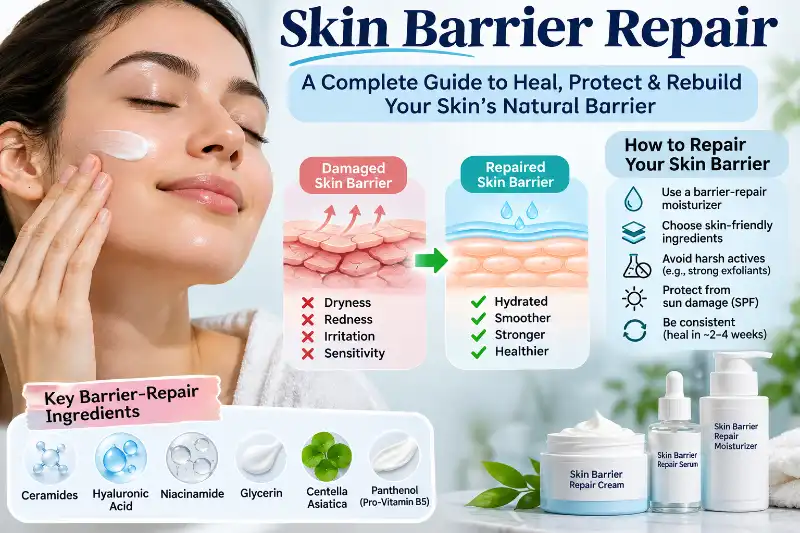
Does your face feel tight after washing? Maybe your regular moisturizer suddenly stings, or your skin looks red, dry, and flaky even though you use skincare every day.
You might be dealing with a damaged skin barrier.
The good news is that many forms of skin barrier irritation can improve with gentle care. You don’t always need expensive serums or a shelf full of new products. Sometimes, using fewer products is the better place to start.
Skin barrier repair starts with a simple routine: use a gentle cleanser, apply a suitable moisturizer, protect your skin from the sun, and avoid products that make irritation worse. Ingredients like ceramides, glycerin, and petrolatum can help support your skin’s natural moisture barrier.
But how do you know if your barrier is damaged? And which products are worth trying?
This guide explains how to repair a damaged skin barrier, what ingredients to look for, how long recovery may take, and how to choose skincare that works for your skin type.
Medical note: This article provides general skincare information, not a diagnosis or personal treatment plan. Persistent, painful, or worsening skin symptoms should be checked by a healthcare professional.
FIND YOUR AGE - IN YEARS, MONTHS, DAYS, HOURS & SECONDS!
What Is the Skin Barrier, and Why Does It Need Repair?
Your skin barrier is the outer protective layer of your skin. Its main job is to help keep moisture inside while limiting contact with irritants and other outside substances.
Think of it like the roof of a house.
When the roof is in good shape, it helps protect everything underneath. When the roof has gaps, water can get through, and things inside become harder to protect.
Your skin works in a similar way.
A healthy skin barrier helps your face stay comfortable, hydrated, and better protected from everyday conditions.
How the Skin Barrier Protects Your Face
The outermost part of your skin is called the stratum corneum. It is part of the epidermis, your skin’s outer layer.
This protective layer contains skin cells called corneocytes. Natural fats, known as lipids, help hold those cells together.
Dermatologists often explain this structure using bricks and mortar.
- The skin cells are the bricks.
- The natural lipids are the mortar.
- Together, they help form a protective surface.
Three important types of skin lipids are ceramides, cholesterol, and fatty acids.
Your skin also has a slightly acidic surface environment, sometimes called the acid mantle. It helps support normal skin function.
You don’t need to memorize these names. What matters is understanding that healthy skin needs both moisture and a working protective barrier.
What Happens When Your Skin Barrier Is Damaged?
When the protective barrier is not working well, water can escape more easily.
This is called transepidermal water loss, or TEWL.
As your skin loses moisture, it may become dry, rough, or uncomfortable.
Your face might also react more strongly to cleansers, skincare products, weather, or other irritants.
For example, a moisturizer that once felt comfortable might suddenly cause stinging.
That doesn’t automatically mean the moisturizer is dangerous. Your skin may be irritated, or you could be reacting to an ingredient.
The important thing is to identify the problem rather than covering it with more products.
How Can You Tell If Your Skin Barrier Is Damaged?
You might suspect skin barrier damage if your face suddenly feels more sensitive than usual.
Maybe your cheeks burn when you apply skincare. Or your forehead feels dry even after moisturizing.
These changes can happen when your skin barrier is irritated, but they can also have other causes.
Common Signs of a Damaged Skin Barrier
Some common signs include:
1. Dry and flaky skin
Your face may develop dry patches or visible flakes, especially around your nose, cheeks, or mouth.
2. Tightness after washing
Your skin feels stretched or uncomfortable when you finish cleansing.
3. Stinging or burning
A cleanser, moisturizer, or serum that normally feels fine starts to sting.
4. Redness and irritation
Some people notice red patches. On darker skin tones, inflammation may look purple, brown, gray, or simply darker than the surrounding skin.
5. Rough skin texture
Your face may feel uneven, irritated, or unusually rough.
6. Increased sensitivity
Products, hot water, wind, or sunlight may feel more irritating than before.
These symptoms don’t prove your skin barrier is damaged. Still, they are good reasons to review your routine and look for possible irritants.
Damaged Skin Barrier vs. Dry Skin vs. Dehydrated Skin
These terms often appear together, but they don’t mean exactly the same thing.
| Skin Concern | What You May Notice | What It Means |
|---|---|---|
| Dry skin | Flaking, roughness, tightness | Skin tends to have less oil and may need more moisturizing care |
| Dehydrated skin | Tight or dull-looking skin | A skincare term describing skin that lacks water |
| Compromised skin barrier | Stinging, sensitivity, dryness, irritation | The protective barrier may not be functioning normally |
| Contact dermatitis | Itching, rash, redness, burning | An irritant or allergen may be causing inflammation |
| Eczema | Dry, itchy, inflamed patches | A skin condition that often involves barrier dysfunction |
Here’s something worth remembering: dry skin and a damaged moisture barrier can happen together.
You may have naturally dry skin, then make it worse by washing too often or using harsh skincare products.
When Skin Irritation May Be Something Else
Not every skin problem is a broken skin barrier.
Eczema, rosacea, psoriasis, allergic contact dermatitis, and other conditions can cause similar symptoms.
Even acne-prone skin can become irritated without having the same underlying problem as eczema.
If your skin develops a spreading rash, severe pain, swelling, oozing, crusting, or other unusual symptoms, don’t assume you can fix everything with a moisturizer.
A dermatologist can help find the cause and recommend treatment.
What Causes Skin Barrier Damage?
If your skin keeps getting irritated, the first step is to figure out what may be causing it.
Buying another repair cream won’t help much if you continue using something that irritates your face every day.
Over-Exfoliating and Using Too Many Active Ingredients
Exfoliation removes dead surface skin cells.
That can be useful for some people, but using strong exfoliating products too often may irritate the skin.
Common examples include:
- Glycolic acid
- Salicylic acid
- Lactic acid
- Strong exfoliating toners
- Facial scrubs
- Retinoids, especially when introduced too quickly
Imagine using a salicylic acid cleanser in the morning, a glycolic acid toner in the afternoon, and retinol at night.
Your skin may tolerate some of these ingredients individually. But using several irritating products together can increase the chance of dryness and discomfort.
More active ingredients do not always mean better results.
Harsh Cleansers, Hot Water, and Over-Washing
Does your face feel squeaky clean after washing?
That feeling isn’t necessarily a good sign.
Some cleansers remove too much surface oil, leaving skin tight and uncomfortable.
Hot water and frequent washing may make the problem worse.
Try using lukewarm water and a gentle cleanser instead.
You don’t need to scrub hard to clean your face.
Weather, Sun Exposure, and Skin Conditions
Your environment affects how your skin feels.
Cold weather, dry indoor air, wind, and low humidity can make dryness more noticeable.
Sun exposure can also damage your skin, which is one reason daily sunscreen matters.
Some medical conditions, including atopic dermatitis, are linked with skin barrier problems.
If you have ongoing eczema or another inflammatory skin condition, basic skincare may help, but you might also need medical treatment.
Can Acne Treatments or Retinoids Affect Your Skin Barrier?
Yes. Some acne treatments can cause dryness, peeling, and irritation.
These may include:
- Benzoyl peroxide
- Topical retinoids
- Salicylic acid
- Prescription acne medications
Oral isotretinoin, often known by the former brand name Accutane, can also cause significant skin dryness.
If you’re searching for Accutane side effects on the skin barrier in month six, remember that individual experiences vary.
Don’t change or stop prescribed treatment on your own. Ask your dermatologist how to manage irritation while following your treatment plan.
How to Repair a Damaged Skin Barrier Step by Step
So, how do you repair your skin barrier without making things worse?
Start simple.
The goal is to reduce irritation, keep your skin moisturized, and give its protective layer a chance to recover.
Here are six practical steps.
Step 1: Simplify Your Skincare Routine
If your bathroom shelf is full of toners, exfoliants, serums, and treatments, you may want to review what you’re using.
A basic routine is often easier for irritated skin to tolerate.
Focus on three things:
- A gentle cleanser
- A suitable moisturizer
- Broad-spectrum sunscreen
You don’t have to use a toner, essence, overnight mask, and multiple serums to support skin barrier repair.
When your skin is irritated, consider putting nonessential exfoliating products and strong cosmetic treatments aside.
However, if you’re using a prescription treatment, check with your clinician before making changes.
Step 2: Switch to a Gentle Facial Cleanser
Cleaning your face should remove dirt and excess oil without leaving your skin feeling stripped.
Look for a gentle, preferably fragrance-free facial cleanser.
When washing:
- Use lukewarm water.
- Massage gently with your fingertips.
- Avoid rough washcloths and facial brushes.
- Rinse without scrubbing.
- Pat dry with a soft towel.
If your skin is very dry, you may not need cleanser every morning. A gentle water rinse may be enough for some people.
At night, cleanse as needed to remove sunscreen, makeup, and daily buildup.
If your cleanser makes your face burn or leaves it extremely tight, it may not be suitable for your skin right now.
Step 3: Apply a Barrier-Supporting Moisturizer
A good moisturizer is one of the most useful products for skin barrier support.
It helps reduce moisture loss and makes dry skin feel more comfortable.
Try applying moisturizer after washing, while your skin is still slightly damp.
Look for helpful ingredients such as:
- Ceramides
- Glycerin
- Hyaluronic acid
- Petrolatum
- Dimethicone
- Squalane
- Cholesterol and fatty acids
You don’t need a product containing every ingredient on this list.
A simple, fragrance-free moisturizer that your skin tolerates may be more helpful than an expensive cream packed with unfamiliar actives.
If your face feels dry during the day, you may need to reapply moisturizer.
Step 4: Protect Your Skin With Daily Sunscreen
Sunscreen matters even when your goal is repairing dryness or irritation.
Ultraviolet radiation can damage skin and make certain skin concerns worse.
Choose a broad-spectrum sunscreen with SPF 30 or higher.
Apply it to exposed skin as directed, and reapply when needed, especially outdoors.
If sunscreen stings, try a different gentle formula rather than giving up sun protection completely.
Mineral sunscreens containing zinc oxide or titanium dioxide may feel more comfortable for some sensitive users, although everyone reacts differently.
Shade, hats, and protective clothing offer extra protection.
Step 5: Avoid Irritating Products While Your Skin Recovers
Your skin needs fewer sources of irritation, not more.
During a period of significant irritation, review whether you should temporarily avoid:
- Harsh exfoliating scrubs
- Strong cosmetic acid treatments
- Fragranced skincare products
- Alcohol-heavy products that sting
- Unnecessary active ingredient combinations
- Frequent product switching
Retinoids and acne medications deserve special care because some are prescribed for medical reasons. Ask your clinician about adjusting use if they are causing significant irritation.
You may also see people recommending lemon juice, baking soda, essential oils, or homemade exfoliating treatments.
These are not reliable skin barrier repair treatments and may cause additional irritation.
Natural does not automatically mean gentle.
Step 6: Track Your Skin’s Response Before Adding Products Back
You don’t need to examine your face under bright lighting every hour.
Instead, pay attention to how your skin feels over time.
Ask yourself:
- Does my face feel less tight after washing?
- Does my moisturizer sting less?
- Are dry patches becoming less uncomfortable?
- Is my skin tolerating the basic routine?
- Are symptoms improving rather than spreading?
You could take a photo every week under similar lighting if you want to compare visible changes.
Don’t expect perfect skin after two days.
Improvement takes time, and some conditions need more than a home skincare routine.
What Is the Best Skin Barrier Repair Routine for Morning and Night?
If you’re wondering exactly when to use each product, keep the routine easy.
You don’t need ten steps in the morning and another ten before bed.
Morning Skin Barrier Repair Routine
| Step | Product | Why It Helps |
|---|---|---|
| 1 | Gentle cleanser or water rinse | Removes buildup without unnecessary scrubbing |
| 2 | Fragrance-free moisturizer | Helps reduce moisture loss |
| 3 | Broad-spectrum SPF 30+ sunscreen | Protects against UV damage |
Start with the cleanser only if you need it.
Then apply moisturizer and finish with sunscreen.
If your moisturizer already contains suitable SPF 30+ protection, it may serve both purposes when applied in the amount needed for effective sun protection.
Night Skin Barrier Repair Routine
| Step | Product | Why It Helps |
|---|---|---|
| 1 | Gentle facial cleanser | Removes sunscreen, makeup, and dirt |
| 2 | Barrier-supporting moisturizer | Hydrates and protects dry skin |
| 3 | Optional protective ointment | Helps seal in moisture on suitable dry areas |
At night, cleanse gently and apply your moisturizer.
For small, particularly dry areas, a thin layer of plain petrolatum may help reduce moisture loss.
But don’t assume thick ointments are right for every face. Some people dislike the texture, and certain acne-prone users may prefer lighter products.
Do You Need a Serum, Toner, or Multiple Moisturizers?
Not necessarily.
A skin barrier repair serum can be useful if it contains moisturizing ingredients your skin tolerates.
But a serum isn’t required.
You also don’t need a toner just because someone online includes one in their routine.
What about using two moisturizers for a damaged skin barrier?
It can make sense when a lightweight moisturizer isn’t enough and your skin benefits from an additional protective layer.
For example, someone with very dry cheeks might use a regular moisturizer followed by a thin amount of ointment on those dry patches.
Still, if one moisturizer keeps your skin comfortable, there’s no reason to complicate things.
Which Ingredients Actually Help Support Skin Barrier Repair?
Skincare labels can feel confusing.
One product talks about ceramides. Another promises intense hydration from hyaluronic acid. A third highlights niacinamide.
So which ingredients matter?
The answer depends on whether your skin needs added moisture, reduced water loss, lipid support, or help with irritation.
Ceramides, Cholesterol, and Fatty Acids
Ceramides are natural lipids found in your skin.
They help hold the outer skin cells together and support the skin’s protective structure.
A ceramide moisturizer can help replenish some of the lipids that are important for barrier function.
You may notice names such as:
- Ceramide NP
- Ceramide AP
- Ceramide EOP
These are different types of ceramides used in skincare formulas.
Cholesterol and fatty acids are also part of the skin’s natural lipid system.
Products combining these ingredients can be useful for dry or barrier-impaired skin.
Does this mean ceramides repair every damaged skin barrier?
No. They can support barrier function, but they won’t automatically treat allergies, infections, rosacea, or every type of dermatitis.
Hyaluronic Acid and Glycerin for Hydration
Hyaluronic acid is a humectant.
That means it helps attract and hold water.
It can make skin feel more hydrated, but it does not replace every lipid involved in the skin barrier.
Glycerin is another useful humectant.
You’ll find it in many affordable moisturizers, cleansers, and lotions.
Here’s the simple difference:
Humectants help attract water. Lipid-supporting ingredients help maintain the barrier. Occlusive ingredients help reduce water loss.
A well-formulated moisturizer may combine all three functions.
Petrolatum, Dimethicone, and Squalane
Petrolatum is an occlusive ingredient.
It forms a protective layer that helps slow water loss from the skin.
That’s why petroleum jelly is often used for very dry or cracked areas.
Dimethicone also helps protect skin and reduce moisture loss while giving creams a smooth feel.
Squalane is an emollient. It helps soften and smooth the skin.
These ingredients can make a moisturizer more comfortable, especially when dryness is a major concern.
However, thicker products aren’t automatically better for everyone.
Choose a texture that feels good and doesn’t worsen your symptoms.
Does Niacinamide Help Repair the Skin Barrier?
Niacinamide is a form of vitamin B3.
It is used in many skincare products because it may help support barrier function and improve the appearance of certain skin concerns.
But there’s a catch.
A product containing a high concentration of niacinamide may irritate some sensitive users.
More isn’t always better.
If your face already burns when you apply skincare, choosing a simple moisturizer with a gentle overall formula may be more sensible than experimenting with a strong standalone niacinamide serum.
Are Panthenol and Colloidal Oatmeal Helpful?
Panthenol, also called provitamin B5, is often included in moisturizing and soothing skincare products.
Colloidal oatmeal can also help with dry, itchy skin and is found in some products made for sensitive or eczema-prone skin.
Allantoin and centella asiatica are other ingredients you may see in calming skincare formulas.
They can be useful parts of a product, but their presence doesn’t guarantee that the entire formula will suit your skin.
Always consider the full ingredient list.
Quick Ingredient Comparison
| Ingredient | Main Role | Why You Might Use It |
|---|---|---|
| Ceramides | Barrier lipid support | Dry or compromised skin |
| Cholesterol | Supports lipid structure | Barrier-focused creams |
| Fatty acids | Emollient and lipid support | Dry skin |
| Hyaluronic acid | Humectant | Dehydrated-feeling skin |
| Glycerin | Humectant | Everyday hydration |
| Petrolatum | Occlusive | Very dry areas |
| Dimethicone | Skin protectant | Reducing moisture loss |
| Squalane | Emollient | Softening rough skin |
| Niacinamide | Barrier-supporting active | Suitable formulas for tolerant skin |
| Panthenol | Moisturizing and soothing | Sensitive-feeling skin |
| Colloidal oatmeal | Skin protectant | Dry, itchy skin |
The best ingredients for skin barrier repair are often those that work together in a simple formula your skin can tolerate.
How to Choose the Best Skin Barrier Repair Cream, Moisturizer, or Serum
Here’s where shopping gets confusing.
Every product seems to promise a stronger, healthier skin barrier.
But you don’t need to choose based on the biggest claim printed on the bottle.
Start by deciding what type of product your skin actually needs.
Skin Barrier Repair Cream vs. Moisturizer vs. Serum
A moisturizer is a general category.
It can be a lotion, gel, cream, or ointment.
Creams usually have a richer texture and are often comfortable for dry skin.
Lotions are generally lighter and may suit people who dislike heavy products.
Gels can feel comfortable on oily skin, although some are not moisturizing enough for significant dryness.
Ointments often provide stronger protection against water loss but feel heavier.
Serums are optional products that may contain humectants or other ingredients.
If your main problem is severe dryness and tightness, a good moisturizer is usually more important than buying another serum.
What to Look for on a Skin Barrier Repair Product Label
When comparing products, look for:
- Fragrance-free formulas
- Helpful moisturizing ingredients
- A texture suited to your skin
- Clear ingredient information
- Products designed for sensitive skin, when appropriate
- Non-comedogenic options if you are acne-prone
“Fragrance-free” is generally more helpful than “unscented” when you’re trying to avoid fragrance, because unscented products can contain masking fragrances.
Also, don’t assume a product is safe for you just because it says dermatologist-tested.
You may still react to an ingredient.
Which Product Type Works Better for Your Skin?
| Skin Type or Concern | What to Consider |
|---|---|
| Very dry skin | Rich cream or suitable ointment |
| Oily skin | Lightweight moisturizer |
| Acne-prone skin | Non-comedogenic formula |
| Sensitive skin | Simple, fragrance-free product |
| Eczema-prone skin | Rich emollient and medical care as needed |
| Combination skin | Lighter application on oily areas, richer care on dry areas |
The best skin barrier repair cream is the one that supports your skin without causing new irritation.
Price alone can’t tell you that.
Best Skin Barrier Repair Products: What Should You Compare?
You may have searched for the best skin barrier repair products for your face and found dozens of lists.
CeraVe, La Roche-Posay, COSRX, and Ceradan are names that often appear in related searches.
Instead of treating one product as the perfect solution for everyone, it’s more useful to understand what each formula offers.
The examples below are based on published product information, not personal testing. Ingredient lists and formulas can change, so check the package before buying.
CeraVe Moisturizing Cream — Key Barrier-Supporting Ingredients
CeraVe Moisturizing Cream is a fragrance-free moisturizer designed for normal to dry skin.
Its formula includes:
- Ceramide NP
- Ceramide AP
- Ceramide EOP
- Hyaluronic acid
- Petrolatum
- Dimethicone
- Cholesterol
These ingredients provide a mix of moisture support, lipids, and protection against water loss.
The cream is marketed for use on both the face and body.
Because of its richer texture, it may appeal to people with dry skin who want one product for several areas.
However, someone who prefers a very lightweight facial moisturizer may find a different texture more comfortable.
If you’re researching CeraVe skin barrier repair ingredients, focus on the full formula rather than assuming the ceramide name alone tells you everything.
Official product information: CeraVe Moisturizing Cream.
La Roche-Posay Toleriane Double Repair — Ingredients and Skin Types
La Roche-Posay skin barrier repair products are often considered by people looking for facial moisturizers.
One example is Toleriane Double Repair Face Moisturizer.
Its listed ingredients include:
- Ceramide-3, also called Ceramide NP
- Niacinamide
- Glycerin
- Squalane
- Dimethicone
The product has a lighter cream texture than many heavy body moisturizers.
It is marketed for normal, combination, dry, and sensitive skin.
For someone who wants a dedicated face moisturizer instead of a thick multipurpose cream, this may be worth comparing.
The brand makes specific hydration and barrier claims for the product. Those claims should not be interpreted as a guarantee that every person’s damaged skin will recover within the advertised period.
The most important question is whether the formula feels comfortable and meets your needs.
Official product information: La Roche-Posay Toleriane Double Repair.
COSRX Ceramide Moisturizers — What to Verify Before Buying
COSRX offers a product called The Ceramide Skin Barrier Moisturizer.
According to its published product information, it includes a blend of:
- Ceramides
- Cholesterol
- Fatty acids
- Hyaluronic acid
- Panthenol
- Allantoin
That combination makes sense for a product designed around hydration and barrier support.
The brand markets it for dry, sensitive, and irritation-prone skin.
Before buying a COSRX ceramide skin barrier moisturizer, check the exact product name.
Brands sometimes sell several products with similar names, and formulas may differ.
Also, don’t feel pressured to use every additional product shown in a brand’s suggested routine.
If your skin is irritated, a simpler routine may be easier to tolerate.
Official product information: COSRX The Ceramide Skin Barrier Moisturizer.
Ceradan Skin Barrier Repair Cream — What to Check in Reviews
Ceradan is another name you may find while researching ceramide-focused skincare.
If you’re looking at Ceradan Skin Barrier Repair Cream reviews, don’t judge the product only by star ratings.
First, confirm the exact formula and product version.
Then look for useful details such as:
- Which lipids are included
- Whether fragrance is present
- What skin type the product is designed for
- How the cream feels during use
- Whether the reviewer has a similar skin concern
- Whether the review is independent or sponsored
- Whether the product is available through a reliable seller
A product may work well for one person and irritate another.
Without verified personal testing or reliable review evidence, it wouldn’t be fair to give Ceradan a made-up performance score.
How to Compare Barrier Repair Products Without Falling for Marketing Claims
| Product | Main Ingredients to Notice | Texture or Positioning | What to Consider |
|---|---|---|---|
| CeraVe Moisturizing Cream | Ceramides, hyaluronic acid, petrolatum | Rich cream | May suit dry face or body skin |
| La Roche-Posay Toleriane Double Repair | Ceramide-3, niacinamide, glycerin | Lightweight face cream | Consider if you prefer a lighter texture |
| COSRX Ceramide Skin Barrier Moisturizer | Ceramides, cholesterol, fatty acids, panthenol | Barrier-focused moisturizer | Check full ingredients and tolerance |
| Ceradan Skin Barrier Repair Cream | Depends on exact verified formulation | Barrier-focused cream | Confirm product version and independent evidence |
Don’t buy four moisturizers just because all four sound helpful.
Choose one suitable product, try it carefully, and see how your skin responds.
A good skin barrier repair moisturizer doesn’t have to be the most expensive option.
How to Repair Your Skin Barrier for Different Skin Types
Your skin type matters.
Someone with very dry cheeks may need a rich cream, while someone with oily, acne-prone skin may prefer a lighter moisturizer.
The basic repair principles stay the same, but the product texture and routine may change.
Skin Barrier Repair for Dry and Flaky Skin
If your skin is naturally dry, look for a moisturizer that provides lasting comfort.
Creams containing humectants, emollients, and occlusive ingredients can be useful.
Try these habits:
- Moisturize after washing.
- Avoid very hot showers.
- Use a gentle cleanser.
- Reapply moisturizer when needed.
- Consider protecting especially dry areas with a suitable ointment.
Dry indoor air may also make your skin feel worse.
If your home becomes very dry during winter, improving indoor humidity may help with comfort.
Skin Barrier Repair for Oily and Acne-Prone Skin
If your skin is oily, you might think moisturizer will only make things worse.
But oily skin can still become dry, dehydrated, or irritated.
Using strong cleansers to remove every trace of oil can leave your face uncomfortable.
For oily skin barrier repair, try a lightweight, non-comedogenic moisturizer that feels comfortable.
Avoid the temptation to wash your face repeatedly throughout the day.
If you’re using acne treatments, ask your dermatologist how to manage dryness without losing control of your acne.
You don’t have to choose between acne care and a comfortable skin barrier.
Skin Barrier Repair for Sensitive Skin
Sensitive skin needs a little extra patience.
When searching for skin barrier repair products for sensitive skin, focus on a simple formula rather than a long list of trendy ingredients.
Consider:
- Fragrance-free moisturizers
- Gentle cleansers
- Products with fewer potentially irritating extras
- Introducing one new product at a time
- Testing products on a small area before wider use
A formula labeled sensitive-skin-friendly can still cause a reaction.
If you notice a rash or persistent burning, stop using the new cosmetic product and seek advice when needed.
How to Support the Skin Barrier When You Have Eczema
Eczema is not simply another word for dry skin.
Atopic dermatitis is a medical condition that involves inflammation and often an impaired skin barrier.
Moisturizers play an important role because they help reduce dryness and protect the skin.
The American Academy of Dermatology recommends fragrance-free creams or ointments for many people with eczema.
However, eczema flares may also require prescribed treatments.
If you have eczema, don’t rely on barrier creams alone when symptoms are persistent or severe.
A dermatologist can help you build a routine that supports your skin while treating the underlying inflammation.
How Long Does It Take to Repair Your Skin Barrier?
Skin barrier repair can take days, weeks, or longer, depending on what caused the damage and how severe it is. Mild irritation may settle sooner once you remove the trigger and moisturize regularly. More persistent barrier problems, especially those linked to eczema or another skin condition, may need longer treatment.
There isn’t one recovery time that applies to everybody.
Can Your Skin Barrier Repair Overnight?
You may notice your face feels softer after one night of using moisturizer.
That’s encouraging, but it doesn’t prove your protective barrier has completely recovered.
Some products can reduce dryness or improve comfort quickly.
Full recovery from ongoing irritation is a different matter.
Be careful with promises such as “repair your skin barrier overnight” or “completely restore damaged skin in 24 hours.”
Those claims can give you unrealistic expectations.
What Can Recovery Look Like Over Days or Weeks?
Instead of following a fixed countdown, think about recovery in stages.
Early improvement: Your skin may start feeling less tight or uncomfortable once you remove an irritating product and use a suitable moisturizer.
Ongoing improvement: Dry patches, sensitivity, and stinging may gradually become less noticeable.
Longer recovery: Persistent irritation or underlying skin conditions may take weeks or months to improve and may require medical treatment.
Some dermatology sources discuss improvement within weeks for mild problems, while others describe several months before the full benefits of a consistent routine become clear.
These are not guaranteed timelines.
The cause of your symptoms matters much more than a number printed on a skincare advertisement.
How Do You Know Your Skin Barrier Is Healing?
Look for gradual, meaningful changes.
Your cleanser may stop making your skin feel painfully tight.
Your regular moisturizer may feel comfortable again.
Flaking may become less noticeable, and your skin may react less strongly to routine care.
You might also notice fewer irritated patches.
The best sign isn’t always how shiny or smooth your skin looks in a photo.
It’s whether your skin is becoming more comfortable and stable.
Can a Damaged Skin Barrier Fully Recover?
Often, the skin can recover from irritation when the cause is addressed and appropriate care is used.
But the answer depends on what damaged it.
For example, irritation caused by excessive exfoliation may improve after the triggering products are stopped.
On the other hand, chronic conditions such as eczema may need ongoing treatment and maintenance.
So if you’re asking whether the skin barrier repairs itself 100% fully, there is no honest universal percentage.
Many people improve, but nobody should promise complete recovery without knowing your skin condition.
Why Is Your Skin Barrier Not Getting Better?
You’ve switched to a gentle cleanser. You’re applying moisturizer twice a day.
Yet your skin still stings.
What’s going on?
Sometimes the answer is that an irritating product is still in your routine. Other times, the problem needs a medical diagnosis.
You May Still Be Using an Irritating Product
A product doesn’t have to be labeled an exfoliant to cause irritation.
Fragrance, certain preservatives, botanical extracts, or other ingredients can trigger reactions in some people.
Even a product marketed for sensitive skin might not agree with you.
If irritation began soon after introducing something new, review that change.
Keep in mind that allergic reactions and other skin conditions can require medical care.
You May Be Exfoliating or Restarting Actives Too Soon
It’s tempting to return to your normal skincare routine the moment your face feels a little better.
But introducing several products at once makes it harder to identify what causes discomfort.
When considering retinol, glycolic acid, salicylic acid, or another cosmetic active, start slowly and pay attention to tolerance.
For prescribed treatments, follow your clinician’s advice on how and when to resume them.
There is no benefit in forcing your skin through persistent burning just because a product is popular.
The Problem May Be Eczema, Rosacea, or Contact Dermatitis
Sometimes a moisturizer improves dryness but doesn’t fix the main problem.
That can happen when your symptoms are caused by an inflammatory skin condition.
For example, contact dermatitis may continue until the trigger is identified and avoided.
Rosacea may require treatment beyond basic moisturizing.
Eczema may need prescribed anti-inflammatory medication during a flare.
If your symptoms don’t improve or keep returning, a dermatologist can help determine what’s happening.
When Should You See a Dermatologist?
Arrange medical evaluation if:
- Burning or pain is severe.
- Irritation is persistent or worsening.
- A rash keeps returning.
- Skin is cracked, bleeding, crusting, or oozing.
- You suspect an allergic reaction.
- Symptoms interfere with sleep or daily activities.
- Regular gentle skincare isn’t helping.
Spreading redness with warmth, swelling, fever, or signs of infection deserves prompt medical attention.
Don’t spend months switching between creams if your skin is clearly getting worse.
How to Keep Your Skin Barrier Healthy After It Recovers
Once your skin starts feeling normal again, you might want to go straight back to every serum and exfoliating product you own.
Try not to rush.
Keeping your skin comfortable is easier when your routine remains manageable.
Reintroduce Skincare Actives Slowly
If you want to use exfoliating acids, vitamin C, or retinol again, add products gradually.
Introduce one new cosmetic product at a time.
That makes it easier to notice irritation.
Use only products your skin actually needs, and avoid combining several strong treatments without a good reason.
For prescription medications, your dermatologist can explain how to balance treatment and skin comfort.
Keep a Simple Daily Routine
A healthy skin barrier doesn’t require a complicated schedule.
For many people, the basics are enough:
- Cleanse gently when needed.
- Apply moisturizer regularly.
- Use broad-spectrum SPF 30+ sunscreen.
- Avoid unnecessary irritation.
- Pay attention when your skin starts feeling uncomfortable.
Consistency is more useful than constantly chasing the newest skincare trend.
Adjust Your Routine During Dry or Cold Weather
Your skin may need different care throughout the year.
In winter, dry air and indoor heating can make moisture loss more noticeable.
You may prefer a richer cream during colder months.
When the weather becomes warm and humid, a lighter moisturizer may feel better.
You can adjust the texture without replacing your entire routine.
And remember that sun protection still matters when it’s cold or cloudy.
Frequently Asked Questions About Skin Barrier Repair
How Do I Repair My Skin Barrier Naturally?
Start with gentle daily habits. Use lukewarm water, avoid harsh scrubs, moisturize regularly, and protect your skin from the sun.
You can also limit unnecessary skincare products.
But don’t assume homemade remedies are safer than regular moisturizers. Lemon juice, baking soda, and undiluted essential oils can irritate skin.
Can Ceramides Repair a Damaged Skin Barrier?
Ceramides help support the skin’s protective lipid structure.
Moisturizers containing ceramides may help improve barrier function and reduce dryness.
However, they are not a cure for every cause of irritation. If your symptoms come from eczema, an allergy, or another skin disease, additional treatment may be needed.
Does Hyaluronic Acid Help Repair the Skin Barrier?
Hyaluronic acid helps attract and retain water, making it useful for hydration.
It can support a moisturizing routine, but it doesn’t replace all the natural fats your skin barrier needs.
Combining humectants with suitable emollient and occlusive ingredients can provide broader moisture support.
Does Niacinamide Help Repair the Skin Barrier?
Niacinamide may support skin barrier function and is included in many moisturizing products.
But sensitive skin can sometimes react to strong formulas.
If your skin is already irritated, choose a product that feels comfortable rather than assuming a higher niacinamide percentage is better.
Can I Use Two Moisturizers for a Damaged Skin Barrier?
Yes, if your skin needs extra moisture protection and tolerates both products.
For example, you might apply your regular moisturizer and add a thin protective layer to especially dry areas.
But two moisturizers aren’t automatically better than one.
If a single cream keeps your skin comfortable, that may be all you need.
Should I Stop Using Retinol While Repairing My Skin Barrier?
Retinol can cause dryness, peeling, or irritation, especially when first introduced or used too often.
If an over-the-counter retinol product is causing irritation, taking a break may help.
If you’re using prescription tretinoin or another prescribed treatment, ask your clinician about adjustments instead of changing the treatment yourself.
Can a Damaged Skin Barrier Cause Acne?
Skin irritation and barrier problems can occur alongside acne, but acne has several causes.
These include clogged pores, excess oil, inflammation, and other factors.
A damaged skin barrier doesn’t explain every breakout.
If you have acne-prone skin, choose a suitable moisturizer and avoid trying to dry out your entire face.
Can I Repair My Skin Barrier Without Expensive Products?
Yes. Expensive skincare isn’t required for every case of skin barrier irritation.
A gentle cleanser, appropriate moisturizer, and sunscreen can form a useful basic routine.
Ingredients and how well the product suits your skin matter more than luxury packaging.
Is a Skin Barrier Repair Serum Necessary?
No.
A serum can provide extra hydration or other supportive ingredients, but it isn’t essential.
A well-formulated moisturizer may already contain ceramides, glycerin, hyaluronic acid, and other useful ingredients.
If your face is sensitive, adding fewer products may be the better choice.
Can Skin Barrier Damage Become Permanent?
Many forms of irritation improve when the cause is treated and gentle care is followed.
However, some chronic skin conditions can create recurring barrier problems.
If dryness, redness, itching, or burning doesn’t improve, seek medical advice rather than assuming your skin is permanently damaged.
The Bottom Line on Skin Barrier Repair
Skin barrier repair doesn’t have to mean buying a completely new skincare collection.
Start with the basics: cleanse gently, moisturize regularly, protect your skin from UV exposure, and avoid products that cause unnecessary irritation.
Ceramides, glycerin, hyaluronic acid, petrolatum, and other moisturizing ingredients can help support your skin, but the best product is one your skin tolerates.
Give your routine time to work. Don’t expect overnight healing, and don’t ignore symptoms that keep getting worse.
Healthy-looking skin starts with a protective barrier that can do its job.
Sources and Further Reading
- American Academy of Dermatology — National Healthy Skin Month 2026
- Cleveland Clinic — Signs Your Skin Barrier Is Damaged
- American Academy of Dermatology — Eczema Skin Care
- CeraVe — Moisturizing Cream Ingredients
- La Roche-Posay — Toleriane Double Repair
- COSRX — The Ceramide Skin Barrier Moisturizer
BMI & BMR CALCULATOR - CHECK YOUR HEALTH