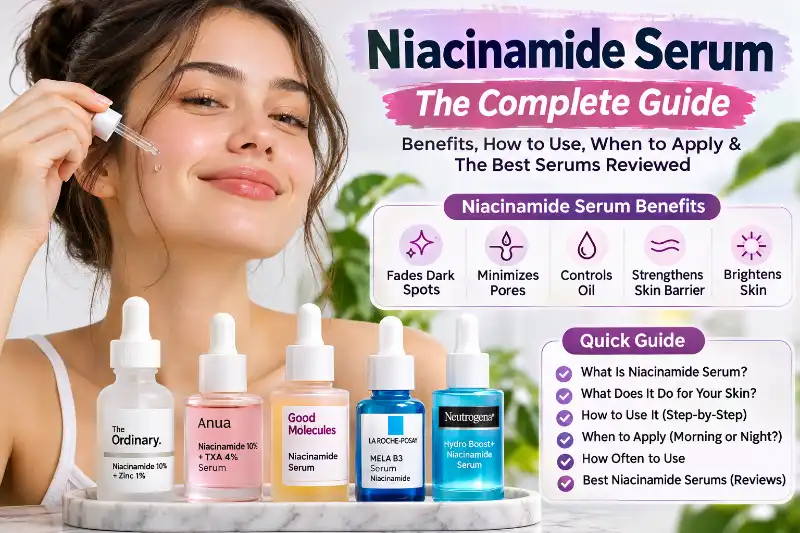
If you’ve spent even a few minutes looking at skincare products, you’ve probably seen niacinamide serum everywhere. One bottle says it helps with oily skin. Another promises a brighter face. Some even claim to improve pores, acne marks, and fine lines.
Sounds pretty good, right? But what does niacinamide serum actually do, and is it worth adding to your skincare routine?
Niacinamide is a form of vitamin B3 that can help your skin hold moisture, manage excess oil, and improve the look of uneven skin tone. It’s found in many face serums, moisturizers, and other skincare products.
The tricky part is choosing the right one. A 10% serum isn’t always better than a 5% formula, and not every product works the same way.
This guide explains the real niacinamide serum benefits, how to apply it, when to use it, and how to find a formula that suits your skin.
FIND YOUR AGE - IN YEARS, MONTHS, DAYS, HOURS & SECONDS!
What Is Niacinamide Serum and What Does It Do?
Niacinamide serum is a skincare product that contains niacinamide, also called nicotinamide. It’s a water-soluble form of vitamin B3.
Unlike a cleanser, which you wash away, a niacinamide face serum usually stays on your skin. This gives the ingredient time to work as part of your daily skincare routine.
But what is niacinamide serum good for?
It can help:
- Support your skin’s natural protective barrier.
- Reduce the appearance of excess oil and shine.
- Improve the look of dark spots and uneven skin tone.
- Make enlarged pores appear less noticeable.
- Calm some types of visible redness.
- Improve rough texture and the appearance of fine lines.
Think of niacinamide as a helpful supporting ingredient, not a product that fixes everything.
It’s especially useful when your skin feels unbalanced. Maybe your forehead looks oily by lunchtime, but your cheeks feel dry. Or perhaps old pimples have left dark marks that won’t fade quickly.
A well-formulated niacinamide serum may help with several of these concerns at once.
How Does Niacinamide Work on Your Skin?
Your skin has a protective outer layer called the skin barrier.
You can think of this barrier like a wall. Your skin cells are the bricks, while natural fats, including ceramides, help hold everything together.
When that barrier becomes weak, moisture escapes more easily. Your skin may feel tight, rough, or irritated.
Niacinamide helps support barrier function and the skin’s ability to hold moisture. Researchers have also studied how it affects oil production, inflammation, pigmentation, and skin texture.
For dark spots, niacinamide can help reduce the transfer of pigment-containing particles to surrounding skin cells. This may gradually improve the appearance of uneven skin tone.
It doesn’t bleach your skin or change your natural skin color.
What Is Niacinamide Serum Good For?
The short answer is that niacinamide serum is useful for several common skin concerns, especially oily skin, visible redness, uneven tone, and a weakened moisture barrier.
However, its effects depend on the concentration, the rest of the formula, your skin type, and how consistently you use it.
A serum may improve the look of post-acne marks, for example, without treating the acne that caused them.
That’s why it’s important to choose a product based on the problem you’re actually trying to solve.
Niacinamide Serum Benefits: What Can It Actually Improve?
Niacinamide has become popular because it can support more than one part of your skincare routine.
Still, some online claims make the ingredient sound more powerful than the research supports.
Here’s what you can reasonably expect.
1. Helps Control Excess Oil and Shine
Does your face look shiny just a few hours after washing it?
Your skin produces a natural oil called sebum. You need some sebum to keep your skin comfortable, but excess oil can leave your face looking greasy.
Niacinamide may help regulate oiliness, making it a useful ingredient for people with oily or combination skin.
This doesn’t mean it will stop your skin from producing oil.
You may simply notice that your face looks more balanced over time.
If oily skin is your main problem, look for a lightweight, non-comedogenic serum that doesn’t feel heavy beneath sunscreen.
2. Makes Enlarged Pores Look Less Noticeable
Here’s something worth knowing: you can’t permanently close your pores with a face serum.
Pores are natural openings in your skin. Their appearance depends on genetics, oil production, age, and other factors.
Niacinamide may make pores look less noticeable by helping improve oil balance and overall skin texture.
The difference may be subtle.
If you have clogged pores or blackheads, a product containing salicylic acid may be a more direct treatment. Niacinamide can sometimes be used alongside it.
3. Helps Improve Dark Spots and Uneven Skin Tone
Dark marks left behind by pimples can be frustrating.
Even after a breakout disappears, the discoloration may remain for weeks or months. This is often called post-inflammatory hyperpigmentation.
Niacinamide has been studied for its ability to improve the appearance of hyperpigmentation.
It may help with:
- Post-acne dark marks.
- Uneven facial tone.
- Some forms of discoloration.
- Dull-looking skin.
Results usually take time.
One important point: sunscreen matters just as much as your brightening serum. Sun exposure can make existing dark spots darker and slow your progress.
If you’re trying to improve discoloration, wear a broad-spectrum SPF 30 or higher sunscreen during the day.
For stubborn melasma or deep pigmentation, a dermatologist can recommend more targeted care.
4. Supports the Skin Barrier and Hydration
A healthy skin barrier helps your face hold onto moisture.
When the barrier isn’t working well, your skin might feel dry even if you use moisturizer every day.
Niacinamide can support the skin’s natural lipid barrier and help reduce moisture loss, also called transepidermal water loss, or TEWL.
That can make your skin feel softer and more comfortable over time.
Don’t confuse niacinamide with hyaluronic acid, though.
Hyaluronic acid is mainly used to attract and hold water. Niacinamide supports several skin functions, including barrier health.
You can use both ingredients in the same routine.
5. May Calm Redness and Acne-Related Inflammation
If your skin becomes red after a breakout, niacinamide may help calm some visible inflammation.
It has anti-inflammatory properties and is often included in products for skin that looks irritated or uneven.
However, niacinamide isn’t a complete acne treatment.
For ongoing acne, ingredients such as benzoyl peroxide, salicylic acid, or adapalene may be more directly useful, depending on the type and severity of your breakouts.
Likewise, if you have rosacea, eczema, or persistent skin irritation, don’t rely on a cosmetic serum instead of medical care.
6. May Improve Fine Lines and Rough Skin Texture
Niacinamide is also used in skincare products designed for mature-looking skin.
Some clinical research has found improvements in fine lines, skin texture, and uneven appearance after regular use of topical niacinamide formulas.
But don’t expect deep wrinkles to disappear.
A good moisturizer, daily sunscreen, and a suitable retinoid may also have important roles in an anti-aging skincare routine.
Niacinamide works best as one part of a sensible routine rather than the entire routine.
Is Niacinamide Serum Right for Your Skin Type?
One of the good things about niacinamide is that many different skin types can use it.
But not all serums feel the same, and some formulas contain stronger ingredients that may irritate sensitive skin.
Here’s an easy way to choose.
| Skin type | What to look for | What to avoid |
|---|---|---|
| Oily skin | Lightweight, non-comedogenic serum | Heavy formulas that feel greasy |
| Dry skin | Niacinamide with glycerin, hyaluronic acid, or ceramides | Formulas that leave skin tight |
| Sensitive skin | Gentle, fragrance-free formula and a lower strength | Starting several strong actives together |
| Acne-prone skin | Simple formula that layers with acne treatment | Products that repeatedly cause breakouts |
| Combination skin | Lightweight, hydrating serum | Over-drying the cheeks |
| Mature skin | Barrier-supporting and hydrating ingredients | Expecting serum to erase deep wrinkles |
Niacinamide Serum for Oily and Acne-Prone Skin
If your T-zone gets oily but you still deal with breakouts, niacinamide may be a useful addition.
Some products combine niacinamide with zinc PCA, an ingredient used in formulas aimed at oily skin.
The Ordinary Niacinamide 10% + Zinc 1% is one well-known example.
Just remember that controlling shine and treating acne are not exactly the same thing.
A serum might make your face look less oily without clearing persistent pimples.
Niacinamide Serum for Dry and Sensitive Skin
Dry skin needs more than a high percentage of active ingredients.
Look for a formula that supports hydration and feels comfortable after application.
Ingredients such as glycerin, ceramides, panthenol, and hyaluronic acid can be useful.
If your skin stings easily, consider starting with a gentle product containing a lower concentration of niacinamide instead of jumping straight to 10% or 15%.
Also, don’t assume a product is gentle just because the front label says “soothing.” Check the complete ingredient list.
Niacinamide Serum for Combination and Mature Skin
Combination skin can be tricky because different parts of your face behave differently.
Your nose and forehead may be shiny while your cheeks feel dry.
A light, hydrating serum can work across both areas without requiring two completely different routines.
For mature skin, niacinamide may help support hydration and improve the look of uneven texture and tone.
It’s not a replacement for sunscreen or other proven skincare treatments, but it can be a useful extra step.
How to Use Niacinamide Serum Step by Step
Wondering how to apply niacinamide serum without making your routine complicated?
The process is pretty simple.
For most watery serums, the general order is:
Cleanser → Niacinamide Serum → Moisturizer → Sunscreen (morning)
Let’s go through it.
Step 1: Cleanse Your Face Gently
Start with a gentle facial cleanser.
You want to remove dirt, excess oil, makeup, and sunscreen without leaving your face feeling stripped.
Pat your skin dry unless your product’s directions say to apply it to damp skin.
There’s no need to scrub your face before applying niacinamide.
In fact, using a harsh exfoliating cleanser every day may make sensitive skin feel worse.
Step 2: Apply a Small Amount of Niacinamide Serum
Put a few drops of serum onto clean fingertips or your palm.
Gently spread it over your face, avoiding direct contact with your eyes.
You don’t need to rub hard or use half the bottle.
Most serums are designed to spread easily, and using more won’t necessarily make them work faster.
Follow the amount recommended on the product label.
If this is your first time using a concentrated facial serum with niacinamide, test it on a small area first.
Step 3: Follow With a Moisturizer
Once the serum has settled, apply your regular moisturizer.
This step is useful even if you have oily skin.
Moisturizers help reduce water loss and support your skin barrier. The right one doesn’t have to feel thick or greasy.
Choose a lightweight lotion for oily skin or a richer cream if your face tends to feel dry.
Step 4: Finish Your Morning Routine With Sunscreen
If you’re using niacinamide during the day, finish with sunscreen.
Choose a broad-spectrum SPF 30 or higher product.
Sunscreen helps protect against UV damage, early signs of aging, and worsening dark spots.
If you’re outdoors, reapply according to the sunscreen instructions, usually about every two hours.
Niacinamide does not replace sunscreen, no matter how many antioxidant benefits a product claims.
Should You Apply Niacinamide Before or After Moisturizer?
Most thin niacinamide serums go on before moisturizer.
A useful general rule is to apply lighter products first and thicker products afterward.
However, skincare formulas vary. Some products are creams, milky serums, or combination treatments.
When the package gives a different order, follow the manufacturer’s directions.
If you have very sensitive skin, keeping your routine simple matters more than getting every layering detail perfect.
When to Use Niacinamide Serum: Morning or Night?
You can generally use niacinamide serum in the morning, at night, or both.
There’s no strong reason to believe that everyone must apply it at one particular time to get results.
Consistency and skin tolerance are more important.
Morning Niacinamide Skincare Routine
A simple morning routine looks like this:
- Wash your face with a gentle cleanser.
- Apply your niacinamide serum.
- Use a moisturizer.
- Finish with broad-spectrum SPF 30 or higher sunscreen.
This is a practical routine if you want to address shine, uneven tone, or dryness during the day.
You can wear makeup over your sunscreen after it sets.
Nighttime Niacinamide Skincare Routine
Your nighttime routine can be even simpler:
- Remove makeup and sunscreen.
- Cleanse your face.
- Apply niacinamide serum.
- Finish with moisturizer.
If you use retinol or another treatment at night, check the instructions for both products before layering them.
You don’t need to use every active ingredient in one evening.
How Often Should You Use Niacinamide Serum?
Many niacinamide products are suitable for daily use, but that doesn’t mean you must start with twice-daily application.
If you’re new to skincare or your skin reacts easily, consider using the product a few times a week at first.
If your skin stays comfortable, gradually increase use according to its label.
Watch for itching, burning, unusual redness, or new irritation.
A routine you can follow comfortably is better than a complicated routine that leaves your skin unhappy.
Niacinamide Serum 5% vs. 10%: Which Strength Is Better?
This is one of the most common questions people ask before buying serum.
And there’s a simple answer:
A stronger niacinamide percentage is not automatically better.
Several studies have found benefits from topical formulas containing around 2% to 5% niacinamide. Higher percentages are common in commercial serums, but that doesn’t prove they will work better for everyone.
| Concentration | General considerations | Who might consider it |
|---|---|---|
| 2% | Lower-strength option used in some skincare formulas | Beginners and people seeking gentle formulas |
| 4–5% | Studied for several skin benefits | Many everyday skincare users |
| 10% | Common in concentrated face serums | People who already tolerate niacinamide |
| 12–15% | Higher strength, with potentially greater irritation concerns | Experienced users who have a reason to choose it |
| 20% and above | Very concentrated; superiority isn’t established for everyone | Only with careful product selection and tolerance assessment |
Is 2% to 5% Niacinamide Enough for Beginners?
Yes, a 2% to 5% niacinamide formula may be a reasonable place to start.
You don’t need the strongest bottle on the shelf to support your skin barrier or improve the look of uneven tone.
For someone with sensitive skin, a gentle moisturizer containing niacinamide may even be more comfortable than a separate serum.
Remember, the complete formula matters as much as the percentage.
Is 10% Niacinamide Serum Better for Oily Skin?
A 10% niacinamide serum is popular among people with oily skin.
Products such as The Ordinary Niacinamide 10% + Zinc 1% and Good Molecules Niacinamide Serum are often considered by shoppers who want a concentrated formula.
But there’s no universal rule that 10% will control oil better than 5%.
If your skin already responds well to a lower concentration, there’s no need to change just because the bottle has a bigger number.
Should You Use 15% or 20% Niacinamide Serum?
Higher-strength products do exist.
For example, COSRX The Niacinamide 15 Serum contains 15% niacinamide and zinc PCA. Some targeted pore serums advertise concentrations around 20% or higher.
That doesn’t mean beginners should start there.
Higher concentrations can increase the chance of discomfort for some users, especially when combined with exfoliating acids or other strong products.
If your skin is easily irritated, a simpler formula is usually a more sensible first choice.
Best Niacinamide Serums to Consider for Different Skin Needs
Shopping for the best niacinamide serum can feel confusing because so many products make similar promises.
The right one depends on your skin concern, budget, preferred texture, and tolerance for active ingredients.
These are useful products to compare, not a personally tested ranking. Product formulas can change, so check the latest ingredient label before buying.
The Ordinary Niacinamide 10% + Zinc 1%
The Ordinary niacinamide serum is one of the better-known concentrated options.
It combines 10% niacinamide with 1% zinc and is marketed for concerns such as excess oil and visible pores.
This makes it worth considering if your face looks shiny and you prefer a simple, ingredient-focused skincare routine.
However, sensitive beginners may find a lower-strength formula more comfortable.
If you’re searching for ordinary niacinamide serum or the ordinary serum niacinamide, this is generally the product people mean.
Consider it for: Oily skin and visible shine.
Keep in mind: A high percentage isn’t necessary for everyone.
Good Molecules Niacinamide Serum
Good Molecules niacinamide serum is another popular option for people who want an ingredient-focused skincare product without building an expensive routine.
Its commonly sold 10% niacinamide formula is designed to support smoother-looking skin and a more balanced appearance.
It’s worth comparing with The Ordinary if you’re choosing between affordable concentrated serums.
Before buying, check the full ingredient list, bottle size, and current price rather than relying on brand popularity.
Consider it for: Budget-conscious users who want a concentrated niacinamide serum.
Keep in mind: Sensitive skin may still prefer a gentler formula.
Anua Niacinamide 10 + TXA 4 Serum
Anua niacinamide serum is often searched by people dealing with dark spots and uneven skin tone.
Its Niacinamide 10 + TXA 4 formula combines niacinamide with tranexamic acid, often shortened to TXA.
Both ingredients are used in products designed to improve the appearance of discoloration.
So, is Anua niacinamide serum good?
It may be worth considering if dark spots are your main concern, but it isn’t automatically the best choice for everyone.
Because this is a multi-active brightening formula, pay close attention to the directions and how your skin responds.
Consider it for: Uneven skin tone and post-acne dark marks.
Keep in mind: Don’t combine several brightening treatments at once without checking their ingredients.
Naturium Niacinamide Serum
Naturium offers a concentrated niacinamide formula marketed with zinc.
Its Niacinamide Serum 12% Plus Zinc 2% is aimed at concerns such as oiliness, visible pores, and uneven-looking skin.
Since the percentage is higher than many commonly studied formulas, it may not be the first option I’d point a sensitive beginner toward.
If you’re already comfortable using active skincare products, compare its texture and full ingredient list with lower-strength alternatives.
Consider it for: People seeking a higher-strength oil-focused formula.
Keep in mind: More niacinamide doesn’t guarantee better results.
La Roche-Posay Mela B3 Serum
La Roche-Posay Mela B3 Serum is designed for the appearance of dark spots and discoloration.
The formula combines niacinamide with Melasyl, a proprietary ingredient used in the brand’s pigmentation-focused skincare products.
The brand markets Mela B3 as a dark spot serum with 10% niacinamide.
It may interest someone who wants a formula focused on discoloration rather than a basic single-ingredient serum.
However, a multi-ingredient product makes it harder to tell which ingredient is responsible for any improvement.
Consider it for: Uneven tone and dark-spot concerns.
Keep in mind: Check the complete formula and product directions.
The INKEY List Niacinamide Serum
The INKEY List niacinamide serum is another option for shoppers looking for a straightforward skincare product.
It’s commonly discussed alongside The Ordinary and Good Molecules because these brands focus on familiar skincare ingredients.
Compare the currently available formula, texture, additional hydrating ingredients, and price per ounce.
If your skin is dry, pay particular attention to how comfortable the product feels beneath moisturizer.
Consider it for: Someone comparing ingredient-focused skincare products.
Keep in mind: Choose based on the full formula, not packaging alone.
Other Niacinamide Serums Worth Knowing
There are more options beyond those six products.
Neutrogena Hydro Boost+ Niacinamide Serum: This fragrance-free formula contains 10% niacinamide and hyaluronic acid. It’s worth considering if you want to address uneven-looking skin while also adding hydration.
Sunday Riley B3 Nice Niacinamide Serum: A premium 10% niacinamide product marketed for visible pores, surface redness, and post-acne discoloration.
COSRX The Niacinamide 15 Serum: A high-strength Korean skincare formula containing 15% niacinamide, zinc PCA, and other supporting ingredients.
Beauty of Joseon Glow Serum: Propolis + Niacinamide: A different type of formula that combines niacinamide with propolis and a BHA ingredient. It may appeal to people who want a hydrating, glow-focused serum, but the added exfoliating ingredient is worth checking if you’re sensitive.
Other related skincare products include First Aid Beauty Dark Spot Serum, CeraVe Resurfacing Retinol Serum, and La Roche-Posay Retinol B3 Serum. These are combination products rather than direct substitutes for a simple niacinamide-only serum.
Quick Comparison: Which Serum Should You Choose?
| Product | Main formula feature | Reason to consider it |
|---|---|---|
| The Ordinary Niacinamide 10% + Zinc 1% | Niacinamide and zinc | Oily skin and shine |
| Good Molecules Niacinamide Serum | Concentrated niacinamide | Affordable ingredient-focused care |
| Anua Niacinamide 10 + TXA 4 | Niacinamide and TXA | Dark spots and uneven tone |
| Naturium Niacinamide Serum | Higher-strength niacinamide and zinc | Oil-focused routine |
| La Roche-Posay Mela B3 | Niacinamide and Melasyl | Discoloration-focused formula |
| The INKEY List Niacinamide Serum | Niacinamide-based formula | Straightforward skincare |
| Neutrogena Hydro Boost+ | 10% niacinamide and hyaluronic acid | Hydration and uneven tone |
| Sunday Riley B3 Nice | 10% niacinamide | Premium skincare option |
| COSRX The Niacinamide 15 | 15% niacinamide and zinc PCA | High-strength serum comparison |
| Beauty of Joseon Glow Serum | Propolis, niacinamide, and BHA | Hydrating, glow-focused care |
No single serum is best for everyone.
A basic product that your skin tolerates is often a better purchase than an expensive bottle full of ingredients you don’t need.
How to Choose the Best Niacinamide Serum for Your Skin
If you’re still unsure which serum to buy, forget the product rankings for a moment.
Start with your own skin.
Ask yourself what you want to improve most.
Is it oiliness, dryness, uneven tone, or irritation?
Once you know that, comparing formulas becomes much easier.
Choose the Concentration Based on Your Skin’s Needs
If you’ve never used niacinamide before, consider a lower-strength formula or a moisturizer that contains the ingredient.
If your skin already tolerates concentrated serums, you may choose a 10% product.
Don’t increase your concentration simply because you aren’t seeing overnight results.
Skin changes take time.
Check Supporting Ingredients and Fragrance
A niacinamide serum can contain several other active ingredients.
Here are some common combinations:
- Zinc PCA: Often used in products for oily skin.
- Hyaluronic acid: Helps hold water and improve hydration.
- Glycerin: A humectant that helps attract moisture.
- Ceramides: Support the skin barrier.
- Tranexamic acid: Used in some products for discoloration.
- Alpha arbutin: Found in certain brightening formulas.
- Salicylic acid: Helps exfoliate inside pores and address acne-related congestion.
- Panthenol: Often included in soothing and barrier-supporting products.
If your skin reacts easily, a shorter ingredient list and a fragrance-free formula may be easier to manage.
Fragrance-free doesn’t guarantee irritation-free, though.
Compare Value, Texture, and Product Authenticity
Price doesn’t always tell you how well a serum will work.
Check the price per ounce, not just the price on the front of the listing.
A smaller bottle may look cheaper but cost more for the same amount of product.
Also, buy from the brand’s official website or a reputable authorized retailer when possible.
Counterfeit and poorly stored products can create problems even when the original formula is well designed.
And if you’re reading niacinamide serum reviews, look for details about skin type, length of use, irritation, and actual results.
A review saying “amazing product” doesn’t tell you much.
Can You Use Niacinamide Serum With Other Skincare Ingredients?
You don’t need to throw away your current products just because you’re adding niacinamide.
The ingredient is compatible with many common skincare ingredients, but some combinations may be too irritating for certain people.
| Ingredient | Can you combine it with niacinamide? | Main consideration |
|---|---|---|
| Vitamin C | Often, depending on the products | Check formula-specific directions |
| Retinol | Often | Introduce slowly if skin is sensitive |
| Hyaluronic acid | Generally yes | Useful for hydration |
| Salicylic acid | Often | Watch for dryness or irritation |
| Glycolic acid | Often, with care | Avoid excessive exfoliation |
| Peptides | Usually | Follow product instructions |
| Ceramides | Generally yes | Good barrier-supporting combination |
Niacinamide and Vitamin C
You may have heard that niacinamide and vitamin C should never be used together.
That rule is too broad.
Many modern skincare formulas allow the two ingredients to be part of the same routine.
However, certain manufacturers give specific instructions for their own products. For example, The Ordinary advises against combining its Niacinamide 10% + Zinc 1% directly with some vitamin C products in the same routine.
If either product causes irritation, use them at different times or simplify your routine.
Niacinamide and Retinol
Retinol is used for concerns such as fine lines, rough texture, and acne.
Niacinamide can help support the skin barrier, making it a useful ingredient in routines that also contain retinol.
Still, both products don’t need to go on your face at once.
If you’re new to retinol, begin gradually and watch for dryness or peeling.
CeraVe Resurfacing Retinol Serum and La Roche-Posay Retinol B3 Serum are examples of retinol-focused products that also include niacinamide-related barrier-supporting ingredients.
Follow the specific product instructions, especially when using retinoids.
Niacinamide and Hyaluronic Acid
This is one of the simpler combinations.
Hyaluronic acid helps the skin hold moisture, while niacinamide supports barrier function and other skin processes.
You can often use them together without making your routine complicated.
Some products, including Neutrogena Hydro Boost+ Niacinamide Serum, already combine these ingredients.
Niacinamide With Salicylic Acid, AHAs, or BHAs
Salicylic acid and other exfoliating acids help remove dead skin cells or address clogged pores.
Niacinamide works differently.
Using them together may suit some people, but too many active products can leave your skin dry, tight, or irritated.
If you’re using glycolic acid, lactic acid, or another AHA, start slowly.
If your face begins burning or peeling, stop adding new treatments and give your skin time to recover.
Niacinamide Serum Side Effects and Common Mistakes
Niacinamide is generally well tolerated in topical skincare products, but no ingredient is perfect for everyone.
Some people experience redness, itching, burning, or breakouts after using a new serum.
Sometimes the problem is the niacinamide concentration. Other times, it may be another ingredient in the formula.
Can Niacinamide Serum Cause Redness or Breakouts?
Yes, irritation is possible.
If your skin turns red, feels itchy, or develops bumps after starting a serum, don’t automatically assume it’s normal.
You may see online claims that niacinamide always causes “purging” before it starts working.
That’s misleading.
Niacinamide isn’t mainly an exfoliating ingredient, and new breakouts should not automatically be treated as a necessary adjustment period.
Stop using a product that causes persistent irritation and seek professional advice if symptoms continue.
What Happens if You Use Too Much Niacinamide?
Using extra serum won’t necessarily bring faster results.
The bigger concern is often combining several products that all contain niacinamide, especially when they’re high-strength formulas.
You might be using a niacinamide cleanser, toner, serum, and moisturizer without realizing it.
That doesn’t automatically make the routine unsafe, but it can make irritation harder to understand.
Keep things simple and add new products one at a time.
How to Patch-Test a New Niacinamide Serum
Before applying a new serum to your whole face, test it on a small area of skin.
Use the product as directed and watch for redness, itching, or discomfort over several days.
The American Academy of Dermatology recommends testing new skincare products on a small area before regular use.
If you develop a significant reaction, wash off the product and stop using it.
Seek medical care for severe swelling, blistering, or other concerning symptoms.
Who Should Be Careful With Niacinamide Serum?
Be extra careful if you have:
- Very sensitive or easily irritated skin.
- A known allergy to an ingredient in the formula.
- An active rash or damaged skin barrier.
- A history of reactions to concentrated skincare products.
- A skin condition that is currently being treated by a dermatologist.
If your skin is already painful or inflamed, adding another active product may not help.
Sometimes the best skincare decision is to use fewer products.
How Long Does Niacinamide Serum Take to Show Results?
One of the biggest mistakes people make is expecting results in two or three days.
Niacinamide isn’t an instant fix.
Different skin concerns can improve at different speeds, and not everyone will notice the same changes.
What Changes Might You Notice in the First Few Weeks?
Some people notice that their skin feels more comfortable or looks less shiny after regular use.
But those changes may also come from other ingredients in the formula, such as glycerin or hyaluronic acid.
Don’t judge a product only by how your skin looks the morning after you apply it.
Give the routine enough time, as long as your skin remains comfortable.
When Can Dark Spots and Uneven Tone Improve?
Pigmentation usually needs patience.
Some studies of topical niacinamide formulations have evaluated changes after around 8 to 12 weeks.
That doesn’t mean everyone will see clear results within that exact period.
Your skin tone, the cause of discoloration, sun exposure, and other skincare products all matter.
Deep or persistent dark spots may need more targeted treatments.
How Do You Know if Your Serum Is Working?
A simple way to track progress is to take a face photo every few weeks.
Use similar lighting and avoid changing several skincare products at the same time.
Pay attention to:
- Changes in excess shine.
- Skin comfort and hydration.
- The appearance of old dark marks.
- Roughness and uneven texture.
- Any new redness or irritation.
If your skin feels worse, don’t keep applying the serum just to finish the bottle.
Frequently Asked Questions About Niacinamide Serum
Can I Use Niacinamide Serum Every Day?
Many niacinamide serums can be used daily if your skin tolerates them. Start gradually if you’re new to active skincare, especially with a 10% or higher formula. Follow the product label and reduce use if you notice irritation.
Is Niacinamide Serum Better in the Morning or at Night?
Niacinamide serum can generally be used in either routine. Morning application works well beneath moisturizer and sunscreen, while nighttime application can fit into a simple skincare routine. Choose the time that suits your products and skin tolerance.
Does Niacinamide Serum Help With Acne Scars?
Niacinamide may help fade some dark marks left after acne, but it won’t remove deep, pitted, or raised scars. Those scars involve changes in skin structure and often need professional treatment.
Can I Use Anua Niacinamide Serum Every Day?
The Anua Niacinamide 10 + TXA 4 serum is a concentrated, multi-ingredient product. Daily use may suit some people, but beginners should follow the product directions and watch for irritation. You don’t need to use it twice daily to get started.
What Does Anua Niacinamide Serum Do?
Anua’s Niacinamide 10 + TXA 4 formula is designed for uneven skin tone and dark spots. It combines niacinamide with tranexamic acid and other supporting ingredients. Results depend on the complete formula, regular use, and individual skin response.
Can I Use Niacinamide Serum Without Moisturizer?
You can, but a moisturizer is still useful for most people. Niacinamide supports skin barrier function, while a moisturizer helps reduce water loss. Even oily skin can benefit from a lightweight, non-comedogenic moisturizer.
Is 10% Niacinamide Too Strong for Sensitive Skin?
It can be too irritating for some people, especially if they’re new to concentrated serums. A 2% to 5% formula may be a more comfortable starting point. Always consider the full product formula, not just the percentage.
Can Niacinamide Serum Replace Sunscreen?
No. Niacinamide doesn’t provide reliable UV protection. Use a broad-spectrum SPF 30 or higher sunscreen during the day to help protect against sun damage, premature aging, and worsening dark spots.
What Is Niacinamide Serum Used For?
Niacinamide serum is commonly used to support the skin barrier, improve the appearance of oiliness, help with uneven tone, and make visible pores look less noticeable. It is a skincare ingredient, not a replacement for medical acne treatment or sunscreen.
Is Niacinamide Serum Suitable for Teenagers?
Niacinamide can be suitable for teenagers, but younger skin doesn’t automatically need a concentrated serum. A gentle cleanser, moisturizer, and sunscreen are a good starting point. For persistent acne, an appropriate acne treatment may be more useful than adding multiple cosmetic serums.
Are Balea, Minimalist, and The Derma Co Niacinamide Serums Worth Trying?
These brands offer products that appear in niacinamide serum reviews, but the best choice depends on the exact formula and your skin’s needs. If you’re comparing Balea Niacinamide Serum, Minimalist Niacinamide Serum, or The Derma Co 10% Niacinamide Serum, check current ingredients, seller authenticity, and detailed reviews instead of relying on star ratings alone.
Can Niacinamide Be Used in Body Serums and Deodorants?
Yes. Niacinamide is also found in body-care products, including some Dove cream serum deodorants and Dove body cream serum formulas marketed for even-looking tone. These aren’t the same as a facial serum. Use them only on the areas indicated on their labels.
What Does “Niacinamide Serum Para Que Sirve” Mean?
The Spanish phrase niacinamide serum para qué sirve means “What is niacinamide serum used for?” In simple terms, it’s used to support skin hydration and barrier health and improve the appearance of oiliness, uneven tone, and some dark marks.
Final Thoughts: Is Niacinamide Serum Worth Adding to Your Routine?
Niacinamide serum can be a helpful skincare product if you’re dealing with excess oil, uneven skin tone, visible pores, or dryness.
But you don’t need the most expensive bottle or the highest concentration to get started.
If you’re new to niacinamide, choose a gentle formula that fits your skin type. Use it consistently, pay attention to irritation, and keep your basic routine simple.
And remember, even the best niacinamide serum can’t replace a good moisturizer, daily sunscreen, or proper treatment for ongoing skin problems.
The goal isn’t to use more skincare products. It’s to find a few that make your skin feel comfortable and look healthier over time.
BMI & BMR CALCULATOR - CHECK YOUR HEALTH