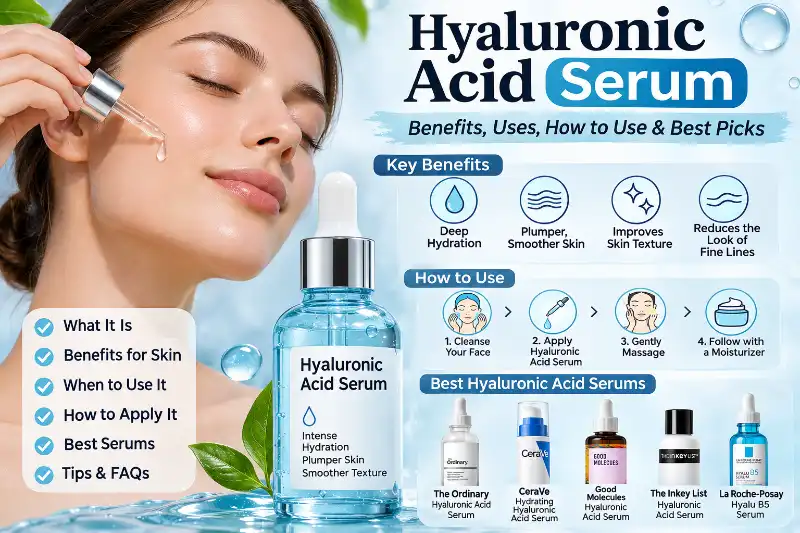
Does your face feel tight after washing it? Maybe your skin looks dull, your makeup settles into dry patches, or those little lines around your eyes seem more noticeable than usual.
A hyaluronic acid serum might help.
This skincare ingredient is known for one simple thing: helping your skin hold onto moisture. It can leave your face feeling softer, smoother, and more comfortable without needing a complicated routine.
But choosing the right serum is where things get confusing.
Should you buy The Ordinary, CeraVe, or Good Molecules? Do you apply hyaluronic acid on wet or dry skin? Can you use it with vitamin C? And is a more expensive formula actually better?
This guide answers those questions in plain English. You’ll learn what hyaluronic acid serum does, its real benefits, how to apply it, and which formulas are worth comparing for your skin type.
FIND YOUR AGE - IN YEARS, MONTHS, DAYS, HOURS & SECONDS!
What Is Hyaluronic Acid Serum, and What Does It Do?
Hyaluronic acid serum is a skincare product that helps attract and hold water in your skin. Its main job is hydration, which can make your face look smoother, feel softer, and appear temporarily plumper.
Hyaluronic acid, also called hyaluronan, is a substance your body already makes. You’ll find it naturally in your skin, eyes, and joints.
It belongs to a family of molecules called glycosaminoglycans. That sounds complicated, but you don’t need to remember the name to understand how it works.
Think of hyaluronic acid as a tiny water-loving sponge.
It helps hold moisture near your skin, so your face doesn’t look or feel as dehydrated.
Despite having “acid” in its name, hyaluronic acid isn’t an exfoliating acid like glycolic acid or salicylic acid. It doesn’t work by peeling away dead skin cells.
How Hyaluronic Acid Attracts and Holds Moisture
Hyaluronic acid is a humectant, meaning it attracts and binds water.
When you apply a hydrating hyaluronic acid serum, the formula helps increase moisture in the outer skin layers.
The outermost layer of your skin is called the stratum corneum. It works with your skin’s natural barrier to help keep moisture in and irritants out.
When that layer is well hydrated, skin often looks smoother and feels more flexible.
But here’s something people sometimes miss.
Attracting moisture and keeping it from escaping aren’t exactly the same thing.
That’s why hyaluronic acid serum often works best alongside a good moisturizer. Moisturizers can contain emollients and occlusive ingredients that help soften skin and slow water loss, also called transepidermal water loss (TEWL).
Hyaluronic Acid vs. Sodium Hyaluronate — Are They the Same?
If you’ve checked a serum’s ingredient list, you’ve probably seen names like:
- Hyaluronic acid
- Sodium hyaluronate
- Hydrolyzed hyaluronic acid
- Sodium acetylated hyaluronate
- Sodium hyaluronate crosspolymer
These are related forms of hyaluronic acid used in skincare.
Sodium hyaluronate is a salt form of hyaluronic acid. Hydrolyzed hyaluronic acid has been broken into smaller pieces.
Some products combine different molecular weights, meaning different molecule sizes.
Larger molecules mainly help hydrate the skin’s surface. Smaller molecules may reach somewhat deeper into the outer skin layers.
Does that mean a product with five types of hyaluronic acid automatically beats one with a single type?
No.
The complete formula, concentration, supporting ingredients, and how your skin responds all matter.
Is Hyaluronic Acid Serum Different From a Moisturizer?
Yes, although both can help hydrate your skin.
A face serum is usually made to deliver particular ingredients in a lightweight liquid, gel, or lotion formula.
A moisturizer has a broader job. It can add moisture, soften skin, and help reduce water loss.
For example, a moisturizer might contain glycerin, ceramides, squalane, shea butter, or petrolatum.
You don’t always need both products.
If your daily moisturizer already contains hyaluronic acid and keeps your skin comfortable, buying a separate facial serum may not add much.
But if your face still feels dehydrated, a dedicated serum could be a useful extra step.
Hyaluronic Acid Serum Benefits — What Can It Actually Do for Your Skin?
The biggest benefit of hyaluronic acid serum is better skin hydration.
There are other possible benefits, too, but it’s important to understand what comes from moisture and what requires a different skincare treatment.
1. Helps Hydrate Dry and Dehydrated Skin
Does your face feel tight a few minutes after cleansing?
That can be a sign that your skin needs more moisture.
Hyaluronic acid can help improve hydration in the outer skin layers, making your face feel more comfortable.
There’s also a difference between dry skin and dehydrated skin.
Dry skin is a skin type that tends to produce less natural oil. Dehydrated skin is a condition in which the skin lacks enough water.
You can even have oily but dehydrated skin.
A hyaluronic acid serum for the face may help with dehydration, but naturally dry skin often needs a richer moisturizer as well.
2. Makes Skin Look Plumper and Smoother
You know those fine lines that look more noticeable when your face feels dry?
Better hydration can soften their appearance.
When skin holds enough water, its surface may look fuller and smoother.
This doesn’t mean hyaluronic acid can erase deep wrinkles or replace professional treatments.
The plumping effect from a topical serum is mainly related to hydration.
3. Supports a Healthy-Looking Skin Barrier
Your skin barrier helps protect your face from everyday moisture loss and outside irritants.
When it isn’t functioning well, your skin may feel rough, dry, or uncomfortable.
Hyaluronic acid provides hydration, while ingredients such as ceramides and certain emollients can provide additional barrier support.
For this reason, formulas combining hyaluronic acid, glycerin, ceramides, and panthenol can be worth considering.
Just remember that a moisturizing serum isn’t a guaranteed treatment for eczema, dermatitis, or another medical skin condition.
4. Improves the Appearance of Dull, Rough Skin
Sometimes dull skin simply needs moisture.
When the surface becomes dehydrated, it may look uneven or less smooth.
A hydrating serum can improve that appearance by helping the skin feel softer and look more supple.
It won’t directly remove dark spots or acne scars.
Those concerns usually need different ingredients or treatments.
5. Offers Lightweight Hydration
Not everyone enjoys a thick face cream.
If you have oily or combination skin, you might prefer a lightweight hydrating face serum.
Many hyaluronic acid formulas are water-based and feel lighter than rich moisturizers.
But not every serum feels the same.
Some are thin and watery. Others are thick, tacky, or almost cream-like.
That’s why texture matters when choosing a product.
6. Helps Your Skin Feel More Comfortable Under Makeup
Dry patches can make foundation look uneven.
A well-formulated hydrating serum, followed by a suitable moisturizer, may help create a smoother base.
The trick is not to use too much.
A thick layer of serum can sometimes cause your moisturizer, sunscreen, or foundation to roll into tiny flakes.
That’s called pilling, and we’ll cover how to avoid it later.
Who Should Use Hyaluronic Acid Serum? Find the Right Formula for Your Skin Type
Hyaluronic acid can fit into routines for many different skin types.
The important part is choosing the right complete formula, not simply buying something because the front label says “hyaluronic acid.”
Best Hyaluronic Acid Serum for Dry Skin
If your skin often feels rough, tight, or flaky, look for a serum that includes moisturizing ingredients alongside hyaluronic acid.
Helpful ingredients may include glycerin, ceramides, panthenol (vitamin B5), and squalane.
CeraVe Hydrating Hyaluronic Acid Serum and The Ordinary Hyaluronic Acid 2% + B5 with Ceramides are two formulas worth comparing.
Both contain ingredients beyond basic hyaluronic acid hydration.
Still, don’t skip moisturizer if your skin needs it.
A serum alone may not provide enough lasting comfort for very dry skin.
Best Hyaluronic Acid Serum for Oily and Acne-Prone Skin
Having oily skin doesn’t mean your face has enough water.
Oil and hydration are different things.
If you have oily or acne-prone skin, you may prefer a light serum that absorbs easily without leaving a greasy finish.
Good Molecules Hyaluronic Acid Serum and Torriden DIVE-IN Serum are examples to compare.
Check the full formula and look for non-comedogenic labeling where available.
Remember, hyaluronic acid isn’t an acne medication. It won’t replace ingredients such as benzoyl peroxide, adapalene, or salicylic acid when those treatments are needed.
Hyaluronic Acid Serum for Sensitive Skin
Sensitive skin needs a little more care when trying something new.
Start by looking for a fragrance-free product with a relatively simple ingredient list.
Good Molecules, CeraVe, and certain Vichy formulas may be worth comparing based on their published ingredients.
But “fragrance-free” doesn’t mean irritation is impossible.
Preservatives, botanical extracts, or other ingredients can still cause reactions.
Test a new product on a small area before applying it to your entire face.
Best Hyaluronic Acid Serum for Mature Skin
Mature skin can become drier over time, making fine lines and rough patches more noticeable.
A good hyaluronic acid serum can help improve moisture and temporarily soften the look of some lines.
For mature skin, look beyond hyaluronic acid alone.
You may also want ingredients such as ceramides, panthenol, peptides, and emollients.
La Roche-Posay Hyalu B5, The INKEY List Hyaluronic Acid Serum, and CeraVe Hydrating Hyaluronic Acid Serum are useful comparison options.
The best hyaluronic acid serum for mature skin isn’t necessarily the most expensive bottle.
It’s the one that provides comfortable hydration and works with the rest of your routine.
Hyaluronic Acid Serum for Combination Skin
Combination skin can be oily around the forehead and nose but dry around the cheeks.
A lightweight serum can help provide hydration across your face.
Then you can adjust your moisturizer.
For example, you might use a lighter moisturizer around the T-zone and a richer one on dry areas.
Your needs may also change with the weather, especially during cold or dry months.
Quick Skin-Type Guide
| Skin type | What to look for |
|---|---|
| Dry | Hyaluronic acid, glycerin, ceramides, richer moisturizer |
| Oily | Lightweight, non-greasy serum |
| Acne-prone | Simple formula, non-comedogenic options |
| Sensitive | Fragrance-free formula, patch testing |
| Mature | Hydration plus barrier-supporting ingredients |
| Combination | Lightweight serum with adjustable moisturizer |
How to Use Hyaluronic Acid Serum Correctly — Step-by-Step
If you’re wondering how to use hyaluronic acid serum, the process is actually pretty simple.
Apply a small amount to clean, slightly damp skin, then follow with moisturizer. In the morning, finish with sunscreen.
You don’t need ten different skincare products to make it work.
Step 1 — Wash Your Face With a Gentle Cleanser
Start with a gentle facial cleanser suited to your skin type.
Use lukewarm water rather than very hot water.
You don’t need to scrub your skin until it feels squeaky clean. In fact, aggressive cleansing can leave your face more irritated or dry.
After washing, gently pat away excess water.
Step 2 — Apply the Serum to Slightly Damp Skin
This is one of the most useful hyaluronic acid serum application tips.
Leave your skin slightly damp after cleansing.
Then apply the amount recommended on your product label, often a few drops or a small pump.
Damp skin gives a humectant formula water to work with.
However, your face doesn’t need to be dripping wet, and some formulas may have different instructions.
Always follow the directions for the product you’re using.
Step 3 — Spread It Gently Across Your Face and Neck
Use clean fingertips to spread the serum over your face.
Gently smooth or pat it into the skin.
There’s no need to rub hard or massage for several minutes.
If the product instructions allow it, you can also apply it to your neck.
Avoid getting serum into your eyes, and follow any eye-area warnings on the packaging.
Step 4 — Follow With a Moisturizer
Don’t forget this step if your skin tends to feel dry.
Hyaluronic acid helps attract water, while a suitable moisturizer can help keep your skin comfortable and reduce moisture loss.
Look for a moisturizer that matches your skin type.
If you have dry skin, you may like a cream with ceramides or petrolatum.
If your skin is oily, a lighter lotion or gel-cream may feel better.
You don’t have to wait until every trace of serum has completely dried before moisturizing.
Step 5 — Apply Sunscreen in the Morning
If you’re using hyaluronic acid in the morning, sunscreen should be the final skincare step before makeup.
Choose a broad-spectrum sunscreen with SPF 30 or higher.
Hyaluronic acid does not protect your skin from UV damage.
So even if your skin looks hydrated and glowing, you still need sun protection.
Easy application order:
- Gentle cleanser
- Hyaluronic acid serum
- Moisturizer
- Broad-spectrum sunscreen (morning)
If you use prescription skincare treatments, follow your dermatologist’s instructions for the order of application.
When to Use Hyaluronic Acid Serum — Morning, Night, or Both?
You can use many hyaluronic acid serums in the morning, at night, or both.
The best time depends on your skin, product directions, and the rest of your routine.
Morning Routine With Hyaluronic Acid Serum
Morning is a good time to use a lightweight hydrating serum, especially if your face feels tight after washing.
Try this simple routine:
Cleanser → Hyaluronic Acid Serum → Moisturizer → Sunscreen
This routine provides hydration before you head out for the day.
It can also help your skin feel more comfortable under makeup.
Night Routine With Hyaluronic Acid Serum
Nighttime is another easy option.
After cleansing, apply a small amount of serum and finish with moisturizer.
Cleanser → Hyaluronic Acid Serum → Moisturizer
If you also use retinol, acne medication, or another treatment, the order may change according to that product’s instructions.
How Often Should You Use Hyaluronic Acid Serum?
Most basic hyaluronic acid serums are designed for daily use.
Some can be applied twice daily.
But you don’t have to start with morning and night.
If your skin is sensitive or your routine already includes several products, once a day may be enough.
Pay attention to how your face feels.
If you develop stinging, redness, or itching, stop using the product and check whether another ingredient may be causing a reaction.
Should You Apply Hyaluronic Acid Before or After Moisturizer?
In a typical routine, a lightweight hyaluronic acid serum goes before moisturizer.
The serum provides hydration, and the moisturizer helps support your skin’s moisture balance.
But don’t treat the thinnest-to-thickest rule as more important than medical instructions.
If you’re using a prescription cream, a treatment with special directions, or an unusual serum formula, follow the product guidance first.
Can You Use Hyaluronic Acid Serum With Vitamin C, Retinol, and Other Ingredients?
It’s common to use more than one skincare ingredient.
The real question isn’t whether two popular ingredients sound good together. It’s whether your skin can tolerate the complete products and whether the routine makes sense.
Vitamin C Serum or Hyaluronic Acid Serum First?
You can often use vitamin C and hyaluronic acid in the same skincare routine.
Vitamin C is commonly used for antioxidant care and the appearance of uneven skin tone.
Hyaluronic acid helps with hydration.
For a typical lightweight vitamin C treatment, one possible morning routine is:
Cleanser → Vitamin C Serum → Hyaluronic Acid Serum → Moisturizer → Sunscreen
But there’s no universal order for every vitamin C product.
The formulation matters.
Some vitamin C serums have specific pH requirements or application instructions. Follow those directions rather than automatically applying products based only on thickness.
How to Use Hyaluronic Acid and Vitamin C Serum Together
If you’re new to vitamin C, start slowly.
Use vitamin C as directed and add hyaluronic acid for hydration if your skin needs it.
Avoid introducing several new products on the same day.
That way, if irritation happens, you have a better idea of which product caused it.
You can also choose a combined vitamin C hyaluronic acid serum.
For example, Mad Hippie Vitamin C Serum includes a vitamin C derivative called sodium ascorbyl phosphate, along with hyaluronic acid and supporting ingredients.
A combination product may simplify your routine, although it won’t be ideal for every skin type.
Can You Use Hyaluronic Acid With Retinol?
Yes, hyaluronic acid can often be used alongside retinol or other retinoids.
Retinoids can cause dryness, peeling, or irritation, especially when you first start using them.
Adding a moisturizing serum may help your skin feel more comfortable.
However, hyaluronic acid doesn’t cancel out retinoid irritation.
Start retinoids according to their directions, use a moisturizer, and avoid adding too many active ingredients at once.
If you’re using prescription tretinoin or another medical treatment, follow your clinician’s advice.
Can You Combine Hyaluronic Acid With Niacinamide or Ceramides?
Usually, yes.
Niacinamide is used in skincare for concerns such as barrier support and the appearance of uneven tone.
Ceramides are lipids naturally found in your skin barrier.
Hyaluronic acid helps with hydration.
These ingredients have different jobs, so they can make sense in the same formula or routine.
You don’t need a separate bottle of each ingredient, though.
A well-formulated moisturizer might already contain several of them.
Ingredient Combination Guide
| Combination | Main purpose | What to remember |
|---|---|---|
| Hyaluronic acid + vitamin C | Hydration and antioxidant care | Follow vitamin C directions |
| Hyaluronic acid + retinol | Hydration during a retinoid routine | Watch for irritation |
| Hyaluronic acid + niacinamide | Hydration and barrier support | Avoid unnecessary product overload |
| Hyaluronic acid + ceramides | Moisture and barrier support | Helpful for many dry-skin routines |
| Hyaluronic acid + glycerin | Additional humectant hydration | Very common combination |
| Hyaluronic acid + vitamin B5 | Hydration and skin comfort | Check the full formula |
<WritingBlock id=”58321″ variant=”document”>## Best Hyaluronic Acid Serums to Consider in 2026
Finding the best hyaluronic acid serum isn’t just about choosing a popular brand.
A good product should suit your skin type, feel comfortable, and fit your budget.
Some formulas focus on basic hydration. Others include ceramides, peptides, panthenol, or other supporting ingredients.
The following products are worth comparing based on their publicly listed formulas and intended uses.
These are ingredient-based comparisons, not personal testing results. Product ingredients, prices, and packaging may change.
1. The Ordinary Hyaluronic Acid 2% + B5 — An Affordable Option
The Ordinary Hyaluronic Acid 2% + B5 is a familiar choice for people who want a simple hydrating serum without spending a lot.
Its updated formulation includes several forms of hyaluronic acid, provitamin B5, and ceramides.
The brand describes the formula as water-based and designed for hydration and barrier support.
Why consider it?
- Multiple forms of hyaluronic acid
- Vitamin B5 for additional moisturizing support
- Added ceramides
- Affordable pricing compared with many premium serums
- Can fit into morning and evening routines
One important detail: older reviews may describe a different version of this product.
The Ordinary updated its original formula to include ceramides, so check the bottle you’re purchasing.
Best suited for: Shoppers looking for an affordable serum with hydration and barrier-supporting ingredients.
Possible drawback: If you dislike layered serums or have a preference for very thin textures, you’ll need to decide whether its feel works for you.
Check the current formula at The Ordinary.
2. CeraVe Hydrating Hyaluronic Acid Serum — A Barrier-Focused Formula
CeraVe Hydrating Hyaluronic Acid Serum is another option worth comparing, especially if you want more than a basic water-based serum.
Its published formula includes hyaluronic acid, three essential ceramides, glycerin, and panthenol.
CeraVe also includes moisturizing ingredients that give the formula more of a cream-gel character than some very watery serums.
Why consider it?
- Hyaluronic acid for moisture
- Ceramides for skin barrier support
- Panthenol, also known as vitamin B5
- Fragrance-free formula
- Can be used alone or underneath moisturizer, according to the brand
This makes it worth looking at if your skin feels dry or uncomfortable.
But does that mean CeraVe is automatically better than The Ordinary?
Not necessarily.
The Ordinary may appeal more to someone seeking a water-based serum at a lower price. CeraVe may appeal to someone who likes a more moisturizing formula.
What About CeraVe Hydrating Hyaluronic Acid Serum Reviews?
When reading CeraVe hyaluronic acid serum reviews, pay attention to the reviewer’s skin type.
Someone with very dry skin may appreciate a richer formula, while someone who prefers watery products might feel differently.
Look for comments about texture, layering, irritation, and how the serum performs under moisturizer.
Also, remember that customer reviews describe individual experiences. They aren’t the same as controlled clinical testing.
Best suited for: People interested in hydration with ceramides and a more moisturizer-like formula.
Possible drawback: The richer feel may not be everyone’s preference.
Review CeraVe’s product details.
3. Good Molecules Hyaluronic Acid Serum — A Budget-Friendly Choice
If you’re trying to keep your skincare routine affordable, Good Molecules Hyaluronic Acid Serum deserves a look.
The published formula contains sodium hyaluronate, glycerin, and other ingredients that help create a lightweight moisturizing serum.
It’s a relatively straightforward product without a long list of trendy extras.
Why consider it?
- Simple hydration-focused formula
- Glycerin and hyaluronic acid
- Fragrance-free formulation
- Lightweight texture described by the brand
- Budget-friendly positioning
Is Good Molecules Hyaluronic Acid Serum Good?
It can be a reasonable choice if your main goal is simple hydration.
The formula includes familiar humectants, and the brand recommends using it on damp skin before moisturizer.
Still, it’s not guaranteed to work perfectly for everyone.
If your skin is extremely dry, you may need a richer moisturizer. If you react easily to new products, patch testing remains important.
Best suited for: Beginners, budget-conscious shoppers, and people looking for a straightforward hydration step.
Possible drawback: It may not offer the richer moisturizing feel or extra ingredients found in some other formulas.
View Good Molecules Hyaluronic Acid Serum.
4. The INKEY List Hyaluronic Acid Serum — A Simple Routine Option
The INKEY List Hyaluronic Acid Serum combines 2% multi-molecular hyaluronic acid with a peptide complex known as Matrixyl 3000.
Its formula is designed to deliver hydration while addressing the appearance of fine lines.
That makes it interesting for someone who wants a lightweight serum with more than a basic humectant formula.
Why consider it?
- Multi-molecular hyaluronic acid
- Added peptides
- Designed for morning and evening use
- Lightweight positioning
- Suitable for layering with other skincare products
Peptides are often included in formulas aimed at mature or aging skin.
However, their benefits depend on the exact formulation and supporting evidence. A peptide ingredient alone doesn’t guarantee major wrinkle reduction.
Best suited for: People who want hydration with additional peptide ingredients.
Possible drawback: You may not need the added peptide complex if simple hydration is your only concern.
5. La Roche-Posay Hyalu B5 Serum — A Mature-Skin Option to Compare
La Roche-Posay Hyalu B5 is aimed at concerns such as dehydration, fine lines, and signs of aging.
The current US product listing describes an updated Hyalu B5 Suractivated Serum with multiple forms of hyaluronic acid and vitamin B5.
Its ingredient list also includes glycerin and madecassoside.
Why consider it?
- Multiple forms of hyaluronic acid
- Vitamin B5
- Additional supporting skincare ingredients
- Focus on hydration and visible fine lines
- A formula positioned for people concerned about aging skin
There’s an important catch for sensitive skin, though.
The current published ingredient list includes alcohol denat. and fragrance.
These ingredients aren’t automatically a problem for everyone, but they may matter if your skin reacts easily to fragrance or certain formulas.
Best suited for: People comparing multi-ingredient hydration products for mature or dehydrated skin.
Possible drawback: The fragrance-containing formula may not suit everyone.
Also, check whether you’re buying an older Hyalu B5 Pure Hyaluronic Acid Serum or the newer Suractivated version. Formula names and packaging can differ.
Check La Roche-Posay’s current US serum.
6. Torriden DIVE-IN Serum — A Lightweight Korean Skincare Option
Torriden DIVE-IN Low Molecular Hyaluronic Acid Serum has become a recognizable option among shoppers interested in Korean skincare.
The product contains multiple forms of hyaluronic acid alongside ingredients such as panthenol, allantoin, and glycerin.
Its formula is positioned as a lightweight hydrating serum.
Why consider it?
- Five forms of hyaluronic acid in the published formula
- Panthenol and allantoin
- Lightweight, watery-serum positioning
- Additional moisturizing ingredients
- Suitable for people comparing Korean skincare formulas
If your combination skin feels dehydrated but you dislike heavy creams, this could be an option to research.
That said, check the complete ingredient list.
Some versions include botanical extracts, including witch hazel, which may not suit every sensitive-skin user.
Best suited for: People looking for a lightweight hydrating serum with multiple HA forms.
Possible drawback: The full ingredient list may be more complex than a basic serum.
7. Vichy Minéral 89 — An Alternative Hydrating Serum
Vichy Minéral 89 is another well-known name in hydrating skincare.
The updated US formula combines hyaluronic acid with polyglutamic acid and Vichy volcanic water.
Polyglutamic acid is another water-binding ingredient used in skincare.
The product is designed to feel like a lightweight gel rather than a rich cream.
Why consider it?
- Hyaluronic acid and polyglutamic acid
- Lightweight gel texture
- Fragrance-free formula
- Hydration-focused design
- Useful as a daily moisturizing step
If you enjoy simple gel textures, Vichy Minéral 89 may be worth comparing with The Ordinary or Torriden.
Just make sure you’re comparing the current product, as older online reviews may describe earlier formulas.
Best suited for: People interested in a lightweight, fragrance-free hydration booster.
Possible drawback: You might not need a separate hydration booster if your moisturizer already does the same job.
Hyaluronic Acid Serum Comparison — Which One Fits Your Skin?
| Serum | Notable ingredients | Main reason to consider |
|---|---|---|
| The Ordinary | Multiple HA forms, B5, ceramides | Affordable multi-ingredient hydration |
| CeraVe | HA, ceramides, panthenol | Barrier-focused moisturizing formula |
| Good Molecules | Sodium hyaluronate, glycerin | Simple budget hydration |
| The INKEY List | Multi-molecular HA, peptides | Hydration with peptide ingredients |
| La Roche-Posay | Multiple HA forms, B5, madecassoside | Mature-skin hydration concerns |
| Torriden | Multiple HA forms, panthenol, allantoin | Lightweight Korean skincare |
| Vichy | HA, polyglutamic acid | Lightweight gel hydration |
No single product wins for everyone.
If you’re looking for the best hyaluronic acid serum, start with your skin type, then compare the full formulas.
You may find that a basic affordable serum meets your needs just as well as a premium bottle.
How to Choose the Best Hyaluronic Acid Serum Before You Buy
Here’s a mistake that’s easy to make: seeing a big percentage or an expensive bottle and assuming it’s automatically better.
A serum’s real value depends on much more than its marketing.
Check the Type of Hyaluronic Acid
Look at the actual ingredient list.
Names such as sodium hyaluronate, hydrolyzed hyaluronic acid, and sodium acetylated hyaluronate tell you which related compounds are included.
Some brands describe their formulas as multi-weight or multi-molecular.
That means they’ve combined different sizes or forms of hyaluronic acid.
It’s useful information, but it doesn’t prove that the serum will outperform a simpler product.
Is 2% Hyaluronic Acid Better Than 1%?
Not automatically.
A 2% serum isn’t guaranteed to hydrate your skin twice as well as a 1% serum.
The percentage may describe a blend of ingredients rather than one pure form of hyaluronic acid.
How the serum is formulated also affects its texture and performance.
And what about a product advertised as a 3 hyaluronic acid serum?
That might refer to three forms of HA rather than a 3% concentration.
Read the description carefully instead of guessing from the number.
Look for Supporting Ingredients
Hyaluronic acid works alongside many familiar moisturizing ingredients.
A few worth knowing are:
- Glycerin: Another humectant that attracts water.
- Ceramides: Lipids that support the skin barrier.
- Panthenol: Also called provitamin B5, used for moisturizing and skin comfort.
- Squalane: An emollient that helps soften skin.
- Allantoin: Commonly used in soothing skincare formulas.
- Petrolatum: An occlusive ingredient that helps limit water loss.
- Peptides: Added to some formulas aimed at visible signs of aging.
You don’t need all these ingredients in one serum.
A good moisturizer may already provide several of them.
Check Fragrance, Texture, and Sensitivity
If you have sensitive skin, fragrance-free products are a reasonable place to start.
But even a simple serum can cause irritation.
Check preservatives, botanical extracts, and the complete ingredient list.
Also, think about texture.
Do you want a thin serum that disappears quickly, or a richer gel that leaves a more noticeable moisturizing layer?
Comfort matters because you’re more likely to keep using a product you actually like.
Compare Price, Bottle Size, and Where to Buy
A $25 bottle isn’t always a worse deal than a $15 one.
Check how much product you’re getting.
A 60 mL bottle can offer different value from a 30 mL bottle, even when its price is higher.
When deciding where to buy hyaluronic acid serum, consider the brand’s official website or an established US beauty retailer such as Ulta, Sephora, Target, or another authorized seller.
Availability depends on the product.
Before ordering, check the size, current formula, seller, return policy, and packaging.
Avoid unusually cheap listings from sellers you can’t verify.
Hyaluronic Acid Serum Side Effects and Common Mistakes
Hyaluronic acid is generally considered well tolerated when used in properly formulated skincare products.
Still, every serum contains more than one ingredient.
And even a good formula can feel uncomfortable if you apply too much or combine it with products your skin doesn’t tolerate.
Why Does Hyaluronic Acid Serum Sometimes Feel Sticky?
Some serums contain a high level of water-binding ingredients or ingredients that create a thicker gel texture.
If you apply too much, the product may leave a tacky feeling.
Try using less.
For many dropper serums, a few drops are enough for your face, although the label should guide you.
You can also wait briefly before adding your next product.
If it still feels sticky, that particular formula might simply not suit your preferences.
Can Hyaluronic Acid Serum Make Skin Feel Drier?
Some people notice that their face feels tight after using a hyaluronic acid product.
That doesn’t always mean the ingredient itself is drying their skin.
Possible reasons include an unsuitable formula, irritation, a cleanser that’s too harsh, or not enough moisturizing ingredients in the rest of the routine.
Environmental conditions can also affect skin hydration.
Try applying your serum to slightly damp skin and following with a moisturizer suited to your skin type.
But don’t assume every uncomfortable reaction is just a moisture problem.
If the product burns, stings, or causes redness, stop using it.
Can Hyaluronic Acid Serum Cause Breakouts or Irritation?
Hyaluronic acid itself isn’t widely known as an acne-causing ingredient.
However, a finished serum may contain oils, emollients, preservatives, fragrance, or botanical ingredients that don’t agree with your skin.
If you notice new breakouts after adding a serum, check what else changed in your routine.
If several new products were introduced together, it can be hard to identify the cause.
For irritation or allergic symptoms, discontinue the product. See a dermatologist if the reaction is severe, persistent, or difficult to explain.
Five Common Hyaluronic Acid Serum Mistakes
1. Using more than you need
A thicker layer doesn’t guarantee better hydration. It may just make your face sticky.
2. Skipping moisturizer when your skin needs it
Hyaluronic acid can help hydrate your skin, but a moisturizer may be needed to reduce moisture loss.
3. Adding too many skincare products at once
If irritation starts, you won’t know which product caused it.
4. Ignoring your skin’s reaction
A product shouldn’t cause ongoing burning or uncomfortable redness.
5. Expecting it to replace every anti-aging product
Hydration can soften the look of fine lines. It doesn’t permanently reverse deep wrinkles, loss of facial volume, or sun damage.
How Long Does Hyaluronic Acid Serum Take to Work?
You may notice your face feeling more hydrated soon after application.
Longer-term changes depend on the product, how often you use it, and your skin’s starting condition.
What You May Notice After the First Application
Some people notice softer skin and a smoother surface after one use.
A well-hydrated face can also look temporarily plumper.
But one application won’t permanently change your skin structure.
Don’t worry if you don’t see a dramatic before-and-after difference.
Hydration is often subtle.
What to Expect After One to Four Weeks
With consistent use, you may notice that your skin feels less tight and that some fine lines caused by dehydration look softer.
Harvard Health notes that some people may notice mild improvements in dryness and wrinkle appearance within about a week.
Results vary by formula and individual skin condition.
If your face remains very dry, look at the rest of your routine rather than adding more layers of the same serum.
Your cleanser, moisturizer, environment, or an underlying skin condition may be contributing.
What Hyaluronic Acid Serum Cannot Do
A facial serum has limits.
It cannot reliably:
- Remove deep wrinkles permanently
- Replace injectable hyaluronic acid fillers
- Cure acne
- Erase acne scars
- Permanently tighten sagging skin
- Replace sunscreen
- Treat every cause of dry or irritated skin
It’s also important not to confuse a topical hyaluronic acid serum with injectable dermal fillers.
They’re different products used in very different ways.
Hyaluronic Acid Serum vs. Other Hydrating Skincare Ingredients
You might be wondering whether you actually need hyaluronic acid when so many moisturizers already contain other hydrating ingredients.
That’s a fair question.
Hyaluronic Acid vs. Glycerin
Both hyaluronic acid and glycerin are humectants.
They help attract and hold water.
Glycerin is widely used in skincare, from face cleansers to moisturizers.
Hyaluronic acid is also common in serums and creams.
One isn’t automatically better than the other.
Many formulas combine both because they work well together.
If your skin loves a basic glycerin moisturizer, you don’t need to replace it just because hyaluronic acid is popular.
Hyaluronic Acid vs. Ceramides
Hyaluronic acid and ceramides have different jobs.
Hyaluronic acid helps with hydration.
Ceramides are natural lipids found in the skin barrier. They help maintain the barrier’s structure and function.
If your skin is dry or prone to moisture loss, using products containing both can make sense.
That’s one reason CeraVe and the updated The Ordinary formula are worth comparing.
Hyaluronic Acid Serum vs. Hydrating Moisturizer
A serum can be a useful extra step, but moisturizer is often the more important basic product.
If you’re trying to build an affordable skincare routine, start with a gentle cleanser, moisturizer, and sunscreen.
Then consider adding a separate serum if you have a specific hydration need.
You don’t have to collect five serums to have healthy-looking skin.
Hyaluronic Acid Serum vs. Vitamin C Serum
These products serve different purposes.
Hyaluronic acid is mainly used for hydration.
Vitamin C is generally used for antioxidant benefits and concerns such as dullness or uneven skin tone.
If your face feels dehydrated, hyaluronic acid may address that concern.
If you’re focused on uneven tone, a suitable vitamin C formula may be more relevant.
You can also use both, provided your skin tolerates them.
Frequently Asked Questions About Hyaluronic Acid Serum
Can I Use Hyaluronic Acid Serum Every Day?
Yes, many hyaluronic acid serums are designed for daily use. Some can be applied in the morning and evening. Follow the product instructions and pay attention to your skin’s response. If you’re sensitive, you can start once daily.
Is Hyaluronic Acid Serum Good for All Skin Types?
Hyaluronic acid can work well in products for dry, oily, combination, and mature skin. However, the complete formula matters. Sensitive or acne-prone skin may react to other ingredients, so choose your product carefully.
Should I Put Hyaluronic Acid Serum on Wet or Dry Skin?
Slightly damp skin is often recommended. After cleansing, gently pat your face and apply the serum while a little moisture remains. Then follow with moisturizer. Your product’s own instructions should come first.
Can I Use Hyaluronic Acid Serum Under Makeup?
Yes. A lightweight serum can fit into a morning routine before moisturizer, sunscreen, and makeup. Use a small amount and let the layers settle. If your foundation starts pilling, try reducing the amount of serum or checking product compatibility.
Can Hyaluronic Acid Serum Remove Wrinkles?
It can make some fine lines look less noticeable by increasing hydration. But it cannot permanently remove deep wrinkles or reverse every sign of aging. Think of it as a moisturizing step, not a replacement for medical treatments.
Is Hyaluronic Acid Serum Safe for Acne-Prone Skin?
Hyaluronic acid is generally well tolerated and isn’t an acne treatment ingredient. Choose a suitable formula and check whether the finished product is labeled non-comedogenic. If you develop breakouts or irritation, discontinue the product and reassess your routine.
How to Make Hyaluronic Acid Serum at Home?
Some DIY recipes use hyaluronic acid powder mixed with water. But a safe cosmetic serum also requires proper preservation, hygiene, stability, and formulation. Homemade water-based products can become contaminated. For routine facial use, a properly formulated commercial product is generally the safer choice.
What Does “Pure Hyaluronic Acid Serum” Mean?
“Pure hyaluronic acid serum” is often a marketing description. It doesn’t necessarily mean that the bottle contains only hyaluronic acid. Most serums include water, humectants, preservatives, and texture ingredients. Always check the full ingredient list.
What Is Hyaluronic Acid Serum Good For?
Its main purpose is hydration. It can help skin feel softer, look smoother, and appear temporarily plumper. It may also reduce the appearance of some fine lines caused by dehydration.
Can You Use Hyaluronic Acid Serum After Microneedling?
Don’t assume an everyday cosmetic serum is safe immediately after microneedling. Skin is more vulnerable after the procedure, and the product’s sterility and ingredients matter. Use only the aftercare recommended by your licensed professional. A regular serum isn’t the same as a sterile product intended for a procedure.
Do You Need a Separate Hyaluronic Acid Serum if Your Moisturizer Already Contains It?
Not necessarily. If your moisturizer keeps your skin comfortable, a separate serum may provide little extra benefit. A serum can be helpful when you want additional hydration, but it isn’t an essential step for everyone.
Is Hyaluronic Acid Serum the Same as Hyaluronic Acid?
No. Hyaluronic acid is an ingredient. A hyaluronic acid serum is a finished skincare product that contains the ingredient alongside other components. You may also find hyaluronic acid in moisturizers, sheet masks, eye creams, and other skincare products.
What Does “Hyaluronic Acid Serum Para Que Sirve” Mean?
This Spanish search phrase means “What is hyaluronic acid serum used for?” The short answer is that it helps hydrate skin and improve the appearance of dryness and some fine lines. It is primarily a moisturizing skincare ingredient.
Are Hyaluronic Acid Serums Used in Professional Treatments the Same as Everyday Face Serums?
No. Professional treatments may require products designed for specific procedures, including sterile formulations. Standard cosmetic serums aren’t automatically suitable for microneedling or other procedures that affect the skin barrier.
Final Thoughts — Is Hyaluronic Acid Serum Worth Adding to Your Routine?
Hyaluronic acid serum can be a useful skincare product if your face feels dry, dehydrated, or uncomfortable.
Its biggest strength is simple: helping your skin hold onto moisture.
You don’t need the most expensive serum to get that benefit. Good Molecules, The Ordinary, CeraVe, The INKEY List, Torriden, Vichy, and La Roche-Posay all offer formulas worth comparing for different needs.
Start with your skin type. Read the ingredient list. Use the serum as directed, and don’t forget moisturizer or morning sunscreen.
And remember, a separate serum isn’t something everyone needs.
If your current moisturizer already keeps your skin happy, that’s perfectly fine.
The best skincare routine is the one that works for your face, fits your budget, and stays easy enough to follow.
Sources and Editorial Notes
This guide is based on publicly available dermatology information and manufacturer ingredient lists. It does not claim personal product testing or clinical evaluation by the article author.
- Harvard Health — Hyaluronic Acid for Skin: Benefits, How to Use It, and Side Effects
- American Academy of Dermatology — Skin Care Product Application Order
- American Academy of Dermatology — How to Test Skin Care Products
- The Ordinary — Hyaluronic Acid 2% + B5
- CeraVe — Hydrating Hyaluronic Acid Serum
- The INKEY List — Hyaluronic Acid Serum
- La Roche-Posay — Hyalu B5 Serum
- Torriden — DIVE-IN Serum
- Vichy — Minéral 89
Product information checked against available US listings in November 2026. Ingredient lists and product versions may change, so always check the packaging before purchase.
BMI & BMR CALCULATOR - CHECK YOUR HEALTH