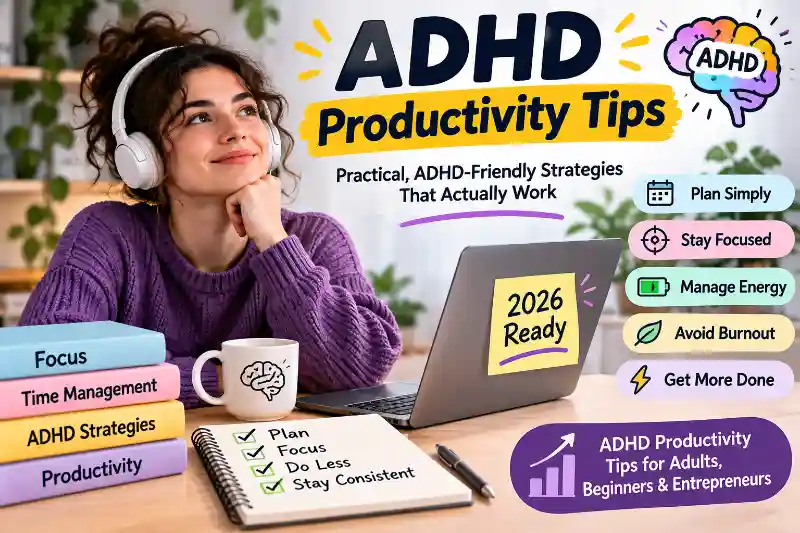
You sit down to finish an important task. Your laptop is open, your coffee is ready, and you know exactly what needs to get done.
But somehow, 30 minutes pass, and you haven’t started.
Maybe you checked your phone, opened five browser tabs, or remembered something else you needed to do. Now you’re frustrated because the day is moving, but your work isn’t.
If this sounds familiar, you’re not alone.
For people with attention-deficit/hyperactivity disorder (ADHD), everyday tasks can feel harder than they appear. Starting work, managing time, staying organized, and finishing projects may require more effort.
The good news? You don’t need a perfect schedule or an expensive productivity app to make progress.
These ADHD productivity tips for 2026 focus on simple strategies you can try in daily life. Whether you’re a college student, a working adult, or an entrepreneur, you’ll learn how to get things done with ADHD, stay focused, and build a routine without pushing yourself toward burnout.
FIND YOUR AGE - IN YEARS, MONTHS, DAYS, HOURS & SECONDS!
What Are the Best ADHD Productivity Tips?
The best ADHD productivity tips include breaking large tasks into small steps, choosing fewer daily priorities, using visual reminders, working in short focus sessions, and taking regular breaks. Body doubling, simple routines, and realistic deadlines may also help. The goal is to build a system that supports your attention rather than relying on motivation alone.
Here are five simple ADHD productivity tips to try today:
- Choose one important task instead of planning your entire day.
- Start with a two-minute action to make the task feel easier.
- Use a timer to help you notice how much time has passed.
- Keep a short list of tasks and reminders where you can see them.
- Schedule breaks so you don’t work until you’re exhausted.
You don’t have to try all five at once. Pick the one that addresses your biggest problem today.
Why Is It So Hard to Be Productive With ADHD?
Have you ever wondered why a small task feels like a huge project?
You might know what needs to happen, understand the deadline, and genuinely want to finish. Still, your brain seems to resist getting started.
ADHD can affect how people manage attention, organize tasks, control impulses, and remember important information.
According to the National Institute of Mental Health (NIMH), adults with ADHD may experience difficulties with planning, time management, organization, and completing activities that require sustained attention.
Understanding these challenges can make it easier to choose helpful strategies.
ADHD and Executive Function: Why Starting Can Feel Hard
Executive functions are mental skills that help you plan, organize, remember instructions, control impulses, and move between tasks.
Think of them as the skills your brain uses to manage everyday activities.
For example, writing a college assignment involves several steps. You need to understand the instructions, choose a topic, gather information, write, edit, and submit your work.
When executive function skills are difficult to manage, even deciding which step comes first can feel overwhelming.
People often describe this feeling as ADHD task paralysis.
You want to act, but you feel stuck.
This doesn’t mean every person with ADHD experiences the same difficulty. Some struggle more with organization, while others find it harder to manage attention or complete long projects.
Time Blindness, Distractions, and Unfinished Tasks
Time blindness is a common informal term for difficulty noticing or estimating the passage of time.
Imagine thinking you’ll spend five minutes answering a message. You look at the clock again, and 25 minutes have passed.
That lost time can make the rest of your schedule harder to manage.
Working memory difficulties may also contribute to forgotten appointments, missed instructions, or unfinished tasks.
Another challenge is switching attention.
Sometimes you get distracted by everything around you. Other times, you become so involved in an interesting activity that stopping feels difficult. People often call the second experience hyperfocus.
These patterns can affect school, work, and personal responsibilities.
The solution isn’t to force yourself to concentrate every minute. It’s to create reminders, routines, and surroundings that make daily tasks easier to manage.
How to Start Tasks When ADHD Makes You Feel Stuck
The hardest part of a task is sometimes the first step.
You may spend more time thinking about cleaning your room than actually cleaning it. Or you might avoid opening an assignment because the whole project feels exhausting.
When this happens, focus on making the starting point smaller.
Break Large Tasks Into Tiny First Steps
A large task creates several decisions at once.
Instead of writing “Finish my project” on your to-do list, break it into actions you can complete separately.
For example:
| Overwhelming Task | Smaller Starting Steps |
|---|---|
| Write a college paper | Open the document and write three ideas |
| Clean the bedroom | Put five items away |
| Prepare a presentation | Create the title slide |
| Organize your finances | Open your bank statement |
| Reply to emails | Answer one important message |
The first step should be so clear that you don’t need another planning session to begin it.
Once that step is finished, choose the next one.
This approach may help reduce the mental effort involved in task initiation and planning.
Try a Two-Minute Start Instead of Waiting for Motivation
What if you stopped telling yourself to finish a task and simply agreed to work on it for two minutes?
That’s the idea behind the two-minute start.
Choose something small and set a short timer.
For example:
- Read the first paragraph of your assignment.
- Write the opening sentence of an email.
- Organize one corner of your desk.
- Enter one expense into your budget.
When two minutes are over, decide whether to continue.
You might keep going because starting no longer feels as difficult. You might also stop, and that’s okay.
The purpose of this technique is to make beginning feel more manageable. It isn’t a guaranteed treatment for ADHD procrastination.
Use Body Doubling When Working Alone Isn’t Helping
Sometimes having another person nearby makes a task easier to approach.
This practice is often called body doubling.
You work on your own task while someone else works beside you or joins a virtual session.
For example, you and a friend could agree to spend 30 minutes studying together. Neither person needs to talk much. You simply share the working time.
Other body-doubling options include studying in a library, joining a virtual coworking session, or arranging a quiet work period with a roommate.
The other person’s presence may provide structure and accountability.
Body doubling is popular in ADHD communities, although direct research on it as a specific ADHD intervention remains limited.
If working alone feels difficult, it’s one option worth trying.
How to Stay Focused Without Fighting Every Distraction
Starting a task is one challenge. Staying with it is another.
Your phone lights up. Someone starts talking. You remember a video you wanted to watch.
Before you know it, you’ve moved away from the task.
Instead of expecting yourself to ignore every distraction, make your working environment easier to manage.
Make Your Workspace Easier to Focus In
You don’t need a perfect desk or a completely silent room.
Start by identifying what interrupts you most often.
If your phone is the problem, put it somewhere you can’t easily reach during a focus session.
If browser tabs distract you, close the ones unrelated to your work.
If noise makes concentrating difficult, try headphones, a quieter location, or background sound that doesn’t compete with your attention.
Here are a few simple changes:
- Keep only the materials needed for your current task nearby.
- Turn off notifications that aren’t urgent.
- Use a separate browser window for work.
- Keep a notebook for thoughts you want to remember.
- Make sure your workspace is comfortable.
Some people prefer a clean desk. Others work better with familiar background noise or movement.
Test what helps you rather than copying someone else’s ideal workspace.
Test Short Focus Sessions and Flexible Pomodoro Timers
The Pomodoro Technique is a time-management method that usually involves working for 25 minutes and then taking a five-minute break.
But 25 minutes isn’t a rule you have to follow.
If you’re struggling with ADHD focus problems, a shorter session may feel more realistic.
Try one of these examples:
| Focus Session | Break |
|---|---|
| 10 minutes | 3 minutes |
| 15 minutes | 5 minutes |
| 25 minutes | 5 minutes |
Choose a duration that matches the task and your current energy.
During a break, you might stand up, stretch, drink water, or walk around.
When you return, continue from the next clear step.
If a timer makes you anxious or interrupts useful concentration, adjust it or try another method.
The best focus timer is one that supports your work rather than becoming another distraction.
Keep a Distraction Note to Return to Later
Here’s a problem many people recognize.
You’re writing a report when you suddenly remember that you need to order groceries. You open a shopping website so you won’t forget.
Then you notice a sale.
Twenty minutes later, your report is still unfinished.
A distraction note can help.
Keep a small notebook or digital note titled “Later.”
Whenever an unrelated task pops into your head, write it down without immediately acting on it.
For example:
Later
- Order groceries
- Check the electric bill
- Reply to Alex
- Look up weekend plans
Now you have a record of those thoughts without needing to switch tasks.
This simple external memory system may be especially useful when working memory makes it difficult to hold several things in mind.
Simple ADHD Time Management Tips for Busy Days
Have you ever made a detailed schedule in the morning, only to fall behind before lunch?
Planning every minute can seem productive, but it leaves little room for interruptions, slower tasks, or unexpected responsibilities.
ADHD-friendly time management works better when your plan is clear and flexible.
Pick Three Priorities Instead of Making an Endless To-Do List
A list with 20 tasks can make it difficult to decide where to begin.
Try choosing three priorities for the day.
One should be your main responsibility. The other two can be smaller but useful tasks.
For example:
Today’s priorities
- Submit the college assignment.
- Reply to the internship application email.
- Buy groceries.
You can keep other tasks on a separate list for later.
This doesn’t mean you can only complete three things. It means you’re giving yourself a clear starting point.
If everything seems equally important, ask:
“What will cause the biggest problem if I don’t do it today?”
That question can help you identify the task that needs attention first.
Use Visual Timers and Calendar Reminders for Time Blindness
If you often underestimate how long things take, don’t depend only on remembering the time.
Use external reminders.
For example, if you have an online meeting at 2 p.m., set one reminder at 1:45 p.m. and another at 1:55 p.m.
The first reminder gives you time to prepare. The second signals that it’s almost time to join.
Visual countdown timers can also help you see how much time remains in a work session.
A phone calendar, smartwatch, or basic kitchen timer may be enough.
You don’t need a special ADHD productivity app unless it solves a problem your current tools can’t handle.
Add Buffer Time Between Tasks and Meetings
Imagine scheduling a one-hour assignment immediately before a one-hour meeting.
What happens if the assignment takes 75 minutes?
Suddenly, the rest of your day feels rushed.
Adding buffer time gives you space for transitions, interruptions, and tasks that take longer than expected.
For example, you could reserve 45 minutes for work and leave 15 minutes before your next commitment.
You can also track how long repeated tasks actually take.
If answering emails usually takes 30 minutes instead of 10, use the more realistic estimate next time.
Over time, this may help you create a schedule that matches your actual working pace.
How to Finish Tasks When Your Motivation Drops
Some tasks are exciting at first.
You start a new project, make a plan, and feel ready to work.
But a few days later, the excitement disappears.
Now the project feels boring, complicated, or easy to avoid.
When motivation changes, try making progress more visible and the finish line clearer.
Define What “Done” Looks Like Before You Begin
One reason tasks stay unfinished is that the goal keeps growing.
For example, “Make a great presentation” doesn’t tell you exactly when the task is complete.
A clearer goal would be:
“Create eight slides, check the spelling, and upload the file before 5 p.m.”
Now you know what finishing means.
For larger projects, define a small completed result for each working session.
You might aim to finish one slide, write 200 words, or review five pages.
Clear completion targets can reduce unnecessary decisions and help you notice progress.
Make Boring Work More Engaging With Small Rewards
Not every task will feel interesting.
If you need to complete repetitive paperwork or household chores, a small reward may help make the process more appealing.
You could:
- Listen to enjoyable music during a routine chore if it doesn’t distract you.
- Check off each completed step.
- Take a short walk after finishing a work block.
- Share your progress with an accountability partner.
- Turn a repeated task into a simple personal challenge.
This is sometimes called gamification.
For example, instead of thinking “I have to clean the entire kitchen,” you might challenge yourself to put away ten items.
Keep rewards realistic and avoid making them dependent on working beyond your limits.
Leave Yourself a Clear Restart Point
Stopping in the middle of a project can make returning difficult.
Before ending a work session, write one sentence describing what comes next.
For example:
“Tomorrow, open page four and finish the second paragraph.”
Or:
“Next step: check the prices for the three remaining products.”
You won’t have to spend your next session trying to remember where you stopped.
This is especially helpful for long-term projects, studying, and ADHD task management at work.
ADHD Productivity Tips Without Burnout
Trying to be productive all day can leave anyone exhausted.
For someone who already finds attention management difficult, forcing long working hours may make things even harder.
If your goal is to get more done without burnout, don’t measure success only by how many hours you work.
Look at whether your routine is realistic, repeatable, and leaves room for recovery.
Plan Your Day Around Energy, Not Just Available Time
Having four free hours doesn’t necessarily mean you have four hours of strong concentration.
Pay attention to when different tasks feel easier.
Maybe you concentrate better in the morning. Perhaps you feel more alert after lunch or later in the evening.
You can try matching demanding work to the times when you usually have more energy.
For example:
- High-energy period: Writing, studying, or complicated problem-solving.
- Moderate-energy period: Meetings, emails, or routine assignments.
- Low-energy period: Simple organization or preparing tomorrow’s materials.
These aren’t medical rules. Your energy may change from day to day.
The point is to make a plan based on your experience rather than expecting the same performance every hour.
Take Breaks Before You’re Completely Exhausted
Breaks aren’t something you have to earn after finishing everything.
They can be part of staying productive.
NIMH recommends short breaks during tasks that require sustained attention. It also identifies regular exercise, adequate sleep, and consistent routines as useful self-management strategies for ADHD.
A break might involve walking outside, stretching, getting water, or taking a few minutes away from your screen.
You don’t have to fill every break with another productive activity.
Rest should actually give you space to recover.
If you become deeply involved in a task and forget to stop, consider setting a gentle reminder to check how you’re feeling.
Create a Minimum Plan for Difficult Days
Some days, even simple tasks feel overwhelming.
Maybe you slept poorly, have several stressful responsibilities, or simply don’t have your usual energy.
On those days, try a minimum plan.
Instead of expecting yourself to complete everything, choose what genuinely needs attention.
For example:
Minimum plan for today
- Attend the required meeting.
- Send one urgent email.
- Prepare for tomorrow.
- Make time for meals and rest.
Move anything that can safely wait.
A minimum plan is not about giving up on your goals. It’s about avoiding an unrealistic workload when your capacity is limited.
And remember, feeling tired after a difficult week doesn’t automatically mean you have ADHD burnout. Persistent exhaustion or major changes in functioning deserve attention from a healthcare professional.
ADHD Productivity Tips for Work and Fast-Paced Environments
A busy workplace brings its own challenges.
There may be constant emails, changing deadlines, meetings, phone calls, and people asking questions.
If you work in a fast-paced environment, you may have fewer chances to control when interruptions happen.
The following ADHD productivity tips for adults focus on making work easier to organize.
Handle Meetings, Emails, and Constant Interruptions
Start by reducing the number of times you need to switch between unrelated tasks.
If your job allows it, schedule a few specific periods for routine emails instead of checking your inbox every few minutes.
For example:
You might review emails when you start work, after lunch, and before finishing the day.
Urgent communications still need to be handled according to your job’s requirements.
For meetings, keep a simple note with three sections:
Meeting notes
- Main decision
- My action items
- Due dates
After the meeting, move your action items into your calendar or task tracker.
If someone interrupts while you’re working, write down your next step before switching tasks. That small action may make returning easier.
Productivity Tips for ADHD Entrepreneurs
Running a business often means handling several roles.
You might be responsible for marketing, customer messages, invoices, planning, and actual client work.
Trying to handle everything at once can create constant task switching.
A simple approach is to group related tasks.
For example:
| Work Category | Example Tasks |
|---|---|
| Client work | Complete projects and deliver orders |
| Communication | Respond to customers and partners |
| Business admin | Review invoices and expenses |
| Growth | Work on marketing and new opportunities |
You could assign separate working periods to these categories.
Another helpful idea is to keep one list for urgent business responsibilities and another for future ideas.
That way, a new marketing idea doesn’t automatically replace the client project you need to finish.
For ADHD entrepreneurs, a simpler workflow may be more useful than a complicated business management system.
Ask for Clear Deadlines and Helpful Workplace Support
If instructions are unclear, ask for more specific details.
For example, instead of accepting “Finish the report soon,” you could ask:
“Would Friday at 3 p.m. be the right deadline?”
Written instructions, shared calendars, and regular check-ins may also make responsibilities easier to track.
According to CHADD’s workplace guidance, strategies such as reducing distractions, breaking up long projects, and using reminders can help address some common workplace challenges.
Some employees with ADHD may also qualify for reasonable workplace accommodations under the Americans with Disabilities Act (ADA), depending on their circumstances.
Possible accommodations may include a quieter workspace, written instructions, or changes that help manage interruptions.
You can discuss your needs with your employer or human resources department and review the appropriate guidance. Eligibility and available accommodations depend on the individual situation.
Can Notion, ChatGPT, and Productivity Apps Help With ADHD?
A good productivity tool should make your day easier.
But here’s where things get tricky.
You download a new app, spend two hours choosing colors and organizing folders, and end up doing none of the work you wanted to finish.
That’s why an ADHD-friendly productivity system should be simple enough to maintain.
Use Notion for a Simple ADHD Task Dashboard
Notion can be useful for keeping notes, tasks, and project information together.
However, you don’t need an advanced template with dozens of features.
Start with three sections:
| Today | Later | Done |
|---|---|---|
| Finish assignment | Organize old files | Submit application |
| Send important email | Review next month’s goals | Pay phone bill |
Move tasks between the sections as your day progresses.
Keep the Today section short.
If you find yourself spending more time building the dashboard than using it, remove features until it becomes manageable.
These Notion ADHD productivity tips are about reducing organization work, not adding more of it.
Use ChatGPT to Break Down Tasks and Plan Your Day
AI tools such as ChatGPT can help turn a broad task into smaller actions.
For example, instead of asking “How do I become more productive?” try a specific request:
Example prompt:
“Help me break my college assignment into five small steps. I have 45 minutes available today. Give me one easy action to start with, a short work plan, and a reminder to take a break.”
You could also ask ChatGPT to help you:
- Turn a long list into three priorities.
- Create a simple daily checklist.
- Draft a professional email.
- Divide a large project into manageable steps.
- Compare two possible schedules.
- Prepare a plan for a low-energy day.
AI-generated plans aren’t always accurate or realistic, so review them before following them.
Avoid sharing sensitive medical, financial, workplace, or personal information that you don’t want included in an AI conversation.
ChatGPT can assist with organization, but it cannot replace an ADHD assessment or professional treatment.
Choose Tools Based on Your Biggest Difficulty
Before installing another app, identify the specific problem you’re trying to solve.
| Your Biggest Challenge | Tool to Consider |
|---|---|
| Forgetting appointments | Calendar reminders |
| Losing track of time | Visual timer |
| Too many tasks | Simple checklist or Notion dashboard |
| Breaking down projects | ChatGPT or a paper planning worksheet |
| Difficulty working alone | Virtual coworking or body doubling |
| Forgetting ideas | Voice notes or a quick-capture notebook |
Try one tool first.
Use it for several days and notice whether it reduces the effort needed to manage your work.
If it creates more work, switch to something simpler.
You don’t have to use a popular productivity app just because other people recommend it.
What Does Research Say About ADHD Productivity Strategies in 2026?
When searching for ADHD productivity tips in 2026, you’ll find everything from clinical recommendations to TikTok routines and Reddit discussions.
Some advice comes from research. Other tips come from people’s personal experiences.
Both may offer useful ideas, but they aren’t the same kind of evidence.
Strategies Supported by Clinical Guidance
Research and clinical guidance support several approaches to managing ADHD-related difficulties.
The NIMH recommends strategies such as breaking large tasks into smaller steps, keeping routines, writing down important information, prioritizing tasks, and taking breaks.
These methods can help people manage everyday responsibilities.
Cognitive behavioral therapy (CBT) is another option that may help adults develop practical ways to handle organization, planning, and attention difficulties.
For some people, ADHD treatment also includes medication prescribed by a qualified healthcare professional.
Treatment decisions should be made with a clinician, not based on a productivity article.
The CDC’s 2026 information on adult ADHD also describes challenges involving attention, organization, lengthy tasks, and daily responsibilities.
The important distinction is that a helpful productivity habit is not necessarily a proven medical treatment for ADHD.
Popular ADHD Hacks That Still Need More Research
You may have seen people recommend body doubling, particular Pomodoro schedules, special music playlists, or productivity apps.
Some users report that these techniques help them.
But research directly testing every individual technique for ADHD is limited.
For example, a person might find that working beside a friend makes studying easier. That’s a useful personal observation, but it doesn’t prove that body doubling works for everyone with ADHD.
Similarly, there’s no single scientifically established timer length that all people with ADHD should use.
Digital planning tools may help with reminders and organization, but their effectiveness depends on how they are used.
A practical way to evaluate a strategy is to ask three questions:
- Does it make starting or completing the task easier?
- Can I use it without creating more stress?
- Does it help repeatedly, not just on the first day?
Reddit discussions and personal stories can help you discover ideas to test. Use credible health information when deciding what claims to trust.
For new research, check the publication date, study design, participant group, and whether results have been repeated.
A post published in the last 24 hours isn’t automatically better evidence than an older, well-designed study.
The key takeaway: Choose strategies that fit your needs, and don’t confuse popular productivity trends with proven ADHD treatments.
A Simple ADHD-Friendly Daily Routine You Can Try Tomorrow
You’ve learned several ways to manage tasks, attention, and time.
But how do you combine them without turning your entire day into a complicated schedule?
Start with a flexible routine.
You can adjust the example below around classes, work shifts, appointments, and your preferred working hours.
| Time | Activity | ADHD-Friendly Strategy |
|---|---|---|
| 9:00 a.m. | Review the day | Choose three priorities |
| 9:15 a.m. | Start the main task | Take one small first step |
| 9:30 a.m. | Focus session | Work with a visible timer |
| 10:00 a.m. | Short break | Move, stretch, or get water |
| 10:15 a.m. | Continue important work | Follow your next written step |
| 11:00 a.m. | Check messages | Handle relevant communications |
| 12:00 p.m. | Lunch and rest | Take time away from work |
| 1:00 p.m. | Second work period | Choose one clear task |
| 2:30 p.m. | Review progress | Update the task list |
| 3:00 p.m. | Finish or hand off work | Note completed steps |
| End of day | Prepare for tomorrow | Write tomorrow’s first action |
This is only an example, not a schedule you must follow exactly.
If you work evenings, move the routine later. If you attend college classes, build it around your class schedule.
And if you only have 30 minutes available, keep the same basic pattern:
Choose → Start → Focus → Break → Review.
That small routine may be easier to repeat than an ambitious plan that requires everything to go perfectly.
What If ADHD Productivity Tips Stop Working?
You discover a new planning method, and it works beautifully for a few days.
Then, without much warning, you stop using it.
Your reminders pile up, your task list gets longer, and the system that once felt helpful becomes stressful.
This doesn’t necessarily mean the technique was useless.
Your schedule, workload, energy, or needs may have changed.
Change One Part of Your System Instead of Starting Over
Before replacing everything, identify the part that’s causing trouble.
If a 25-minute timer feels too long, try 10 minutes.
If your to-do list is overwhelming, reduce your daily priorities.
If your reminders are easy to ignore, change where or when they appear.
If your planner takes too much effort to maintain, use a basic notebook or calendar instead.
For example, imagine that you stopped using a detailed Notion dashboard.
Rather than building another complicated template, try writing tomorrow’s most important task on a sticky note.
Small adjustments can help you find out what isn’t working without creating an entirely new system.
Know When Extra ADHD Support May Help
Productivity tips can help with everyday challenges, but they aren’t a replacement for professional care.
If attention difficulties, procrastination, forgetfulness, emotional overwhelm, or trouble completing responsibilities are seriously affecting your life, consider speaking with a qualified healthcare professional.
A clinician can help determine whether ADHD or another issue may be contributing.
Other concerns, such as anxiety, depression, sleep problems, or high stress, can also affect concentration and daily functioning.
If you already have an ADHD diagnosis, you can discuss whether your current support plan is meeting your needs.
Depending on your circumstances, professional care may include medication, CBT, skills-focused support, or other appropriate approaches.
An ADHD coach may also help with organization and daily routines, although coaching is not the same as licensed medical or mental health treatment.
You deserve support that goes beyond another checklist when everyday challenges become difficult to manage.
Frequently Asked Questions About ADHD Productivity
What Are the Best ADHD Productivity Tips for Beginners?
Start with three simple habits: choose one important daily task, break it into small steps, and use a visible reminder or timer. These beginner-friendly ADHD productivity tips require very little setup and can help you find out which strategies make everyday responsibilities easier.
How Can Adults With ADHD Stay Productive Without Burnout?
Adults with ADHD can try setting realistic priorities, taking regular breaks, allowing extra time between commitments, and adjusting demanding work around their energy levels. Avoid planning every minute of the day. A sustainable routine should include enough time for rest, meals, sleep, and personal responsibilities.
Does the Pomodoro Technique Work for People With ADHD?
The Pomodoro Technique may help some people with ADHD organize work into manageable periods. However, no single timer length works for everyone. Try shorter or longer sessions based on your attention, task difficulty, and comfort. If a timer becomes distracting, use a different approach.
Can ChatGPT or Notion Help Organize ADHD Tasks?
Yes, they can be useful organizational tools. Notion can hold task lists, project notes, and reminders, while ChatGPT can help break large projects into smaller steps. Keep the setup simple, check AI-generated suggestions, and remember that neither tool treats ADHD.
Are ADHD Productivity Tips From Reddit Reliable?
Reddit can be useful for discovering strategies people have tried, including body doubling, focus timers, and simple planning routines. However, personal experiences aren’t clinical evidence. Treat suggestions as ideas to evaluate rather than guaranteed solutions, especially when posts make medical or treatment claims.
How Often Should I Update My ADHD Productivity System?
There’s no fixed rule. A short weekly review may help you notice which methods are useful and which create extra work. You can also adjust your system whenever your schedule, responsibilities, or energy changes. Make one small change at a time so you can tell whether it helps.
Start Small and Build a Routine That Works for You
Living with ADHD can make ordinary tasks feel complicated, especially when you’re trying to balance deadlines, responsibilities, and personal goals.
But productivity doesn’t have to mean following a perfect schedule or pushing yourself to work harder every day.
The most useful ADHD productivity tips are often the simplest: make tasks smaller, keep reminders visible, reduce unnecessary distractions, and give yourself enough time to rest.
You also don’t need to adopt every new productivity trend.
Choose one problem you’re dealing with right now. Try one strategy that fits that problem, and pay attention to what changes.
If it helps, keep it. If it doesn’t, adjust your approach.
Getting more done matters, but building a routine you can actually live with matters just as much.
Sources and Further Reading
- National Institute of Mental Health — Attention-Deficit/Hyperactivity Disorder: What You Need to Know
- Centers for Disease Control and Prevention — ADHD in Adults
- CHADD — Succeeding in the Workplace
- CHADD — Workplace Issues
- American Psychiatric Association — ADHD in Adults
Medical note: This article provides general educational information and practical organization ideas. It does not diagnose ADHD, replace professional medical advice, or recommend a particular treatment.
BMI & BMR CALCULATOR - CHECK YOUR HEALTH