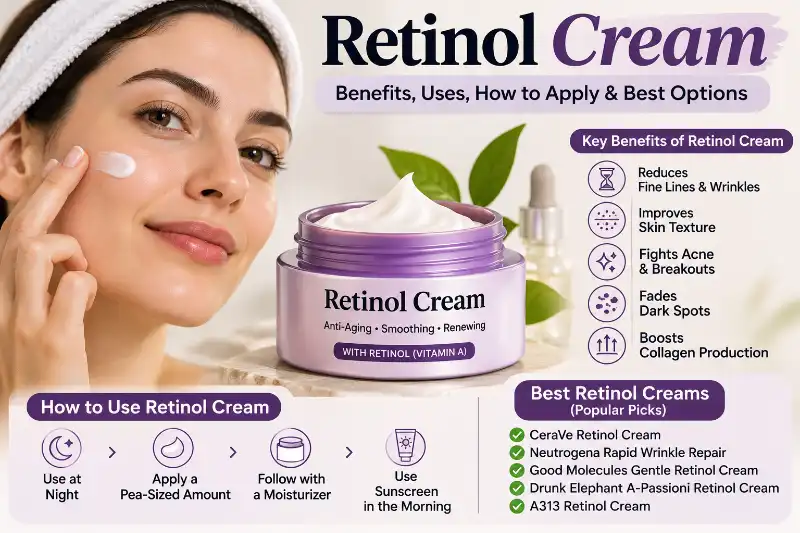
Retinol cream is one of those skincare products that sounds amazing until you actually try to buy one. You see promises about fewer wrinkles, smoother skin, clearer pores, and fading dark spots. But then you notice different strengths, ingredients, and brands. Suddenly, picking a simple face cream feels confusing.
Maybe you’re dealing with acne. Maybe you’ve noticed your first fine lines. Or perhaps you just want your skin to look smoother without spending a fortune.
The good news? You don’t need an expensive skincare routine to get started.
Retinol cream is a vitamin A-based skincare treatment that can help improve fine lines, uneven skin tone, rough texture, and some types of acne. It works gradually, so choosing the right formula and using it consistently matters more than buying the strongest product.
This article explains what retinol cream does, its benefits, how to use it safely, and which popular options may suit your skin.
FIND YOUR AGE - IN YEARS, MONTHS, DAYS, HOURS & SECONDS!
What Is Retinol Cream and What Does It Do?
Retinol cream is a facial skincare product containing retinol, a form of vitamin A that belongs to a family of ingredients called retinoids. It helps support skin cell turnover and collagen production. With regular use, retinol may improve the appearance of wrinkles, dark spots, clogged pores, and uneven texture.
Unlike a basic moisturizer, retinol cream contains an active ingredient that changes how skin cells behave.
But that doesn’t mean every retinol product works the same way.
The amount of retinol, the other ingredients in the formula, and how often you apply it all affect your results.
How Does Retinol Work on Your Skin?
Your skin naturally replaces old cells with new ones. As you age, that process changes. Dead skin cells can build up, your skin may look dull, and fine lines become easier to notice.
Retinol helps regulate skin cell turnover. It also supports collagen production, which helps skin maintain its structure.
Here’s what that means for your face:
- Old surface cells are replaced more efficiently.
- Fine lines may become less noticeable.
- Clogged pores may improve.
- Skin texture can gradually look smoother.
- Some dark spots and uneven pigmentation may fade.
Retinol doesn’t remove wrinkles overnight. It works slowly, and visible results often take several weeks or months.
According to the American Academy of Dermatology, retinoids can be useful for mild acne, fine lines, and uneven pigmentation. American Academy of Dermatology
Is Retinol Cream the Same as a Retinoid?
Not exactly.
Retinol is a type of retinoid, but not all retinoids are retinol.
Here’s an easy comparison:
| Ingredient | What it is | Where it’s commonly found |
|---|---|---|
| Retinol | Vitamin A derivative | Over-the-counter creams and serums |
| Retinal (retinaldehyde) | Another vitamin A derivative | Some OTC skincare treatments |
| Retinyl palmitate | Vitamin A ester | Certain cosmetic creams and ointments |
| Adapalene | Retinoid commonly used for acne | OTC and prescription acne treatments |
| Tretinoin | Prescription retinoid | Prescription acne and photoaging treatments |
| Retinoic acid | Biologically active form | The form that acts on retinoic acid receptors |
Your skin converts retinol into retinal and then retinoic acid.
Tretinoin is already a form of retinoic acid, which helps explain why prescription tretinoin can have stronger effects than many OTC retinol products.
If you’re new to vitamin A skincare, a lower-strength retinol formula may be a more manageable starting point than jumping straight to a strong treatment.
What Are the Benefits of Retinol Cream for Your Face?
People use retinol cream for several reasons, but not everyone is trying to fix the same skin problem.
Some want fewer wrinkles. Others are more concerned about acne, dark spots, or rough skin.
Let’s look at what retinol can realistically do.
Can Retinol Cream Reduce Fine Lines and Wrinkles?
Yes, retinol can help reduce the appearance of some fine lines and wrinkles, especially those linked to photoaging.
Collagen is a protein that helps keep your skin firm. Over time, collagen production changes, and sun exposure can speed up visible aging.
Retinol supports collagen-related processes and improves skin renewal.
With regular use, you may notice smoother-looking skin and softer fine lines.
However, retinol cream cannot completely erase deep wrinkles, lift significantly sagging skin, or produce the same results as cosmetic procedures.
For people comparing the best retinol cream for wrinkles, the most important factors are a suitable concentration, a formula your skin tolerates, and consistent sun protection.
Does Retinol Cream Help with Acne and Clogged Pores?
Retinol may help some people with mild acne by supporting normal skin cell turnover and reducing clogged pores.
That can be useful if you often deal with blackheads, whiteheads, or small breakouts.
But there’s an important difference between a cosmetic retinol cream and a retinoid specifically approved to treat acne.
For example, adapalene is an acne treatment available in the United States without a prescription at certain strengths. Prescription tretinoin is another established option.
If your acne is painful, severe, leaving scars, or not improving, a dermatologist can help you choose a better-targeted treatment. American Academy of Dermatology
Best approach: Choose your product based on your main skin concern, not simply because its packaging says “retinol.”
Can Retinol Improve Dark Spots and Uneven Skin Tone?
Retinol may help improve some kinds of hyperpigmentation, including uneven tone caused by sun exposure or marks left after acne.
Its effects come partly from changes in skin cell turnover and pigmentation processes.
But dark spots don’t all have the same cause.
Sun spots, post-acne marks, and melasma can respond differently to treatment.
One more thing matters here: irritation can actually make dark marks worse, especially in skin that is prone to post-inflammatory hyperpigmentation.
That’s why starting slowly is often better than using a strong retinol every night.
And don’t skip sunscreen. Treating dark spots while allowing more sun damage is like cleaning a window while someone keeps throwing dirt at it.
Will Retinol Make Rough Skin Look Smoother?
If your skin feels uneven or looks dull, retinol may help improve its appearance over time.
It can support a smoother surface and make some enlarged-looking pores less noticeable by helping prevent clogging.
But retinol doesn’t permanently shrink your pores.
Pore size is influenced by genetics, oil production, aging, and other factors.
If smoother texture is your main goal, you may not need the strongest anti-aging cream. A gentle, well-formulated product may be enough.
Which Retinol Cream Is Best for Your Skin Type?
Here’s where shopping gets tricky.
The best retinol cream for face care isn’t necessarily the same for everyone.
A product that feels great on oily skin might leave dry skin uncomfortable. And a cream that works for an experienced user could be too irritating for someone who has never used retinol.
Best Retinol Cream for Beginners
If you’ve never used retinol, don’t start with the strongest formula you can find.
Look for a gentle retinol cream with a relatively low concentration, simple directions, and moisturizing ingredients.
A beginner-friendly formula may include glycerin, ceramides, squalane, or hyaluronic acid.
For example, Good Molecules Gentle Retinol Cream contains 0.1% retinol and is marketed as a fragrance-free formula.
A low concentration still has the potential to cause irritation, so it’s worth doing a patch test and starting with limited applications.
Best Retinol Cream for Sensitive or Dry Skin
Dry or sensitive skin needs a little more care.
Retinol can cause flaking, tightness, and redness. If your skin already feels dry, those symptoms may be especially uncomfortable.
Look for:
- Fragrance-free options where possible.
- Moisturizing ingredients such as glycerin and squalane.
- Ceramides to support the skin barrier.
- A mild formula with clear usage instructions.
Avoid using retinol over irritated or damaged skin.
If you have eczema, rosacea, or frequent allergic reactions, ask a dermatologist before adding a retinoid.
Best Retinol Cream for Oily and Acne-Prone Skin
If your face feels greasy by midday, you may prefer a lightweight lotion, gel-cream, or serum rather than a heavy cream.
Look for a product labeled noncomedogenic, although that label isn’t a guarantee it will work for everyone.
Niacinamide can be a useful supporting ingredient because it may help with skin barrier function and the look of uneven tone.
If your main problem is persistent acne, consider whether an acne-specific retinoid such as adapalene would be more appropriate than a general anti-aging cream.
People searching for Glad2Glow retinol cream for oily skin should check the exact product’s ingredient list and availability rather than assuming every product under the brand contains the same retinoid.
Best Retinol Cream for Fine Lines and Mature Skin
If fine lines are your main concern, look for a product designed to improve visible signs of aging while keeping your skin comfortable.
Retinol formulas with glycerin, hyaluronic acid, peptides, or other moisturizers may be useful when dryness is also an issue.
Remember, mature skin doesn’t automatically need a high retinol percentage.
If a stronger cream makes your face irritated every week, it may be harder to use consistently.
And consistency matters.
What Retinol Percentage Should Beginners Use?
You may see retinol products labeled 0.1%, 0.3%, 0.5%, or even 1%.
Those numbers refer to the concentration of retinol in the formula, when the manufacturer discloses it.
Higher numbers don’t automatically mean better results for your skin.
Low-Strength vs High-Strength Retinol Cream
| Retinol concentration | General consideration |
|---|---|
| 0.1% | Lower-strength option that some beginners may tolerate |
| 0.3% | A stronger option that may be appropriate after building tolerance |
| 0.5% | May increase irritation risk compared with lower-strength formulas |
| 1% | Higher-strength cosmetic retinol; often less suitable for first-time users |
These are broad comparisons, not strict medical categories.
A 0.3% retinol cream from one brand might feel different from another because the formula, delivery system, and other ingredients also matter.
Some manufacturers don’t disclose the exact retinol percentage at all.
When Should You Consider a Stronger Retinol?
Only consider increasing strength after your skin has adjusted and you’re using your current product without significant irritation.
There’s no need to rush.
If your current formula works well and your skin looks healthier, you may not need anything stronger.
People using retinol for acne, pigmentation, or significant sun damage may benefit from discussing prescription treatments with a dermatologist instead of repeatedly buying stronger cosmetic creams.
Best Retinol Creams to Consider in 2026
Finding a good retinol cream can feel overwhelming. Drugstore shelves and online stores are full of products promising smoother, younger-looking skin.
But you don’t need to try them all.
The right product depends on your skin type, main concern, budget, and experience with retinol.
Below are several popular formulas worth comparing. These are research-based options, not products personally tested or ranked through independent clinical testing.
| Product | Main features | Worth considering for |
|---|---|---|
| Good Molecules Gentle Retinol Cream | 0.1% retinol, fragrance-free | Beginners seeking lower-strength retinol |
| Drunk Elephant A-Passioni | 1% retinol, peptides | Experienced retinol users |
| Neutrogena Rapid Wrinkle Repair | Retinol, hyaluronic acid | Fine lines and rough texture |
| CeraVe Resurfacing Retinol Serum | Encapsulated retinol, ceramides, niacinamide | Uneven texture and post-acne marks |
| Olay Retinol24 Night Moisturizer | Retinol, retinyl propionate, niacinamide | Moisturizing nighttime care |
| LilyAna Naturals Retinol Cream | Retinol and moisturizing ingredients | People interested in a cream-based formula |
Check the latest packaging before buying because manufacturers can change ingredients and directions.
Good Molecules Gentle Retinol Cream
If you’re looking for a gentle retinol cream, Good Molecules is worth considering.
Its Gentle Retinol Cream contains 0.1% retinol and has a fragrance-free formula. The brand also includes moisturizing and soothing ingredients intended to make the cream more comfortable to use.
Why people may like it:
- The retinol percentage is clearly stated.
- The formula is fragrance-free.
- It has a cream texture rather than a thin serum.
- The brand gives specific guidance for different skin types.
Good Molecules recommends using it up to three nights weekly for dry or sensitive skin and up to four nights for normal skin. New users may need to begin less often.
Before relying on Good Molecules Gentle Retinol Cream reviews, check whether reviewers have a similar skin type and whether they used the product long enough to judge the results.
A positive review after one night cannot prove that a retinol cream reduces wrinkles.
The official product page confirms its 0.1% retinol concentration. Good Molecules
Drunk Elephant A-Passioni Retinol Cream
Drunk Elephant A-Passioni Retinol Cream is a stronger option.
It contains 1% retinol along with peptides and other supporting ingredients.
This might appeal to someone who has already used lower-strength retinol and wants to consider a more concentrated formula.
However, a higher concentration also makes careful introduction important.
Drunk Elephant recommends beginning once or twice weekly and increasing use gradually as tolerated.
If you’ve never tried a retinoid, there’s no reason to assume A-Passioni should be your first choice.
The brand’s official instructions also emphasize sunscreen and avoiding retinol during pregnancy or nursing. Drunk Elephant
Neutrogena Rapid Wrinkle Repair Retinol Cream
Neutrogena Rapid Wrinkle Repair is a familiar option for shoppers who prefer widely available skincare brands.
The Rapid Wrinkle Repair Retinol Regenerating Cream contains retinol and hyaluronic acid.
It’s marketed for concerns such as fine lines, wrinkles, dark spots, and dull-looking skin.
There are fragranced and fragrance-free versions, so check which one you’re buying.
One useful detail is that the formula contains hyaluronic acid, which helps support hydration.
That doesn’t mean retinol irritation becomes impossible, but moisturizing ingredients can make a formula more appealing when dryness is a concern.
Neutrogena’s official directions vary by product, so follow the instructions on your specific package and introduce retinol cautiously. Neutrogena+1
CeraVe Retinol Products
People often search for “CeraVe retinol cream,” but CeraVe sells several skincare products that shouldn’t be confused with one another.
For example, CeraVe Resurfacing Retinol Serum contains encapsulated retinol, niacinamide, and ceramides.
It’s marketed to help improve the appearance of uneven texture and post-acne marks.
Ceramides help support your skin’s protective barrier, while niacinamide may help with moisture retention and skin comfort.
However, CeraVe Skin Renewing Night Cream is a different product.
That moisturizer contains ingredients such as ceramides, hyaluronic acid, niacinamide, and peptides, but its currently listed US formulation does not include retinol.
So, if you want an actual retinol treatment, choose the correct product rather than assuming every CeraVe night cream contains vitamin A derivatives. CeraVe+1
Olay Retinol Night Cream
Olay offers several anti-aging products, but the word “Regenerist” doesn’t automatically mean a cream contains retinol.
Olay Retinol24 Night Moisturizer lists retinol and retinyl propionate among its ingredients. It also contains niacinamide.
Its formula is intended for nighttime skincare and moisturizing care.
On the other hand, the current US Olay Regenerist Micro-Sculpting Cream ingredient list does not include retinol.
That product focuses on ingredients such as niacinamide and peptides.
If you’re shopping for an Olay night cream with retinol, look for the specific Retinol24 product rather than choosing a jar simply because it promises anti-aging benefits. Olay – OLAY+1
LilyAna Naturals Retinol Cream
LilyAna Naturals Retinol Cream is another option frequently found in searches for face cream with retinol.
The brand markets its product for dry-looking skin, fine lines, dark spots, and uneven texture.
Its formula includes moisturizing ingredients, including hyaluronic acid.
However, don’t confuse marketing descriptions with independent clinical evidence.
The brand discusses retinol percentages and higher-strength comparisons in its product FAQs, but those statements shouldn’t be treated as proof that the cream performs like a prescription treatment.
If you’re considering LilyAna Naturals, check its latest complete ingredient list and start slowly, especially if your skin is sensitive. LilyAna Naturals
Is A313 a Retinol Cream?
A313 is often called a retinol cream online, but the exact vitamin A ingredient matters.
The A313 Vitamin A Pommade formulation described by its distributors contains retinyl palmitate, a vitamin A ester, rather than pure retinol.
Retinyl palmitate needs additional conversion steps in the skin before it becomes active retinoic acid.
A313 also has a thick ointment-like texture that feels different from a typical lightweight retinol face cream.
If you’re searching for A313 cream retinol pommade 50 gr, verify the exact package and ingredient list. Versions and regional product descriptions may differ.
One distributor’s ingredient information also lists peanut oil, which may matter for people with relevant allergies. A313+1
Which one should you choose?
If you’re new to retinol, start by comparing lower-strength options and checking which formulas match your skin type. If you already tolerate retinol, you may have more choices.
Price and popularity matter less than getting a product you can use comfortably and consistently.
How to Use Retinol Cream Without Irritating Your Skin
Buying retinol is the easy part. Using it correctly is where beginners sometimes run into trouble.
Applying too much, using it too often, or mixing it with several strong skincare ingredients can leave your face feeling dry and uncomfortable.
You don’t need a complicated routine.
Step 1 — Cleanse Your Face and Let Your Skin Dry
Start by washing your face with a gentle cleanser.
Avoid harsh scrubs or rough washcloths.
Pat your face dry with a clean towel, then let the skin dry fully before applying retinol.
Applying retinol to damp skin may increase irritation for some people.
If your skin is especially sensitive, your dermatologist may recommend waiting longer after cleansing.
Step 2 — Apply a Pea-Sized Amount of Retinol
For many leave-on facial retinol products, a pea-sized amount is enough for the entire face.
Spread a thin layer over the areas you want to treat, following the product’s directions.
Don’t apply a thick coat.
More retinol does not automatically mean faster results.
Avoid getting regular face retinol cream into your eyes, mouth, nostrils, or onto irritated skin.
And remember, some products have different application instructions, so always read the label.
Step 3 — Follow with a Gentle Moisturizer
Once you’ve applied retinol, use a simple moisturizer if recommended for your formula.
This helps reduce dryness and supports the skin barrier.
Look for products containing ingredients such as glycerin, ceramides, hyaluronic acid, or squalane.
If you’re very sensitive to retinol, you may find the retinol sandwich method helpful.
This means applying moisturizer, then retinol, followed by another thin layer of moisturizer.
The approach can help some people tolerate retinoids, although it may not suit every formula.
Step 4 — Use Broad-Spectrum SPF 30 or Higher Every Morning
Sunscreen is a major part of a retinol skincare routine.
Retinoids can make skin more sensitive to sun exposure, especially during the adjustment period.
Use a broad-spectrum sunscreen with at least SPF 30 every morning.
Reapply it as directed, particularly when spending time outdoors.
A simple daytime routine might look like this:
| Morning | Night |
|---|---|
| Gentle cleanser | Gentle cleanser |
| Moisturizer | Retinol cream on scheduled nights |
| Broad-spectrum SPF 30+ | Moisturizer |
The Cleveland Clinic recommends patch testing before starting retinol, using a small amount, and moisturizing afterward. Cleveland Clinic
How Often Should You Apply Retinol Cream?
If you’re new to retinol, begin slowly.
For example, you might try using a gentle formula once or twice during your first week, with several days between applications.
If your skin remains comfortable, you can gradually increase the frequency according to the product directions.
Some people eventually tolerate nightly use. Others do better using retinol a few nights each week.
Neither approach is automatically wrong.
Your skin’s response matters more than following someone else’s routine.
Can You Use Retinol with Other Skincare Ingredients?
You probably already use other skincare products.
Maybe you have a vitamin C serum, an acne treatment, or a moisturizer with niacinamide.
The question is whether those ingredients work well with retinol.
Retinol with Hyaluronic Acid, Ceramides, and Niacinamide
These ingredients are often found in skincare routines that include retinol.
Hyaluronic acid helps attract and retain moisture.
Ceramides support the skin barrier and help reduce water loss.
Niacinamide may help support barrier function and improve the appearance of uneven skin tone.
Together, these ingredients can make a skincare routine more comfortable.
You don’t necessarily need separate products containing all three. A single well-formulated moisturizer may already provide enough support.
Retinol with Vitamin C, Salicylic Acid, or Glycolic Acid
This combination needs more thought.
Vitamin C is commonly used in morning skincare routines, while retinol is often applied at night.
You can separate them this way if your skin tolerates both.
Salicylic acid, glycolic acid, and other exfoliating acids may increase irritation when used alongside retinol.
If you’re a beginner, avoid introducing multiple strong actives at once.
Try establishing a simple routine first.
Once your skin adjusts, you can decide whether extra exfoliating products are actually needed.
Retinol with Benzoyl Peroxide
Benzoyl peroxide is commonly used to treat acne.
Using it alongside retinol may increase dryness and irritation.
Some benzoyl peroxide combinations may also create formulation-specific stability concerns with certain retinoids.
That doesn’t mean the ingredients can never appear in the same overall skincare plan.
A dermatologist may recommend different application times or prescribe a product designed for a particular combination.
Don’t mix strong acne treatments without checking their instructions.
What Side Effects Can Retinol Cream Cause?
Retinol can offer useful benefits, but it isn’t completely gentle for everyone.
Common side effects include:
- Dryness and tightness
- Redness
- Peeling or flaking
- Itching
- Burning or stinging
- Increased sensitivity during the adjustment period
These effects are more likely if you start too strong or apply retinol too frequently.
Why Does Retinol Cause Dryness, Redness, or Peeling?
Retinol changes skin cell turnover and can temporarily disrupt how comfortable your skin feels.
Your skin may need time to adjust.
A little dryness can occur, but severe burning or painful peeling isn’t something you should simply push through.
Persistent irritation may damage the skin barrier.
And if your skin is prone to hyperpigmentation, that irritation can lead to new dark marks.
What Should You Do If Retinol Burns or Irritates Your Skin?
If retinol causes significant irritation, stop using it.
Switch to a gentle cleanser and moisturizer while your skin recovers.
Avoid adding exfoliating acids, scrubs, or other irritating products.
If you experience swelling, blistering, severe pain, or a persistent reaction, seek medical advice.
For mild irritation, a dermatologist may recommend a weaker formula, smaller amount, or less frequent application.
The American Academy of Dermatology emphasizes adjusting retinoid use to reduce irritation when appropriate. American Academy of Dermatology
Who Should Avoid Retinol Cream or Ask a Dermatologist First?
Retinol isn’t suitable for every situation.
Pregnancy: Avoid topical retinoids, including OTC retinol, during pregnancy. If you’re planning pregnancy, discuss your skincare routine with your healthcare professional.
Breastfeeding: Ask your clinician before using retinol, since advice may depend on the treatment, application area, and individual circumstances.
Rosacea or eczema: Retinol may worsen active irritation or inflammation.
Damaged skin: Avoid applying retinol over sunburned, injured, or severely irritated areas.
Prescription acne treatment: Ask whether adding an OTC retinol product is necessary or likely to increase irritation.
The American Academy of Dermatology specifically advises avoiding retinoids during pregnancy. American Academy of Dermatology
How Long Does Retinol Cream Take to Work?
One of the biggest mistakes people make with retinol is expecting quick results.
Retinol isn’t an instant treatment.
Even if you’re using a good product correctly, your skin may need several weeks or months to show noticeable changes.
What Changes Might You Notice in the First Few Weeks?
At first, you may not see much improvement.
You might notice mild dryness or flaking as your skin adjusts.
Some people experience early changes in skin texture, but those aren’t guaranteed.
Don’t assume a product has failed because your wrinkles still look the same after two weeks.
Retinol generally requires patience.
When Can Retinol Improve Wrinkles, Texture, and Dark Spots?
Results vary depending on the formulation, skin concern, and frequency of use.
Here’s a general timeline, not a promise:
| Time using retinol | What you may notice |
|---|---|
| First 2–4 weeks | Adjustment, possible dryness or irritation |
| 4–8 weeks | Early texture changes in some users |
| 8–12 weeks | More noticeable improvements in some skin concerns |
| 3–6 months | Further changes in fine lines or uneven tone |
| Beyond 6 months | Continued benefits may occur with consistent treatment |
Some people need longer, and others may not see the results they expected.
More severe acne, pigmentation, or deep wrinkles may require different treatments.
What If Your Retinol Cream Is Not Working?
Before buying a stronger product, ask yourself a few questions.
Are you using it consistently? Have you given it enough time? Are you protecting your face from the sun?
Also check the product’s expiration date and storage instructions.
Retinol can degrade when exposed to unfavorable conditions, including excessive heat, light, or air.
If you’ve used a product correctly for several months without meaningful improvement, a dermatologist may help you identify another option.
Is Retinol Eye Cream Different from Face Retinol Cream?
The skin around your eyes is thinner and often more sensitive than the skin on your cheeks or forehead.
That’s why applying regular face retinol too close to your eyes can cause problems.
A dedicated retinol eye cream is formulated for that delicate area.
What Does Retinol Eye Cream Do?
Retinol eye cream may help reduce the appearance of fine lines around the eyes, including crow’s feet.
Some formulas also include ingredients intended to improve hydration and the look of dark circles.
However, dark circles have different causes.
They may be linked to pigmentation, shadows, allergies, skin structure, or lack of sleep.
Retinol won’t solve every cause.
How Do You Apply Retinol Eye Cream Safely?
Start with a small amount, following the product instructions.
Apply only to the recommended eye-contour area.
Avoid direct contact with your eyes, and don’t apply it too close to the lash line unless the product specifically instructs you to do so.
If you notice burning, swelling, or persistent irritation, stop using the product.
If you’re already using facial retinol, be especially careful not to overlap applications near your eyes.
RoC Retinol Correxion vs Other Retinol Eye Creams
RoC Retinol Correxion is a well-known product line among shoppers searching for retinol eye cream.
Other options include La Roche-Posay Redermic R Retinol Eye Cream.
La Roche-Posay describes its Redermic R formula as an ophthalmologist-tested retinol eye treatment intended to improve the appearance of crow’s feet and other fine lines.
It also provides instructions for evening application around the eye contour.
When reading RoC Retinol Correxion eye cream reviews or comparing eye products, check the current formula, application directions, and whether a reviewer describes irritation.
No eye cream can guarantee that dark circles or wrinkles will disappear. Ophthalmologist Tested
Retinol Cream vs Retinol Serum vs Tretinoin — Which Is Better?
If you’ve been comparing skincare products online, you’ve probably seen retinol creams, serums, retinal treatments, and tretinoin creams.
They aren’t interchangeable.
Retinol Cream vs Serum
The main difference is often the product’s texture and supporting ingredients.
Retinol cream usually contains a richer moisturizing base.
Retinol serum often feels lighter and may fit more easily into a layered skincare routine.
But a serum isn’t automatically stronger than a cream.
A retinol cream can contain more retinol than a serum, or the opposite may be true.
Choose based on the actual ingredients, concentration, skin type, and product directions.
Retinol vs Prescription Tretinoin
Tretinoin is a prescription retinoid used for acne and certain signs of sun-related skin aging.
Unlike retinol, tretinoin is already retinoic acid.
It has strong clinical evidence for specific uses and may work more quickly than OTC retinol, but it can also cause significant irritation.
If you’re wondering, “Is tretinoin cream retinol?” the answer is no.
Both are retinoids, but they are different ingredients.
Don’t replace a prescribed tretinoin treatment with a cosmetic retinol cream without discussing your treatment plan with your clinician.
Retinol vs Retinal and Other Retinoids
Retinal, also called retinaldehyde, is another vitamin A derivative used in skincare.
It requires fewer conversion steps than retinol to become retinoic acid.
But that doesn’t mean every retinal product is more effective than every retinol formula.
The final results still depend on concentration, formulation, skin tolerance, and evidence for the specific product.
Meanwhile, adapalene is especially relevant for acne treatment, while tretinoin and other prescription retinoids may be used for particular medical indications.
How to Choose and Buy Retinol Cream in the USA
The good news is that you don’t need to visit an expensive beauty store to find a retinol product.
Many brands sell their products through official websites, drugstores, and major US retailers.
Still, not every product listing deserves your trust.
What Should You Check on a Retinol Cream Label?
Before buying, read the packaging.
Look for the actual vitamin A ingredient rather than relying only on words like “anti-aging,” “renewing,” or “night repair.”
Ingredients may include retinol, retinal, retinyl palmitate, or another retinoid.
Those names aren’t identical.
Also check whether the product discloses its concentration.
A 1% retinol cream and a 1% retinyl palmitate product shouldn’t be treated as equal.
Other helpful details include skin-type guidance, fragrance, packaging, expiration date, and recommended frequency.
Air-limiting, protective packaging may help with formula stability, although the final stability depends on how the product is made.
What Does Dermatologist-Tested Retinol Cream Mean?
You’ll see phrases like “dermatologist-tested,” “dermatologist-recommended,” and “clinically proven” on skincare packaging.
They sound reassuring, but they don’t all mean the same thing.
Dermatologist-tested generally means that dermatologists were involved in some form of testing. The term alone doesn’t tell you how many people participated or what results were measured.
Dermatologist-recommended may refer to a recommendation study or survey.
Clinically proven should be supported by appropriate testing, but you still need to know what the study actually showed.
A product label is a starting point, not a substitute for evidence.
Where Can You Buy Retinol Cream?
You can look for retinol products on official brand websites or through authorized US retailers, including drugstore and beauty chains.
Buying from an authorized seller helps reduce concerns about questionable storage, outdated inventory, or counterfeit products.
For unfamiliar websites, verify the seller before entering payment information.
It’s also smart to compare product sizes rather than looking only at the price on the front page.
A cheaper jar isn’t always the better value if it contains much less product.
And don’t feel pressured to buy the most expensive cream. A simple formula that suits your skin can be a reasonable choice.
Frequently Asked Questions About Retinol Cream
Can I Use Retinol Cream Every Night?
Some people can use retinol cream nightly after their skin adjusts, but beginners should generally start less often. Follow the directions for your specific product. If you develop redness, dryness, or peeling, reduce use or stop until the irritation resolves. More frequent application isn’t always better.
Can I Use Retinol Cream Without Moisturizer?
You can use some retinol products without adding a separate moisturizer, particularly if the formula already provides enough hydration. However, a gentle moisturizer often helps reduce dryness and discomfort. If you’re sensitive to retinol, skipping moisturizer may make your routine harder to tolerate.
Does Retinol Cream Expire?
Yes. Retinol products have a limited shelf life, and their ingredients may become less stable over time. Check the expiration date or period-after-opening symbol. Store the product according to its directions. If the color, smell, or texture changes unusually, contact the manufacturer rather than assuming it’s still effective.
Can Retinol Cream Help with Cellulite?
Retinol may slightly improve the appearance of cellulite for some people, but the evidence is limited. Small studies have looked at topical retinol and skin thickness, with modest or inconsistent cosmetic improvements.
The American Academy of Dermatology notes that 0.3% retinol may help some people see a small reduction in visible cellulite after six months or longer.
It won’t remove the underlying structure responsible for cellulite, and ordinary facial retinol creams shouldn’t be treated as proven cellulite treatments. American Academy of Dermatology+1
Does CeraVe Skin Renewing Night Cream Contain Retinol?
According to CeraVe’s currently published US ingredient list, Skin Renewing Night Cream does not contain retinol.
It includes ingredients such as ceramides, peptides, hyaluronic acid, and niacinamide.
If you want retinol from CeraVe, look at its Resurfacing Retinol Serum or another product that specifically lists retinol. CeraVe
Does Olay Regenerist Micro-Sculpting Cream Have Retinol?
The current US Olay Regenerist Micro-Sculpting Cream does not list retinol among its ingredients.
It is primarily a moisturizing anti-aging product containing niacinamide and peptides.
Olay Retinol24 Night Moisturizer is a different product and does list retinol.
Always check the exact product name and ingredient list. Olay – OLAY+1
Does L’Oréal Midnight Cream Have Retinol?
L’Oréal Age Perfect Cell Renewal Midnight Cream is an anti-aging night moisturizer, but its currently published US formula does not list retinol.
It focuses on ingredients such as antioxidants and moisturizing components.
L’Oréal sells other skincare products containing retinol, so don’t assume that every anti-aging cream in the brand’s collection has the same ingredients. L’Oréal Paris
Is A313 the Same as Retinol?
Not exactly.
The A313 Vitamin A Pommade formulation discussed earlier contains retinyl palmitate, a vitamin A ester.
Retinyl palmitate and retinol belong to the same broader vitamin A family, but they’re chemically different.
If you specifically want a retinol cream, check whether the ingredient list actually says “retinol.”
Can You Use Retinol Cream on Your Hands?
Some retinol products can be used on the hands if their directions allow it.
Retinol may help improve the appearance of some sun-related changes and fine lines, although results vary.
The hands are frequently exposed to sunlight and washing, so moisturizer and broad-spectrum sunscreen remain important.
For rough, dry hands, a basic hand cream may be more useful than retinol.
What Does “Retinol Cream Para Qué Sirve” Mean?
The Spanish phrase “retinol cream para qué sirve” means “What is retinol cream used for?”
Retinol cream is commonly used to improve the appearance of fine lines, uneven skin tone, rough texture, and some acne-related concerns.
Its benefits develop gradually, and proper use matters.
What Is AlphaRet Overnight Cream’s Retinol Percentage?
AlphaRet Overnight Cream is known for its proprietary retinoid and exfoliating ingredient technology.
However, you shouldn’t assume that a product’s proprietary complex has the same concentration as a standard retinol cream.
If the exact retinol percentage isn’t publicly disclosed, don’t rely on an unsupported number from a retailer or online comment.
Check the manufacturer’s current technical information.
Is Glad2Glow Retinol Cream Good for Oily Skin?
That depends on the exact Glad2Glow formula.
For oily skin, consider the texture, moisturizing ingredients, retinoid type, and whether the product is suitable for acne-prone skin.
A lightweight formula may feel more comfortable than a rich cream.
Product availability and formulations can vary by market, so check the current ingredient label before purchasing.
What About Green Cream Retinol and Ambi Even & Clear Fade Cream?
Green Cream retinol products and Ambi Even & Clear Fade Cream searches often appear alongside general retinol queries.
But product names don’t tell you which active ingredients are present.
If you’re researching Ambi Even & Clear Fade Cream Retinol 1 oz, verify the exact package rather than assuming it uses the same formula as other Ambi fade creams.
The same rule applies to Green Cream products.
Look for the complete ingredient list, product directions, and retinoid concentration when disclosed.
What Is the Best Retinol Cream for Your Face?
The best choice is a product that matches your skin concerns and is comfortable enough to use consistently.
Beginners may prefer a lower-strength formula. People with dry skin may benefit from moisturizing ingredients, while oily skin users may prefer lighter textures.
If your main concern is significant acne or pigmentation, a dermatologist can help you choose the most appropriate treatment.
Final Thoughts — Finding a Retinol Cream That Works for You
Retinol cream can be a useful addition to your skincare routine, especially if you’re concerned about fine lines, uneven texture, dark spots, or mild acne.
But you don’t need to buy the strongest formula or use it every night to get started.
Choose a product that fits your skin type, begin with a small amount, and give your skin time to adjust.
Keep the rest of your routine simple. A gentle cleanser, a suitable moisturizer, and daily sunscreen can make a real difference.
And remember, skincare results take time. If a product causes ongoing irritation, it’s worth changing your approach rather than forcing your skin to tolerate it.
The best retinol cream isn’t necessarily the one with the biggest promises. It’s the one that suits your skin, has evidence supporting its ingredients, and fits safely into a routine you can maintain.
Editorial note: This article provides general skincare information and is not a substitute for personalized medical advice. Product ingredients and directions were checked against available manufacturer information in November 2026 and may change.
BMI & BMR CALCULATOR - CHECK YOUR HEALTH