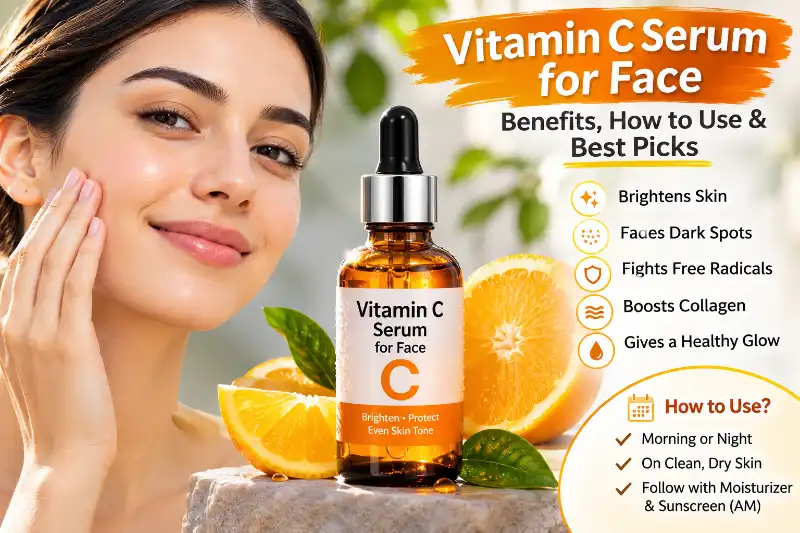
Finding the best vitamin C serum for face can feel harder than it should. One bottle promises brighter skin. Another says it helps fade dark spots. Then you see serums with 10%, 15%, or even 20% vitamin C. Which one should you actually buy?
The good news is that you don’t need the most expensive serum to build a good skincare routine.
What matters is choosing the right vitamin C formula for your skin type, knowing how to use it, and giving it enough time to work.
Some people want a serum for dull skin. Others hope to improve uneven skin tone, fine lines, or leftover acne marks. Your main concern can help you narrow down the choices.
This guide covers the best vitamin C serums for face in 2026, their benefits, important ingredients, possible side effects, and simple ways to use them safely.
Quick Answer: The best vitamin C serum for your face depends on your skin type, budget, and tolerance. CeraVe Skin Renewing Vitamin C Serum is a practical option with 10% pure vitamin C and moisturizing ingredients. TruSkin is worth considering if you prefer a vitamin C derivative. SkinCeuticals C E Ferulic offers a premium 15% L-ascorbic acid formula. Start slowly, moisturize, and wear sunscreen every morning.
FIND YOUR AGE - IN YEARS, MONTHS, DAYS, HOURS & SECONDS!
Best Vitamin C Serums for Face in 2026 — Quick Comparison
If you’re looking for a good vitamin C serum for face care, you probably don’t want to spend hours comparing ingredient lists.
Here’s an easier starting point.
These products have different strengths. Some focus on hydration, while others use stronger vitamin C formulas.
| Vitamin C Serum | Main Ingredient | Best Consideration |
|---|---|---|
| SkinCeuticals C E Ferulic | 15% L-ascorbic acid | Premium antioxidant formula |
| CeraVe Skin Renewing Vitamin C Serum | 10% L-ascorbic acid | Beginners and hydration-focused routines |
| TruSkin Vitamin C Facial Serum | Sodium ascorbyl phosphate | Derivative-based formula |
| Timeless 20% Vitamin C + E Ferulic | 20% L-ascorbic acid | Experienced vitamin C users |
| COSRX Advanced The Vitamin C 23 Serum | 23% ascorbic acid | High-strength Korean skincare |
| Goodal Green Tangerine Vita C Dark Spot Care Serum | Ascorbyl glucoside and supporting ingredients | Korean brightening routine |
These are formulation-based recommendations, not a ranking from personal testing. Always check current ingredients and directions before buying because brands may update their products.
Best Vitamin C Serum Overall: SkinCeuticals C E Ferulic
SkinCeuticals C E Ferulic is one of the better-known premium vitamin C serums.
Its antioxidant combination includes:
- 15% L-ascorbic acid
- 1% vitamin E
- 0.5% ferulic acid
These ingredients work together to provide antioxidant support and help improve the appearance of uneven tone and visible signs of aging.
The formula is worth considering if you’re comfortable paying more for an established skincare product.
What makes it appealing?
It uses a well-studied vitamin C form and pairs it with additional antioxidants.
What should you know first?
It’s expensive, and the acidic formula may still irritate some people. A premium product isn’t automatically the best choice for sensitive skin.
The manufacturer also introduced an enhanced formulation in 2026, so check the current product label rather than relying on old ingredient lists.
Best for: People who want a premium vitamin C serum and can tolerate an active formula.
Best Affordable Vitamin C Serum for Face: CeraVe Skin Renewing Vitamin C Serum
Not everyone wants to spend over $100 on a small bottle of skincare.
CeraVe Skin Renewing Vitamin C Serum is a more affordable option with 10% pure vitamin C.
It also contains ingredients that support hydration, including ceramides, hyaluronic acid, and panthenol.
This makes it interesting for people who want to combine a brightening product with a simple moisturizing routine.
CeraVe lists the serum as fragrance-free and suitable for different skin types, including sensitive skin.
Still, fragrance-free doesn’t mean irritation-free.
Best for: People who want a reasonably priced vitamin C serum with moisturizing ingredients.
Best Vitamin C Serum for Beginners: TruSkin Vitamin C Facial Serum
If you’ve never used vitamin C before, choosing a serum with a different form of vitamin C may be worth considering.
TruSkin Vitamin C Facial Serum uses sodium ascorbyl phosphate, often shortened to SAP.
This is a vitamin C derivative rather than pure L-ascorbic acid.
The formula also includes ingredients such as aloe, vitamin E, and hyaluronic acid-related moisturizing ingredients.
One advantage is that sodium ascorbyl phosphate can be more stable in certain skincare formulas.
However, don’t assume every derivative works exactly like pure vitamin C. Their research and performance can differ.
Best for: Beginners interested in a derivative-based vitamin C serum.
Best Vitamin C Serum for Dark Spots: Timeless Vitamin C + E Ferulic
Dark spots can make your skin tone look uneven, especially after breakouts or too much sun exposure.
Timeless offers a 20% Vitamin C + E Ferulic Acid Serum containing L-ascorbic acid.
It’s a concentrated option aimed at concerns such as dullness and discoloration.
Its lightweight formula may appeal to people who dislike heavy skincare products.
But there’s something important to understand.
A 20% serum isn’t automatically twice as effective as a 10% serum. Your skin needs to tolerate the formula for regular use.
Best for: People who have already used vitamin C and want to consider a stronger formula.
Best Vitamin C Serum for Sensitive Skin
Sensitive skin needs a little more care.
Before choosing a serum, check the entire formula instead of focusing only on the vitamin C percentage.
Look for features such as:
- No added fragrance
- Moisturizing ingredients
- A formula your skin can tolerate
- Clear application instructions
- Protective packaging
CeraVe’s fragrance-free formula is one possible option. A lower-strength serum or certain vitamin C derivatives may also be worth discussing with a dermatologist.
Even a product advertised as gentle can cause irritation.
Best for: People who want a cautious approach to vitamin C skincare.
Best Korean Vitamin C Serum for Face
Korean skincare has become popular because many products combine brightening ingredients with hydration.
Two products worth comparing are COSRX Advanced The Vitamin C 23 Serum and Goodal Green Tangerine Vita C Dark Spot Care Serum.
COSRX contains 23% pure vitamin C. It’s a high-strength option, and the brand markets it toward experienced vitamin C users.
Goodal uses a different approach, combining green tangerine extract with ingredients such as niacinamide and ascorbyl glucoside.
Be careful with one common misunderstanding: a product containing a high percentage of fruit extract does not necessarily contain that same percentage of active vitamin C.
Goodal also contains fragrant plant-derived ingredients that may not suit everyone.
Best for: People interested in Korean skincare who are willing to compare ingredients instead of choosing by popularity alone.
How to Choose the Best Vitamin C Serum for Your Face
A long product list won’t help much if you don’t know what the ingredients mean.
Before buying any serum, answer three questions.
What skin problem are you trying to improve? How sensitive is your skin? And how much do you want to spend?
Once you know those answers, choosing becomes easier.
L-Ascorbic Acid vs. Other Forms of Vitamin C
Vitamin C appears under several names on skincare labels.
L-ascorbic acid is pure vitamin C and is one of the most studied topical forms.
Other forms include:
| Vitamin C Form | What You Should Know |
|---|---|
| L-Ascorbic Acid | Well-studied but can be unstable and irritating |
| Sodium Ascorbyl Phosphate | Stable derivative used in several gentler-style formulations |
| Magnesium Ascorbyl Phosphate | Derivative commonly found in moisturizing skincare |
| Ascorbyl Glucoside | Stable derivative used in brightening products |
| 3-O-Ethyl Ascorbic Acid | Derivative used in modern serum formulations |
| Tetrahexyldecyl Ascorbate | Oil-soluble derivative used in facial products |
Not all these ingredients have the same amount of clinical research behind them.
That’s why a product with a lower percentage of one vitamin C form cannot be compared directly with a higher percentage of another.
The complete formula matters.
Is 10%, 15%, or 20% Vitamin C Better?
You may have searched for a 15 vitamin C serum for face care or wondered whether 20% is the strongest choice.
Here’s a simple comparison.
10% vitamin C: A reasonable starting point for many people who want to try pure L-ascorbic acid.
15% vitamin C: A commonly used concentration in more active antioxidant serums.
20% vitamin C: A higher concentration that may be harder for some people to tolerate.
Research-based dermatology guidance often discusses L-ascorbic acid formulas in the 10%–20% range.
That doesn’t mean everyone should begin with 10%, or that a 20% product will always perform better.
The pH, packaging, supporting ingredients, and your skin’s response all matter.
If you have reactive skin, start with a less aggressive formula and build up slowly.
Look for Vitamin E, Ferulic Acid, and Hydrating Ingredients
Vitamin C doesn’t need to work alone.
Some formulas include other ingredients that improve the overall skincare experience.
Vitamin E: Another antioxidant often paired with vitamin C.
Ferulic acid: Helps support antioxidant combinations and can improve stability in certain formulas.
Hyaluronic acid: Helps the skin hold moisture.
Glycerin: Draws water into the outer skin layers.
Ceramides: Help maintain the skin barrier.
Niacinamide: Supports the skin barrier and may help improve uneven skin tone.
A serum with thoughtful supporting ingredients may feel better on your face than a stronger serum with fewer moisturizing ingredients.
Check the Bottle, Stability, and Expiration Date
Vitamin C can lose effectiveness when exposed to air, light, or heat, depending on its formula.
That’s why packaging matters.
Look for products with suitable protective containers, such as opaque packaging or well-designed pumps.
Keep your serum away from unnecessary heat and direct sunlight. Follow the brand’s storage instructions because some products have special requirements.
If your serum changes color, texture, or smell, check the manufacturer’s guidance.
Some formulas naturally have a light yellow or amber color. Others may darken as they oxidize.
Color alone doesn’t prove that every serum has gone bad.
Is an Organic or Natural Vitamin C Serum Better?
Searching for an organic vitamin C serum for face care is understandable if you prefer products marketed with plant-based ingredients.
But organic doesn’t automatically mean better, safer, or more effective.
The same applies to natural skincare.
A plant extract may be useful, but it can also contain fragrance compounds that irritate sensitive skin.
Instead of trusting the word “natural,” check the ingredient list and the evidence behind the formula.
What Is Vitamin C Serum for Face, and How Does It Work?
Vitamin C serum is a skincare product that delivers a form of vitamin C directly to the skin.
Vitamin C is an antioxidant. Antioxidants help protect cells from damage linked to unstable molecules known as free radicals.
Sunlight, pollution, and normal body processes can contribute to oxidative stress.
Vitamin C also plays a role in collagen production.
Collagen helps give skin its structure and firmness.
When a suitable topical vitamin C formula is used consistently, it may help improve the look of dullness, uneven tone, and fine lines.
However, the ingredient’s benefits depend on how well the product is formulated and how your skin responds.
Why Is Vitamin C Used in Facial Skincare?
Eating foods rich in vitamin C supports your body’s overall health.
But applying a properly formulated serum is a different way to target the skin.
A facial serum delivers the ingredient directly to the skin’s surface.
That doesn’t mean you need both a supplement and a serum to have healthy skin.
A balanced diet, sunscreen, gentle cleansing, and moisturizing remain important parts of skincare.
What Does Vitamin C Serum Do for Your Face?
Vitamin C serum can help brighten dull-looking skin, improve the appearance of some dark spots, support collagen production, and provide antioxidant protection. With regular use, some people notice a more even-looking complexion and smoother appearance. Results depend on the product, skin condition, and consistency.
It’s helpful, but it’s not a miracle treatment.
It won’t erase every wrinkle, permanently remove acne scars, or replace sunscreen.
5 Benefits of Vitamin C Serum for Face
You might wonder whether the benefits of vitamin C serum for face care are worth adding another step to your routine.
For many people, the ingredient can be useful.
Here are five reasons it’s commonly included in facial skincare.
1. Helps Improve Dull-Looking Skin
Does your face sometimes look tired even after you’ve slept well?
Dullness can be linked to dryness, sun exposure, or other skin concerns.
Vitamin C may help your complexion look brighter over time.
This doesn’t mean changing your natural skin color.
The goal is to make the skin look healthier and more even.
A good moisturizer can also make a noticeable difference, especially when dryness contributes to dullness.
2. May Reduce the Appearance of Dark Spots
Dark spots are one of the main reasons people try vitamin C.
Some spots develop after acne. Others are linked to sun exposure or changes in pigmentation.
Vitamin C may help reduce the appearance of certain forms of hyperpigmentation.
Still, dark spots can take time to improve.
Some pigmentation problems, including stubborn melasma, may require a different treatment plan.
Daily sun protection is especially important because UV exposure can make discoloration harder to manage.
3. Supports Collagen Production and Fine-Line Care
Collagen helps keep skin firm and supported.
Your body naturally produces collagen, but skin changes over time.
Vitamin C is involved in the body’s collagen-making process.
A well-formulated topical serum may help improve the appearance of some fine lines with regular use.
Don’t expect deep wrinkles to disappear.
If your main concern is significant skin aging, a dermatologist can explain which treatments have stronger evidence for your goals.
4. Provides Antioxidant Support Against Environmental Stress
Your skin faces environmental exposure every day.
Sunlight and pollution can contribute to the formation of free radicals.
Vitamin C helps neutralize certain free radicals, which is one reason it’s used in antioxidant skincare.
Some people apply vitamin C in the morning to complement their sunscreen routine.
But here’s the important part.
Vitamin C serum is not sunscreen.
It cannot replace broad-spectrum SPF protection.
5. Can Improve the Look of Uneven Skin Tone
Uneven tone can make some areas of your face look darker than others.
Vitamin C may help improve that appearance gradually.
The changes are often subtle rather than dramatic.
You may notice your skin looks more balanced or that some older marks appear less visible.
Results differ from person to person.
The best approach is to use a product your skin tolerates, stay consistent, and protect your face from the sun.
Which Vitamin C Serum Is Best for Your Skin Type?
A serum that feels comfortable on dry skin might feel too heavy on oily skin.
That’s why skin type matters just as much as ingredient strength.
| Skin Type | What to Look For | What to Watch |
|---|---|---|
| Oily Skin | Lightweight, comfortable texture | Heavy formulas that feel greasy |
| Dry Skin | Hyaluronic acid, glycerin, ceramides | Dryness from strong acidic formulas |
| Sensitive Skin | Simple formula, no added fragrance | Burning, redness, repeated irritation |
| Acne-Prone Skin | Lightweight, non-comedogenic products | Products that trigger breakouts |
| Combination Skin | Balanced texture and hydration | Overusing multiple active products |
| Mature Skin | Vitamin C with moisturizing ingredients | Expectations of instant wrinkle removal |
For Oily and Acne-Prone Skin
If your skin gets shiny quickly, you probably want a serum that absorbs without leaving a heavy layer.
Look for lightweight products.
Vitamin C can support the appearance of uneven tone and lingering dark marks from past breakouts.
However, it isn’t a replacement for proven acne treatments when you have active acne.
If a serum repeatedly seems to make breakouts worse, stop using it and reconsider the formula.
For Dry and Dehydrated Skin
Dry skin often needs more than an antioxidant.
A serum containing hyaluronic acid, glycerin, or other moisturizing ingredients may be more comfortable.
Follow your vitamin C serum with a moisturizer.
This helps reduce water loss and supports your skin barrier.
Avoid adding too many strong skincare products at once.
For Sensitive or Reactive Skin
Sensitive skin doesn’t mean you can never use vitamin C.
It means you should choose carefully.
Look for a suitable formula, introduce it gradually, and watch your skin’s response.
If you already deal with frequent redness, eczema, or rosacea, ask a dermatologist before trying a strong acidic serum.
Don’t continue using a product that causes repeated burning.
For Combination and Mature Skin
Combination skin can be oily in some areas and dry in others.
A lightweight serum followed by moisturizer may work well.
Mature skin may benefit from formulas that combine antioxidant care with hydration.
But remember that vitamin C is only one part of a good routine.
Sunscreen, moisturizer, and other evidence-based ingredients may also play important roles.
Is TruSkin Vitamin C Serum for Face a Good Choice?
TruSkin is a popular name among people searching for an affordable facial serum.
Its standard Vitamin C Facial Serum uses sodium ascorbyl phosphate rather than pure L-ascorbic acid.
That difference matters.
Sodium ascorbyl phosphate is a vitamin C derivative that can be more stable in some formulations.
TruSkin pairs it with other skincare ingredients aimed at hydration and overall skin appearance.
TruSkin Vitamin C Serum Ingredients and Benefits
The formula includes:
- Sodium ascorbyl phosphate
- Vitamin E
- Aloe
- Hyaluronic acid-related ingredients
- Supporting botanical ingredients
These ingredients are intended to help with the appearance of dullness, uneven tone, and hydration.
However, the presence of soothing ingredients doesn’t guarantee the formula will work for every sensitive user.
TruSkin also contains additional botanical ingredients, so checking the label is still important.
TruSkin vs. CeraVe vs. SkinCeuticals
| Feature | TruSkin | CeraVe | SkinCeuticals |
|---|---|---|---|
| Vitamin C Type | Sodium ascorbyl phosphate | L-ascorbic acid | L-ascorbic acid |
| Main Appeal | Derivative-based formula | Hydration and brightening | Premium antioxidant combination |
| Formula Focus | Vitamin E, aloe and hydration | Ceramides and moisture | Vitamin E and ferulic acid |
| Price Position | Budget-friendly | Drugstore | Premium |
If you’re choosing between them, don’t focus only on the product name.
TruSkin may suit someone looking for a vitamin C derivative.
CeraVe may appeal to someone who wants 10% pure vitamin C with ceramides.
SkinCeuticals may interest someone willing to pay for a concentrated premium antioxidant formula.
Who Should Consider TruSkin?
TruSkin is worth looking at if you want a derivative-based formula and prefer not to begin with a high-strength L-ascorbic acid serum.
Still, read the ingredient list carefully.
If you react to certain plant extracts or other ingredients, another serum may be a better fit.
And if you’re treating a specific skin condition, product popularity alone shouldn’t guide your decision.
How to Use Vitamin C Serum for Face Correctly
Buying a good serum is only half the job.
Using it correctly matters too.
Fortunately, you don’t need a complicated routine.
Step 1 — Cleanse Your Face
Start with a gentle facial cleanser.
Wash away dirt, oil, and leftover skincare products.
Pat your face dry with a clean towel.
Some brands recommend applying their vitamin C serum to dry skin, so check your product’s instructions.
Avoid harsh scrubbing.
Step 2 — Apply the Recommended Amount
Place the recommended amount of serum on your fingertips and spread it gently over your face.
Avoid the eyes unless the product specifically says it’s suitable for that area.
Don’t assume you need a large amount.
Some serums require only a few drops, while pump-style products may use different directions.
Follow the label.
Step 3 — Follow With Moisturizer
Once the serum has been applied as directed, use your moisturizer.
This is especially helpful if your skin tends to feel dry or tight.
Choose a moisturizer that matches your skin type.
A simple fragrance-free option can work well if you’re building a beginner routine.
Step 4 — Finish Your Morning Routine With Sunscreen
If you’re applying vitamin C in the morning, finish with a broad-spectrum sunscreen of SPF 30 or higher.
Apply enough to cover exposed skin and reapply as needed, especially when spending time outdoors.
Vitamin C and sunscreen can work as complementary parts of your routine.
One provides antioxidant support. The other helps protect your skin from UV radiation.
You need sunscreen even if your serum contains antioxidants.
How Often Should Beginners Use Vitamin C Serum?
If your skin is new to vitamin C, start slowly.
You might begin a few mornings per week to see how your skin reacts.
If everything feels comfortable, you can gradually increase use according to the product directions.
There’s no prize for using the strongest serum every day.
A routine that your skin tolerates is better than one that leaves it irritated.
When to Use Vitamin C Serum for Face — Morning or Night?
People often ask whether they should apply vitamin C serum in the morning or at night.
The answer depends partly on the product and your routine.
For many people, morning is a convenient choice because antioxidant skincare fits naturally before sunscreen.
However, some vitamin C products can also be used at night.
Always follow the manufacturer’s directions.
Morning Skincare Routine With Vitamin C
A simple morning routine looks like this:
- Gentle cleanser
- Vitamin C serum
- Moisturizer
- Broad-spectrum SPF 30+ sunscreen
You don’t need five extra products between these steps.
Keeping your routine simple can make it easier to use consistently.
Can You Apply Vitamin C Serum at Night?
Yes, many vitamin C serums can be used at night.
If you prefer fewer morning steps, nighttime use may be convenient.
However, some products are specifically directed for morning use.
The label should guide your routine.
If you also use retinol, it may be easier to apply vitamin C in the morning and retinol at night.
That helps avoid layering several potentially irritating ingredients at once.
Can You Use Vitamin C Serum Every Day?
Many people can use a suitable vitamin C serum daily.
But daily use isn’t necessary for everyone, especially at the beginning.
If your skin develops burning, peeling, or unusual redness, reduce or stop use.
Let your skin recover before considering whether a different formula would be more appropriate.
Vitamin C Serum for Face Before and After — What Results Can You Expect?
Before-and-after pictures can make skincare products look impressive.
But they don’t always tell the full story.
Lighting, camera settings, makeup, filters, and other treatments can change how skin appears in photographs.
Real skincare results are usually gradual.
What to Expect During the First Few Weeks
During the first few weeks, pay attention to how your skin tolerates the product.
You may notice that the serum feels hydrating or that your skin looks a little brighter.
Some people won’t notice much at all.
That’s normal.
Vitamin C usually requires consistent use over time, especially when the goal is improving uneven tone or visible aging.
What May Improve After 8–12 Weeks?
With regular use, some people may notice:
- A brighter-looking complexion
- A more even appearance
- Some improvement in discoloration
- Smoother-looking skin
- Less noticeable fine lines
These are possible outcomes, not guaranteed changes.
Cleveland Clinic notes that vitamin C results can take around three months to become noticeable.
If you have deep acne scars, persistent melasma, or significant pigmentation, a serum alone may not give you the result you want.
How to Track Results Without Misleading Photos
Take a photo of your face before starting your serum.
Then take another photo about once a month.
Try to use:
- The same location
- Similar natural lighting
- The same camera angle
- No makeup or beauty filters
This makes your comparison more useful.
Don’t judge a serum by one edited promotional image.
Is Vitamin C Serum Safe for Your Face? Side Effects to Know
Vitamin C serums are commonly used in skincare, but that doesn’t mean every formula is suitable for every face.
Possible reactions include dryness, redness, itching, stinging, and irritation.
The risk can be higher with stronger acidic products or when you combine several active ingredients.
Can Vitamin C Serum Cause Redness, Burning, or Breakouts?
Yes, irritation is possible.
Mild temporary tingling can occur with some formulations, but significant burning is not something you should ignore.
If your skin becomes red, swollen, very itchy, or painful, stop using the product.
A dermatologist can help if symptoms persist or are severe.
Breakouts can also happen with individual formulations.
That doesn’t always mean vitamin C itself is the cause. Other ingredients or the product’s texture may play a role.
Who Should Be Extra Careful With Strong Vitamin C Formulas?
Be more careful if you have:
- Very sensitive or reactive skin
- An irritated or damaged skin barrier
- Active eczema or rosacea
- Recent skin procedures
- A history of reactions to skincare products
Testing a small area before regular use is a sensible precaution.
People with existing skin conditions may benefit from personalized dermatologist advice.
What If Your Vitamin C Serum Turns Yellow, Orange, or Brown?
Vitamin C can oxidize, especially when exposed to air, heat, and light.
Some products naturally appear slightly yellow or amber.
But a major change in color, smell, or texture may be a warning that the product has changed.
Check the brand’s storage and expiration guidance.
Don’t use a product that appears spoiled or causes irritation.
For the best results, keep the serum in the recommended conditions and close the container properly after use.
Can You Use Vitamin C Serum With Other Skincare Ingredients?
You don’t always need to keep vitamin C separate from every other skincare ingredient.
Many combinations can be used successfully.
The main concern is often irritation, not a dangerous chemical reaction on your face.
Vitamin C With Hyaluronic Acid
Vitamin C and hyaluronic acid can be part of the same skincare routine.
Hyaluronic acid supports hydration.
This may help if your skin feels dry while using active skincare ingredients.
Some vitamin C products already contain hyaluronic acid, so a second serum may be unnecessary.
Vitamin C With Niacinamide
You’ve probably seen claims that vitamin C and niacinamide should never be used together.
That rule is too simple.
These ingredients can be compatible in modern skincare routines and properly formulated products.
If you’re using two separate products, introduce them carefully.
Skin tolerance matters more than following old internet myths.
Vitamin C With Retinol
Vitamin C and retinol target some overlapping concerns, including signs of skin aging.
However, both can irritate certain skin types.
A simple option is vitamin C in the morning and retinol at night, when product instructions allow.
If you’re new to either ingredient, don’t start both on the same day.
Give your skin time to adjust.
Vitamin C With AHA, BHA, or Exfoliating Acids
Exfoliating acids can help address texture and clogged pores.
But combining strong acids with an acidic vitamin C serum may increase irritation.
That doesn’t mean every combination is forbidden.
It means you should consider product strength, frequency, and your skin’s response.
If your face feels sore or over-exfoliated, simplify your routine.
DIY vs. Store-Bought Vitamin C Serum — Which Is Better?
You may have seen videos about making DIY vitamin C serum for face care with vitamin C powder and water.
The idea sounds simple.
Why buy a bottle when you can mix your own?
Unfortunately, a safe and effective vitamin C product requires more than combining ingredients.
Why Homemade Vitamin C Serum Can Be Unstable
Pure vitamin C can break down when exposed to certain conditions.
A homemade mixture may have an unsuitable pH or an unknown final concentration.
Water-based products also need proper attention to contamination and preservation.
Without suitable testing, it’s difficult to know whether the mixture is stable or safe for repeated facial use.
Why a Properly Formulated Serum Is Usually a Safer Choice
A properly developed skincare product should account for ingredient concentration, packaging, stability, and product safety.
That doesn’t mean every store-bought serum is excellent.
But it gives you more information than an untested homemade mixture.
If you want a pure vitamin C serum for face care, choosing a reputable finished product is generally more practical.
Where to Buy Vitamin C Serum for Face in the USA
Finding an effective product also means buying it from a reliable seller.
You can look at official brand websites and recognized skincare retailers, including authorized stores.
Popular US retailers may carry brands such as CeraVe, TruSkin, La Roche-Posay, SkinCeuticals, and The Ordinary.
Product availability changes, so check directly before purchasing.
How to Identify a Genuine Vitamin C Serum
Before ordering, check:
- The seller’s identity
- The manufacturer’s official product information
- Whether the product has clear ingredients and directions
- The packaging condition
- The expiration or period-after-opening guidance
- The return policy
Be careful with suspiciously low prices from unknown third-party sellers.
Vitamin C formulas can be sensitive to storage conditions, so how the product has been handled matters.
Is a More Expensive Vitamin C Serum Always Better?
No.
An expensive serum may contain a well-studied formula, but its price doesn’t guarantee better results for your particular skin.
A less expensive product that you can use comfortably may be a smarter purchase.
Compare the vitamin C form, percentage, supporting ingredients, packaging, and price per ounce.
And remember that sunscreen and moisturizer deserve a place in your skincare budget too.
Frequently Asked Questions About Vitamin C Serum for Face
What Is the Best Vitamin C Serum for Your Face?
The best choice depends on your skin type and goals. CeraVe is a practical option if you want 10% pure vitamin C with moisturizing ingredients. TruSkin uses a vitamin C derivative, while SkinCeuticals offers a premium 15% antioxidant formula. No serum is best for everyone.
Is Vitamin C Serum Good for Your Face Every Day?
Vitamin C serum can be suitable for daily use if your skin tolerates the formula. Beginners may prefer to start a few times per week. Follow the product label and reduce use if irritation develops.
Does Vitamin C Serum Help With Acne Scars?
Vitamin C may help improve some dark marks left after acne. However, dark spots and true depressed acne scars are different problems. Indented scars usually require treatments beyond a facial serum.
Can Vitamin C Serum Replace Sunscreen?
No. Vitamin C provides antioxidant support, but it doesn’t replace the UV protection of sunscreen. Use a broad-spectrum SPF 30 or higher as part of your morning skincare routine.
Is 15% Vitamin C Serum Good for Beginners?
Some beginners may tolerate a 15% formula, but it’s not necessarily the best starting point for sensitive skin. The full formulation matters. A lower concentration or another form of vitamin C may be more comfortable.
Can Vitamin C Serum Be Used Under Makeup?
Yes, many vitamin C serums can fit under makeup. Apply the serum according to its directions, then use moisturizer and sunscreen before makeup. If the product pills or feels sticky, review how much you’re applying and how you’re layering your products.
Does Vitamin C Serum Work for All Skin Tones?
Vitamin C can be used across different skin tones. It may help improve uneven-looking pigmentation, but results vary. People with deeper skin tones should be especially careful about irritation that could contribute to post-inflammatory dark marks.
What Is the Difference Between Vitamin C Serum and Vitamin C Cream?
The difference usually comes down to the formulation and texture. Serums are often lighter, while creams may provide more moisturizing ingredients. Neither format is automatically stronger or better. Check the active ingredients and the needs of your skin.
What Is a Good Vitamin C Serum for Face Beginners?
A good beginner serum should have clear directions, a suitable formula, and ingredients your skin can tolerate. A fragrance-free 10% vitamin C product or a thoughtfully formulated derivative-based serum may be worth considering.
What Does a Vitamin C Serum Do for Your Face in the Morning?
A morning vitamin C serum provides antioxidant support and may help improve the appearance of dullness and uneven tone over time. Use it before moisturizer and sunscreen, following the directions on your particular product.
Can Vitamin C Serum Make Your Face Glow?
It may help your skin look brighter and more even over time. Moisturizing can also improve the look of dull skin. Vitamin C doesn’t produce the same result for everyone, and a visible glow isn’t proof of deeper skin changes.
Should You Buy a Top-Rated Vitamin C Serum or a Budget Option?
Start with ingredients and skin suitability, not popularity alone. A top-rated vitamin C serum for face care may still irritate you. A budget product can be a good choice if it has a suitable formula, protective packaging, and clear instructions.
Final Verdict — Finding the Right Vitamin C Serum for Your Face
The best vitamin C serum for face care isn’t always the strongest or most expensive bottle.
It’s the one that fits your skin, your goals, and your routine.
If you’re new to vitamin C, start with a gentle formula and introduce it slowly. For dark spots or uneven skin tone, focus on the type of vitamin C, supporting ingredients, and daily sun protection. People with sensitive skin should choose a comfortable formula rather than one with a high concentration.
CeraVe, TruSkin, SkinCeuticals, Timeless, and Korean skincare brands all offer different options worth comparing.
Whatever you choose, keep your expectations realistic.
Vitamin C may help your skin look brighter and more even, but results take time.
A simple routine with gentle cleansing, moisturizing, regular sunscreen, and a well-chosen serum is a better starting point than buying several strong products at once.
Editorial Note: This article is based on published product information, dermatology guidance, and skincare research available in November 2026. The products were not independently tested for this article. Ingredient lists, packaging, and directions may change. This content is educational and is not a substitute for personalized medical advice.
References and further reading:
- Cleveland Clinic — Vitamin C Serum: Benefits and How to Apply
- Good Housekeeping — Best Vitamin C Serums in 2026
- CeraVe — Skin Renewing Vitamin C Serum
- SkinCeuticals — C E Ferulic
- TruSkin — Vitamin C Serum for Face
- Timeless Skin Care — Vitamin C + E Ferulic
- COSRX — Advanced The Vitamin C 23 Serum
BMI & BMR CALCULATOR - CHECK YOUR HEALTH