Have you ever searched for a website and ended up with more questions than answers?
That can happen when you look up Hoodyvan.com. One search result describes a website that shares information on everyday topics. Another connects the name to camper vans and travel equipment. You might also find the domain listed on a website that sells guest-post placements.
So, which description should you believe?
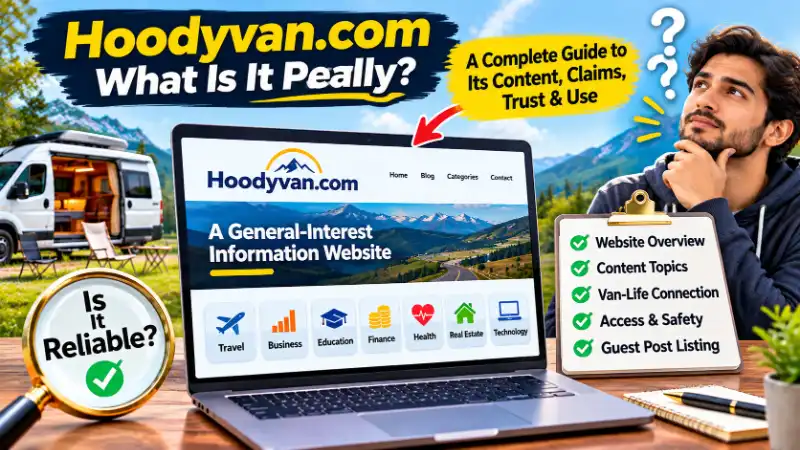
Hoodyvan.com is a domain associated with general-interest online publishing, according to available third-party sources. Its reported subjects include travel, education, business, health, finance, real estate, and technology. However, the website’s current features, publisher, and full content library have not been independently confirmed.
That doesn’t automatically make the domain suspicious. It simply means there is a difference between information found about a website and information verified from the website itself.
Let’s sort through the available clues, clear up the conflicting descriptions, and see what they mean for anyone thinking about visiting, reading, or publishing content on Hoodyvan.com.
FIND YOUR AGE - IN YEARS, MONTHS, DAYS, HOURS & SECONDS!
Why Is Hoodyvan.com Difficult to Identify?
Most websites make their purpose clear right away.
A shopping site usually displays products. A news publisher shows stories. A software company explains its tools.
But identifying Hoodyvan.com through public search results is less straightforward.
There are several descriptions of the domain, and they don’t all point to the same kind of business.
A Baddiehub Magazine article published on October 28, 2026 describes Hoodyvan.com as a website covering different information categories. Meanwhile, a separate article connects the name to camping accessories, and a publishing marketplace advertises a guest-post placement for the domain.
These clues tell us that the name appears in different online contexts.
What they don’t tell us is whether all those descriptions are accurate.
During a research check on November 1, 2026, the official website could not be opened through the research tool. That made it impossible to inspect the current homepage or confirm the services directly.
It’s a bit like finding several descriptions of a store without being able to walk inside.
You may learn what people say the store sells, but you cannot confirm the products on its shelves.
The same distinction applies here.
The strongest available explanation is that Hoodyvan.com has been described as a multi-topic information website. Its exact present-day operation remains unverified.
This is the starting point for understanding everything else associated with the domain.
The Available Clues Point Toward a Multi-Topic Website
One useful clue is the range of subjects linked to Hoodyvan.com.
Rather than appearing connected to only one industry, the domain is described as covering several common areas of interest.
The reported subjects are:
- Travel
- Business
- Education
- Finance
- Health
- Real Estate
- Technology
These topics suggest a broad informational focus.
For instance, someone looking for educational explanations might also be interested in technology. A person researching property may want to understand financial terms. A business owner might read about digital services.
A website that covers multiple categories can serve all these interests.
But there is an important limit to what a category list tells us.
A reported topic is not the same thing as a verified collection of published articles.
Imagine opening a library catalog that lists science, history, and mathematics. That gives you an idea of how the library is organized. It doesn’t tell you how many books are currently available or whether the material is up to date.
Website categories work in a similar way.
A technology label doesn’t prove that the site publishes smartphone reviews. A health label doesn’t confirm that medical professionals write its health content. A travel label doesn’t establish that it provides booking services.
Those details would require access to actual pages.
What Would Make Its Content Useful to Readers?
The number of topics alone doesn’t determine whether an information website is worth reading.
A helpful article needs to answer a real question.
Suppose a reader wants to understand how mortgage interest works. An article that uses a simple example and explains the main terms can be useful.
Another article might mention mortgages many times without explaining how interest affects payments.
Both belong to the same subject category, but they offer very different value.
The same principle applies to the reported Hoodyvan.com categories.
Readers would benefit most from articles that explain unfamiliar ideas, provide supporting evidence, and make difficult subjects easier to understand.
For health, finance, and property topics, accurate sources matter even more. Poor information in these areas can affect important personal decisions.
At present, there is insufficient direct evidence to evaluate the quality or depth of Hoodyvan.com’s current articles.
The category descriptions offer a possible picture of the website, not a confirmed review of its published material.
Where Did the Camper-Van Connection Come From?
The name Hoodyvan may sound like something connected to vans, travel, or outdoor activities.
That impression becomes stronger when you find articles discussing van-life products under the same name.
One example is a TechnoChops article dated May 9, 2026. It associates Hoodyvan.com with vehicle privacy, magnetic window coverings, insulation, and stealth camping.
Those subjects are quite different from a general information website.
To understand the confusion, it helps to separate the product category from the claimed brand identity.
Camper-van accessories are real products. People use window coverings to block light and improve privacy. Insulation materials may also help control heat transfer inside vehicles.
However, knowing how those products work doesn’t tell us who makes or sells them.
For example, an article might explain the benefits of a certain type of camping equipment while mentioning a brand. Unless the article links that claim to an official manufacturer or seller, the relationship remains unconfirmed.
That’s the problem with the Hoodyvan.com association.
The available research does not establish an official storefront, product catalog, or verified manufacturer statement connecting the exact domain with those van accessories.
It would therefore be misleading to present the website as a confirmed van-equipment business.
Why the Exact Website Matters More Than a Similar Name
Names can create false connections.
Consider two businesses with similar names. One might publish travel stories, while another sells outdoor products.
A search engine can display both in results because they share words or branding elements.
That doesn’t mean they have the same owner.
The safest way to distinguish them is to follow the evidence connected to the exact domain.
An official product page, a verifiable company statement, or matching business documentation would be much stronger evidence than an unrelated article.
Without that connection, the van-life description should remain a third-party claim.
At this stage, the camper-van association is an unresolved part of Hoodyvan.com’s online identity, not a confirmed description of what the website sells.
Why Might the Official Website Be Unavailable?
A search result can exist even when you cannot open the website behind it.
That may sound strange, but search engines and website servers do different jobs.
A search engine discovers pages and stores information about them. A web server decides whether to respond to a request for a particular page.
Sometimes a search result remains visible while the website refuses certain requests.
During the November 1, 2026 research, the official Hoodyvan.com address could not be fully accessed through the research tool.
That means the live website’s navigation, current articles, and publishing policies could not be examined directly.
It does not establish that every visitor experiences the same problem.
An Access Error Doesn’t Tell the Whole Story
One response reported during research was 403 Forbidden.
In simple terms, this means a server received a request but did not permit access to the requested resource.
Several things can lead to an access restriction.
A website might block automated tools. It may have security rules that limit certain requests. There could also be a server configuration issue.
The error itself doesn’t tell us which explanation is correct.
Think of a locked classroom door. It tells you that you cannot enter at that moment. It doesn’t explain whether the room is closed for repairs, reserved for another class, or temporarily restricted.
A website access error works in much the same way.
It is also different from a missing-page error or a connection failure.
If you have trouble reaching Hoodyvan.com, confirm the spelling of the address and read the browser’s actual error message.
You can try again later in a normal browser. Avoid installing unknown programs or trying to bypass restrictions just to open a webpage.
Most importantly, an unsuccessful access attempt is not enough to declare a website fraudulent, permanently closed, or safe.
It is one technical observation, not a complete assessment.
What Would Show That the Information Is Dependable?
Suppose the website becomes accessible and you find an article that answers your question.
Should you believe everything it says?
Not automatically.
Even a well-designed website can contain outdated or incorrect information. On the other hand, a small website can publish useful material when its writers explain things carefully and support their claims.
The key is to examine the information itself.
There are several signs that can help you make sense of what you are reading.
A Clear Publisher Makes Accountability Easier
Readers should be able to understand who is responsible for a website’s information.
An About page may explain the publisher’s background. Contact details can provide a way to ask questions or report errors. Author information may show who prepared an article.
None of these details guarantees that every statement is correct.
They do, however, make it easier to identify who is speaking.
Imagine finding a recipe with no author information. That may not be a major concern if you simply want to prepare dinner.
Now imagine finding advice about managing a serious health problem with no author, no medical sources, and no date.
That is a different situation.
The more important the decision, the more important it becomes to know where the advice comes from.
For Hoodyvan.com, the current operator could not be established through direct inspection of the official site.
Public domain-registration services such as ICANN Lookup may provide supporting technical information.
But remember that the registrar, web hosting provider, and website owner are not necessarily the same organization. Registration privacy services can also limit what the public can see.
Ownership should never be guessed from those details alone.
Good Explanations Let You Trace Important Claims
An article becomes easier to trust when readers can understand where its facts came from.
For example, imagine a technology article stating that a particular software update fixes a security problem.
A link to the software developer’s official release notes would help readers confirm the claim.
Without supporting evidence, the statement would be harder to assess.
This doesn’t mean every everyday sentence needs a citation.
It means important claims should have reliable support.
For subjects like personal finance, health, real estate, or regulations, official documentation and qualified sources are especially valuable.
Article dates also deserve attention. A useful explanation written several years ago may no longer reflect current rules or services.
Because Hoodyvan.com’s current article collection was not available for direct inspection, its overall editorial standards cannot fairly be rated.
If you encounter an accessible article, judge that article by the quality of its explanation and evidence.
Don’t treat the domain name itself as proof of expertise.
Visiting a Website Is Different From Sharing Your Information
People often ask whether an unfamiliar website is safe.
But safety depends partly on what you plan to do there.
Reading a public article is not the same as creating an account, sending personal documents, or paying for a service.
Each activity involves different concerns.
If you only want to read general information, the main question may be whether that information is accurate.
If you plan to provide a password or payment information, you also need to understand how the website handles personal data.
This distinction is especially important when the site’s owner and policies have not been confirmed.
A privacy policy should explain what information is collected and how it may be used. Terms of service can help explain the rules of a platform or transaction.
The latest available research does not establish whether Hoodyvan.com requires registration, sells subscriptions, processes payments, or provides a user dashboard.
So those features should not be described as if they exist.
You may also notice that a website uses HTTPS.
HTTPS helps protect information as it travels between your browser and the website. It is useful security technology, but it does not prove that the organization operating the site is trustworthy.
The Federal Trade Commission’s online-shopping guidance also explains that an encrypted website is not automatically legitimate.
For example, a page requesting payment for an unexplained service deserves more attention than a page simply showing a public article.
You should understand what you are paying for, who receives the payment, and what terms apply.
There is no verified basis here for calling Hoodyvan.com a scam. There is also not enough direct evidence to give it an unconditional safety endorsement.
The reasonable approach is to match your level of caution to the action you intend to take.
A Guest-Post Advertisement Adds Another Piece to the Picture
The domain appears somewhere else online that may surprise ordinary readers.
Adoovy’s publishing catalog includes an entry for hoodyvan.com.
The listing places the domain in Finance, Health, and Technology categories and advertises a guest-post publication price of $90, based on the listing reviewed on November 1, 2026.
It also displays third-party search marketing metrics.
Why does this matter?
Because a guest-post listing suggests that someone is offering publication space connected to the domain.
Guest posting means preparing an article for another website. It may be used for expert commentary, brand awareness, or reaching a different audience.
But an advertised opportunity is not the same as a confirmed agreement with the website owner.
What a Listed Price Does—and Doesn’t—Prove
Imagine finding a concert ticket advertised by an outside seller.
The advertisement tells you the seller is offering a ticket. It doesn’t, by itself, prove that the ticket is valid or that the seller is authorized.
A third-party guest-post listing raises a similar question.
The Adoovy listing shows that a marketplace is advertising publication on Hoodyvan.com.
It does not independently verify the arrangement with the domain operator.
Nor does it establish how many people read the website.
The displayed SEO measurements should be treated as third-party estimates rather than a promise of real visitors or future ranking benefits.
A publishing customer would need to confirm several details before paying.
First, can the provider actually arrange publication on the domain?
Second, does the website carry content relevant to the intended audience?
Third, what editorial standards and payment terms apply?
Finally, how will any commercial links be handled?
That last question is especially important for search optimization.
Google Search Central recommends the rel="sponsored" attribute for advertising and paid placements. The nofollow attribute is also an acceptable way to identify such links.
Google’s rules do not prohibit ordinary paid advertising. The concern is using paid links to manipulate search rankings without the appropriate link qualification.
For a business considering a guest post, paying for a placement should never be confused with buying a guaranteed Google ranking.
The marketplace listing is evidence of an advertised publishing opportunity. It is not proof of official authorization, editorial quality, or search performance.
For readers who simply want information about the website, this detail provides context but doesn’t establish whether any particular article is accurate.
The Evidence Tells Us More About the Claims Than the Website Itself
After examining the different sources, a pattern becomes clear.
There is some information about Hoodyvan.com, but much of it comes from outside websites rather than from a directly inspected official homepage.
This is an important difference.
Here is how the main findings fit together:
| Available information | What it means |
|---|---|
| Third-party descriptions mention seven broad subjects | The domain is reported to have a general-interest information focus |
| A separate article connects the name to van accessories | A competing interpretation exists, but the official product connection is unverified |
| The domain appears in Adoovy’s catalog | A marketplace advertises a publishing placement associated with the domain |
| The official site could not be fully opened during research | Current pages, features, and operating details could not be examined directly |
| No confirmed operator information was established | Ownership and editorial accountability remain unresolved |
These findings are useful, but they should not be stretched into stronger claims than the evidence supports.
For instance, it would be inaccurate to say that Hoodyvan.com has a large audience simply because a marketplace displays traffic-related numbers.
It would also be unfair to label the domain dangerous because a research tool couldn’t open it.
And it would be misleading to call the website an established camper-van brand without first-party support.
What we know is that Hoodyvan.com has an online presence in third-party descriptions and publishing advertisements. What we cannot yet confirm is the full identity and current operation behind those descriptions.
That is a more useful answer than a confident-sounding description based on guesses.
Where Does That Leave Someone Searching for Hoodyvan.com?
If your goal was simply to understand the name, the clearest available answer is that Hoodyvan.com has been described as a broad-topic information website. Its reported subjects range from travel and education to technology, finance, and health.
There is also a third-party guest-post advertisement for the domain, while another online article associates the name with van-life products.
Those different descriptions explain why search results may seem inconsistent.
What remains missing is strong, direct evidence from the website itself about its current pages, publisher, and services.
So the next step depends on why you were searching.
If you want to read an article, focus on whether its claims are well explained and supported. If you are considering a business arrangement, confirm the provider’s authority and the agreement before paying. If you encounter a form requesting sensitive details, understand its purpose before submitting anything.
Hoodyvan.com is not a website that can be fully judged from the available search descriptions alone. The responsible approach is to separate observed facts from outside claims and make decisions based on the information you can actually confirm.
That gives you a clearer answer without treating uncertainty as either proof of wrongdoing or a reason for blind trust.
BMI & BMR CALCULATOR - CHECK YOUR HEALTH