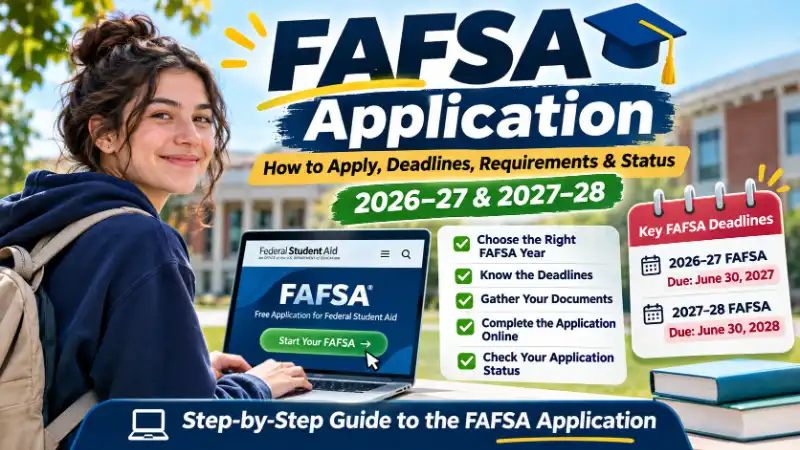
Applying for college financial aid can feel confusing, especially when different FAFSA forms and requirements appear at once. Choosing the wrong school year or leaving a contributor section unfinished can delay your application. This guide explains which form to use, what information to prepare, and how to check your status so you can submit the free application and respond to any next steps.
Quick answer: The 2026–27 and 2027–28 FAFSA applications are available. Apply free through the official FAFSA application, choose the year that matches your enrollment, complete your section, invite required contributors, and confirm submission. Check federal, state, and college deadlines before you begin.
FAFSA stands for Free Application for Federal Student Aid. It is the form students use to apply for federal financial aid for college, career school, or trade school. The U.S. Department of Education uses your information to help determine your eligibility for grants, work-study programs, and federal student loans.
FIND YOUR AGE - IN YEARS, MONTHS, DAYS, HOURS & SECONDS!
Which FAFSA Application Should You Fill Out for 2026 or 2027?
One of the easiest FAFSA mistakes is choosing the wrong school year. You might search for the “FAFSA application 2026” without realizing that two different forms can be available during the same calendar year. The right form depends on when you plan to attend college, not simply when you submit your application.
| FAFSA form | Typical enrollment covered | What to do |
|---|---|---|
| 2025–26 | The previous award year | New federal applications are closed |
| 2026–27 | Fall 2026 and spring 2027 | Select this form for the matching enrollment year |
| 2027–28 | Fall 2027 and spring 2028 | Select this form for the matching enrollment year |
Choose the award year first, then check its federal, state, and college deadlines. Summer enrollment may require confirmation from your school.
2026–27 FAFSA Application for Fall 2026 and Spring 2027
If you started college in fall 2026 or plan to attend during spring 2027, the 2026–27 FAFSA application is generally the correct form. For example, imagine you began your first semester in fall 2026 and want financial aid for spring 2027. You would use the 2026–27 form rather than the 2027–28 form.
The 2026–27 form remains available for students who still need to apply for that academic year. However, some college and state priority deadlines have already passed. Check with your school’s financial aid office before assuming every type of aid is still available.
2027–28 FAFSA Application for Fall 2027 and Spring 2028
Planning to begin college in fall 2027? You should complete the 2027–28 FAFSA application. The U.S. Department of Education has opened this form to the public.
That means the FAFSA application for 2027 is already available. You do not need to wait until 2027 to start. Use it for attendance in the 2027–28 award year.
If you are applying to several colleges for fall 2027, you can submit FAFSA before receiving your admission decisions. What about summer classes? Summer sessions can fall under different financial aid years depending on the school. Ask your college which FAFSA form it requires.
Can You Still Complete the 2025–26 FAFSA Application?
If you searched for the “FAFSA application 2025” or “2025 to 2026 FAFSA application,” you may be looking for an older form. Its federal submission deadline has passed, so you cannot submit a new 2025–26 FAFSA for federal aid. If you already submitted that form, review your existing records through your StudentAid.gov account. Ask your school’s financial aid office about any unresolved issue rather than starting a newer form to fix an older award year.
FAFSA Application Deadlines: When Does It Open and Close?
Missing a FAFSA deadline can affect the amount of financial help available to you. The confusing part is that FAFSA does not have just one deadline. There are three dates to watch: the federal deadline, your state deadline, and your college’s financial aid deadline.
When Did the 2026–27 and 2027–28 FAFSA Forms Open?
Both forms have opened to the public. If you’re wondering, “Is the FAFSA application open?” you can begin either available form through your StudentAid.gov account.
| FAFSA school year | Availability | Choose it for |
|---|---|---|
| 2026–27 | Available | Enrollment in that award year |
| 2027–28 | Available | Enrollment in the following award year |
The form for an upcoming school year can open before that school year begins. You do not need to wait until your first semester, but you must choose the correct form.
Federal FAFSA Deadlines for 2026–27 and 2027–28
Check the Federal Student Aid deadline checker for the exact federal and state deadlines for your selected award year. Check each college’s financial aid page separately for its own deadline. A complete and correct application must also reach your college by the applicable enrollment deadline. A later federal closing deadline does not mean you can wait until after leaving school and still receive aid for that enrollment.
| Deadline type | What it affects | Your next step |
|---|---|---|
| Federal | Whether you can submit that year’s FAFSA for federal aid | Select the award year in the official checker |
| State | Eligibility or priority for state programs | Check your state of legal residence and any separate forms |
| College | Institutional aid and priority consideration | Check every school you list and contact its aid office |
Don’t treat the federal deadline as your ideal submission target. Some types of financial aid have limited funding, and applying late could mean missing money available to earlier applicants.
FAFSA Application Deadline for Fall 2026
If you enrolled in fall 2026, your application belongs to the 2026–27 academic year. Check the federal deadline for the 2026–27 award year and your school’s enrollment requirements. Your college’s fall 2026 priority deadline may already have passed. If you have finished attending that school, ask its aid office whether any eligibility remains before relying on the federal submission window.
Here’s what you should do:
- Check your school’s financial aid website.
- Look for its 2026–27 FAFSA priority deadline.
- Contact the financial aid office if you missed that date.
- Submit your FAFSA as soon as possible if you’re still within the federal deadline.
Even if you missed an earlier school deadline, you may still qualify for certain federal aid programs.
What Happens if You Miss a College or State Deadline?
Missing a priority deadline does not automatically make you ineligible for all federal financial aid. For example, you might miss a state scholarship deadline but still meet the federal FAFSA deadline. The problem is that some state grants, college scholarships, and campus-based aid may no longer be available.
Your next step should be to contact the college financial aid office and ask which funding options remain open. Remember: The best FAFSA deadline is usually the earliest one that applies to you, not the last federal submission date.
Who Can Apply for FAFSA, and What Aid Can You Receive?
Some students skip FAFSA because they think their parents earn too much money or they won’t qualify for aid. That’s not a good reason to ignore the application. Students from different financial backgrounds may qualify for different kinds of assistance. FAFSA can also help schools determine eligibility for their own financial aid programs.
Basic FAFSA Application Requirements
Basic federal student aid eligibility generally involves several factors. You usually need to:
- Be a U.S. citizen or eligible noncitizen.
- Have a high school diploma, GED, or another recognized qualification, or meet an approved alternative.
- Be enrolled or accepted for enrollment in an eligible degree or certificate program.
- Meet applicable satisfactory academic progress standards.
- Complete any required FAFSA information and identity checks.
Other program-specific rules may apply. Your citizenship or eligible noncitizen status matters for federal aid eligibility. A parent who does not have a Social Security number can still create a StudentAid.gov account and participate as a FAFSA contributor when required. Your parent’s citizenship status does not by itself determine your federal student aid eligibility.
Do not assume that every student can apply without an SSN. Student rules differ from contributor rules, with specific exceptions for students from the Freely Associated States. Follow the form’s instructions for your situation.
If you’re unsure about your eligibility, check the official Federal Student Aid requirements or speak with your school’s financial aid office.
Can You Apply if Your Family Income Is High?
Yes. There is no single family-income cutoff that prevents every student from completing FAFSA. Your financial situation may affect which types of aid you qualify for, but the FAFSA also helps determine eligibility for programs that are not based entirely on financial need.
For example, one student may qualify for a Federal Pell Grant, while another may be offered federal student loans. Some colleges also use FAFSA information when reviewing institutional financial aid. So even if your family has a higher income, completing the form can still be worthwhile.
Grants, Work-Study, and Federal Student Loans
FAFSA helps determine eligibility for several types of financial assistance.
| Aid type | What it means | Must you repay it? |
|---|---|---|
| Federal Pell Grant | Grant aid for eligible students | Usually no; repayment can apply in specific circumstances |
| Federal Work-Study | Money earned through eligible part-time employment | No; you earn wages for work performed |
| Federal Direct Loans | Money borrowed for education expenses | Yes, according to the loan terms |
| State or college grants | Assistance under the provider’s eligibility rules | Usually no; check the award conditions |
A Federal Pell Grant is not the same as a loan. Federal Work-Study does not mean money automatically appears in your account or that a job is guaranteed. You generally need to obtain an eligible job and earn the money through work.
Federal Direct Loans must be repaid according to their terms. Also, submitting FAFSA does not mean you have accepted a student loan. You can review your financial aid offer before deciding which aid to accept.
What Do You Need Before Starting Your FAFSA Application?
You don’t want to get halfway through the FAFSA application and realize you cannot finish because an account or important record is missing. You may not need every document listed below, but gathering the information that applies to you is a good starting point.
Create Your StudentAid.gov Account and FSA ID
Before completing FAFSA online, you need a StudentAid.gov account. The account credentials are commonly called your FSA ID. They let you access your federal student aid information and electronically sign your FAFSA form.
Visit StudentAid.gov to create an account. Have your full legal name, birth details, email address, contact information, and the identity information required for your account ready. Students generally need an SSN; a parent or spouse contributor can create an account without one.
Make sure your personal details match your official records. If you already created an account for a previous FAFSA application, use that same account. You don’t need a new FSA ID for each school year.
Never share your password with another person, even if that person is helping you complete the form.
Documents and Tax Information for 2026–27 and 2027–28
The FAFSA application uses financial information from a specific tax year.
| FAFSA form | Tax information used |
|---|---|
| 2026–27 | 2024 tax information |
| 2027–28 | 2025 tax information |
For example, if you are completing the 2027–28 FAFSA, you generally use financial information from your 2025 federal tax return—not your 2026 return. Your FAFSA preparation checklist may include:
- StudentAid.gov login information.
- Required parent or spouse contributor information.
- Relevant federal income tax records.
- Checking and savings account information.
- Records of investments or other reportable assets.
- Child support received, if applicable.
- Names of colleges or career schools you’re considering.
The FAFSA may ask for current asset values rather than values from the tax year. Your primary home and retirement accounts are not reported as investments. The forms also exclude qualifying small family businesses, farms where the family resides, and qualifying commercial fishing businesses; read the exact instructions before including business or farm values.
Some applicants can skip asset questions based on their answers. If questions appear, report the requested assets using the form’s definitions rather than reporting everything your family owns. If the phrase itself is unfamiliar, our net worth meaning guide explains the basic concept. For FAFSA, use only the assets and associated debts the form specifically instructs you to report.
Most federal tax information is transferred from the Internal Revenue Service (IRS) through the FUTURE Act Direct Data Exchange after the required consent and approval are provided. You may still need your tax documents to answer additional questions. If you did not file a tax return, don’t make up income figures. Answer the questions based on your actual situation.
When Does a Parent or Spouse Need to Participate?
FAFSA sometimes requires more than one person to complete the form. A FAFSA contributor is anyone required to provide information on the form, including the student and, when applicable, a parent or spouse. Each required person must complete the applicable questions, consent, and signature steps.
Contributors may include your parent, stepparent, or spouse. Whether a parent is required depends on your FAFSA dependency status. A dependent student generally must include the required parent information. An independent student usually reports their own information and, if married, may need information from their spouse.
FAFSA dependency rules are not the same as whether your parents claim you on their taxes. Also, adding a parent as a contributor does not automatically make that parent responsible for paying your college costs.
If your parents are divorced or separated and do not live together, generally report the parent who provided more financial support during the past 12 months, not automatically the parent you lived with. If support was equal, or neither parent supported you, the parent with greater income and assets is generally used. A remarried parent’s spouse may also need to be included.
Use the “Who’s My FAFSA Parent?” tool available through the official FAFSA guidance if your household situation is unclear. Parents living together, including unmarried legal parents, can have different reporting requirements. If you cannot provide parent information because of an unusual family situation, such as abuse or abandonment, use the relevant FAFSA instructions and contact the college financial aid office.
If parents simply refuse to provide information, that does not automatically make you independent. The parent-refusal route may allow consideration for a Direct Unsubsidized Loan only, after follow-up with your school; it can exclude you from Pell Grants and most other federal aid. Unusual circumstances such as abuse or abandonment are a separate situation. Answer those questions accurately and work with the aid office on any required review.
How to Complete the FAFSA Application Online, Step by Step
The FAFSA application process is manageable when you follow the form in order. Use the official application at StudentAid.gov; creating an account and submitting the federal form are free. The official student step-by-step instructions provide help with individual questions and the parent-selection tool. Page labels can change, so follow the prompts displayed in your selected form.
Step 1: Log In and Select the Correct FAFSA Form
Open the official FAFSA website. Choose Start New Form, then select the school year that matches when you plan to attend college. Sign in using your StudentAid.gov account username and password.
If you’re completing your own application, choose the student option. A parent may also start a form for a dependent student using the parent option. Before moving forward, double-check the academic year displayed on the screen.
Starting the wrong FAFSA form can create unnecessary work later.
Step 2: Verify Your Identity and Approve IRS Tax Data
The FAFSA will display personal information connected to your StudentAid.gov account. Review your name, birth date, address, and other details. If something is incorrect, update it through the appropriate account settings.
Next, you will be asked to provide consent and approval for the transfer of required federal tax information. This process connects FAFSA with IRS information through the FUTURE Act Direct Data Exchange. Required contributors must also give their own consent and approval, even if they did not file a tax return.
Without the required consent and approval, you cannot receive the usual full federal aid determination. A dependent student whose parents refuse to participate should ask the school about the separate Direct Unsubsidized Loan-only process described above.
Step 3: Answer Background and Financial Questions
The FAFSA asks questions about your personal circumstances and financial situation. Depending on your answers, these may cover:
- High school completion.
- Marital status.
- Dependency status.
- Family circumstances.
- Tax filing information.
- Certain government benefits.
- Savings, checking accounts, and other reportable assets.
Read the questions carefully. For example, FAFSA may ask about your current savings balance. That is not necessarily the same amount you had when you filed your tax return.
If a question does not apply to your situation, follow the instructions provided by the form. Use estimates only where the question expressly allows them. Do not replace the required tax year’s information with a guess about current income.
Step 4: Add Colleges and Career Schools
Next, select the schools that should receive your FAFSA information. You can add up to 20 schools at a time to the online FAFSA application. You must list at least one school to submit it.
Use the built-in school search or the college’s Federal School Code to find the correct institution. You can include community colleges, universities, and eligible career or trade schools. For example, if you are considering three colleges but haven’t decided which one to attend, add all three.
You do not need an admission offer before listing a school. After your FAFSA is processed, the schools you selected can access your financial aid information. If you change your mind, you can update your school list later.
Step 5: Invite Required Contributors
If FAFSA determines that a parent or spouse must contribute information, the form will guide you through sending an invitation. The contributor invitation includes a personalized link or code. You can send it by email; the 2027–28 form also supports sharing a customized invitation by text message.
Contributors should follow that invitation or use the “Accept an Invitation” option on the official FAFSA page, then sign in with their own account. They should not complete your student section by logging in as you.
They may need to answer financial questions, approve the tax-information transfer, and provide an electronic signature. Finishing your student section does not always mean the entire FAFSA has been submitted. If a required contributor hasn’t completed their section, your application may remain incomplete. Submitting without required parent information under a special pathway also does not guarantee full aid eligibility.
Make sure everyone who must participate has finished.
Step 6: Review, Sign, and Submit the FAFSA Form
Before submitting, review the information you entered. Check your name, school year, financial answers, and college list. Also confirm that all required contributors have signed their sections.
If an identity-verification prompt appears, follow the official instructions before assuming the form is finished. Some students need additional identity confirmation or follow-up with their school. Once the necessary information and signatures are complete, submit the FAFSA form.
Depending on processing, you may see a submission confirmation or information indicating that your FAFSA results are ready. Save your confirmation details. You should also receive an email or be able to review information through your StudentAid.gov account.
Don’t close the process without confirming that the form was successfully submitted. If a required section remains unfinished, follow the instructions shown in your account.
How Long Does FAFSA Take, and How Do You Check Its Status?
Completing a FAFSA and waiting for it to process are two different things. Finishing your section, completing contributor sections, processing the form, and receiving a college’s aid offer are separate stages.
How Long Does It Take to Complete a FAFSA Application?
Many students can finish their own FAFSA section in approximately 12 minutes or less, according to Federal Student Aid. However, the total time can vary. You may need longer if you are creating an account, gathering financial records, or waiting for a parent or spouse to complete their section.
There is no single completion time for every family. Having your records ready helps, but contributor participation and account or identity issues can add time.
How Long Does FAFSA Processing Take After Submission?
Most completed online FAFSA applications are processed immediately, according to Federal Student Aid. Some applications may take one to three days. Processing time can depend on the information provided and whether the application needs additional review.
If the form requires a correction or missing signature, the process may take longer. Paper applications may take longer than online forms. Processing does not mean a college has awarded or paid out your financial aid.
Once your FAFSA is processed, you can review your FAFSA Submission Summary.
How to Check Your FAFSA Application Status Online
You don’t need to submit a new form just because you’re unsure whether the first one went through. To check your FAFSA application status:
- Visit StudentAid.gov.
- Log in using your StudentAid.gov account.
- Open your Dashboard.
- Find the My Activity section.
- Select the relevant FAFSA application.
- Review the status and any action items.
Your account should show whether the form is still being completed, has been submitted, or has finished processing. If a parent or spouse is required, check their contributor status too.
What Do Draft, In Progress, Action Required, and Processed Mean?
You may see different messages while checking your FAFSA.
| FAFSA status | Meaning | What you should do |
|---|---|---|
| Draft | You started but have not completed your required sections | Continue the form |
| In Progress | Your required sections are complete, but the form has not been submitted | Check remaining submission and contributor steps |
| Action Required | An error or missing item needs attention | Follow the listed correction instructions |
| In Review | The form was submitted but has not been processed | Monitor your account |
| Processed | The form was processed successfully | Review your Submission Summary and school requests |
| Closed | The form was not submitted before the deadline | Ask your school what options remain |
If your FAFSA says Action Required, don’t ignore it. A missing signature, missing consent, or another error could prevent your form from being processed correctly.
What Happens After FAFSA Is Processed?
Once the application is processed, follow the official post-submission guidance to access your FAFSA Submission Summary and review required next steps. This document provides information about your FAFSA responses, estimated aid eligibility, and possible next steps. It may include your Student Aid Index (SAI).
The SAI is a number used in determining financial aid eligibility. It is not your college bill or the amount your family must pay. Your summary may also show estimated Federal Pell Grant eligibility and whether additional verification is required.
Some students are selected for financial aid verification, which means their college may request documents to confirm information. Your selected colleges use FAFSA data when preparing their financial aid decisions. Keep in mind that your FAFSA Submission Summary is not your final financial aid offer.
The college’s financial aid office provides the actual aid offer, which may include grants, scholarships, work-study opportunities, and federal loans. Check each school’s student portal as well as your email. A school may need documents or a separate application, such as the CSS Profile or an institutional form. FAFSA does not replace every state or institutional aid application.
An aid offer is also different from disbursement: accepting an offer does not mean the money has reached your student account. Review each school’s offer and its remaining requirements before making decisions about how to pay for college.
FAFSA Application PDF: Can You Apply on Paper Instead?
Not every student wants to complete the FAFSA online. Some prefer a paper form because of limited internet access or other difficulties. The federal government provides a FAFSA PDF option for applicants who cannot complete the form online.
Where to Download the Official FAFSA PDF
Visit the Federal Student Aid Resources page to find the official FAFSA PDF for your award year. Choose the PDF for the correct academic year. Follow the instructions included with that year’s form, including how and where to submit it.
Make sure you use an official government source rather than an outdated copy from an unfamiliar website. The form is free, whether you complete it online or on paper.
Online FAFSA vs. Paper Application
| Feature | Online FAFSA | FAFSA PDF |
|---|---|---|
| Cost | Free | Free |
| How to complete | Through StudentAid.gov | Fill the official PDF and follow its instructions |
| Submission | Electronic | Mail as instructed; filling a PDF does not submit it |
| School selection | Up to 20 schools at a time | Up to 10 schools initially |
| Processing | Generally faster | May take longer |
| Corrections | Available online for permitted changes | Follow the instructions for your processed record |
For most students, the online FAFSA application is the easier choice. It guides you through the questions, connects your account information, and provides access to application status updates. But if you cannot use the online system, the official PDF is a valid option.
FAFSA Application Problems: How to Fix Mistakes or Cancel a Form
Maybe your parent cannot access the invitation. Perhaps you entered the wrong school. Or you started a FAFSA form and now want to cancel it.
The solution depends on whether your application is still a draft or has already been submitted.
What if You Cannot Log In or Access Your FAFSA?
Start by checking that you’re using the correct StudentAid.gov account. If you forgot your password or username, use the account recovery options on the official website. Also make sure your browser is accessing the official site and that your account information is correct.
If you’re still having trouble, open Help Center from the official StudentAid.gov site. Your school’s aid office or a free FAFSA completion event may also help you work through questions. If a technical problem affects a deadline, contact your school promptly and keep a record of the error. Do not create another account just because you cannot remember your existing login.
What if a Parent Has Not Completed Their Section?
This is a common reason an application stays incomplete. A parent or other required contributor may have received an invitation but not finished their questions or signature. Ask them to log in using their own StudentAid.gov account.
They should check for the FAFSA invitation, accept it using the provided instructions, and finish their required section. If the invitation does not appear, check that the correct contact information was used. For some invitation or identity problems, information in the contributor’s account must match the information connected to the invitation.
If the problem continues, contact Federal Student Aid support.
How to Correct a FAFSA After Submission
You may be able to correct certain mistakes after your FAFSA has been processed. For example, you might need to update contact information, correct a typo, add another school, or provide a missing signature. To begin:
- Log in to StudentAid.gov.
- Open your processed FAFSA from My Activity.
- View your FAFSA Submission Summary.
- Find the Make a Correction option.
- Update the information the system allows you to change.
- Review and submit the correction.
Not every financial detail can be changed directly online. If your family’s financial situation changed significantly, contact the financial aid office at the college you plan to attend. The school may be able to review special circumstances through a process sometimes called professional judgment.
How to Cancel or Delete a FAFSA Application
If you’re searching for “how to cancel FAFSA application,” first check the application’s status. An unsubmitted FAFSA in Draft or In Progress status may offer a delete option through its form-management menu. Confirm the award year and status before deleting anything.
A submitted or processed FAFSA is different. You cannot simply delete a submitted application in the same way you delete a draft. If the problem is incorrect information, use the correction process when available.
If you no longer plan to attend a school or need to change where your FAFSA information goes, contact the school or update your school list as appropriate. Here is a quick way to handle common problems.
| Problem | Best next step |
|---|---|
| Wrong award year, not submitted | Confirm the correct year; remove the wrong draft if appropriate |
| Forgotten login | Use official account recovery |
| Missing contributor invitation | Check the email or shared code and the contributor account |
| Missing signature | Complete the required signature |
| Wrong college listed | Update the school list through a correction |
| Family income changed | Ask the school’s aid office about special circumstances |
| Action Required | Follow the specific instructions shown |
| Identity verification requested | Complete the official verification steps and school follow-up |
Avoid starting multiple forms for the same award year without understanding what happened to your first application.
FAFSA Application FAQs
Can You Submit FAFSA Before Applying to College?
Yes. You can submit FAFSA before completing your college admission applications or receiving acceptance letters. Add the colleges you’re considering to your FAFSA form, even if you haven’t decided where you’ll attend.
Each listed school can receive your FAFSA information after processing. This is useful because waiting for an admission decision could cause you to miss an earlier financial aid deadline.
Do You Need to Complete FAFSA Every Year?
Yes, if you want to be considered for federal student aid in another academic year, you generally need to submit a new FAFSA for that year. For example, submitting the 2026–27 form does not automatically replace the need for a 2027–28 application. Returning students may find that some information is already filled in, but they still need to review and submit the new form.
What if Your Family’s Income Changed After the Tax Year?
FAFSA uses tax information from a specific earlier year. But your family’s current situation might look very different. For example, a parent may have lost a job, experienced a major income reduction, or faced unusually high medical expenses.
Complete the FAFSA using the required tax-year information. Then contact your college’s financial aid office and explain what changed. The school may review your circumstances and determine whether an adjustment is appropriate.
Does Submitting FAFSA Guarantee Financial Aid?
No. Completing the FAFSA does not guarantee that you will receive a grant, scholarship, work-study position, or student loan. It allows federal aid programs and participating schools to review your financial aid eligibility.
Your actual offer depends on factors such as eligibility rules, enrollment, school costs, and available funding. Once you receive your financial aid offer, compare the types of aid carefully. Remember that grants and scholarships generally do not need to be repaid, while student loans do. You can also apply separately for scholarships through their official providers; filing FAFSA is not an application for every private scholarship.
Ready to Apply? Make Sure You Choose the Right FAFSA Year
Start by choosing the school year that matches your college plans. The 2026–27 form generally covers fall 2026 and spring 2027, while the 2027–28 form covers the following academic year. Ask your school which form it needs for summer enrollment.
Before applying, check your deadlines, prepare your financial information, and make sure every required contributor has a StudentAid.gov account. Then complete the free application, review your answers, and confirm that the form has been submitted. Afterward, keep an eye on your FAFSA application status and respond to any requests from your school.
Check both your FAFSA record and your college portal so you can respond to the next required action.
BMI & BMR CALCULATOR - CHECK YOUR HEALTH