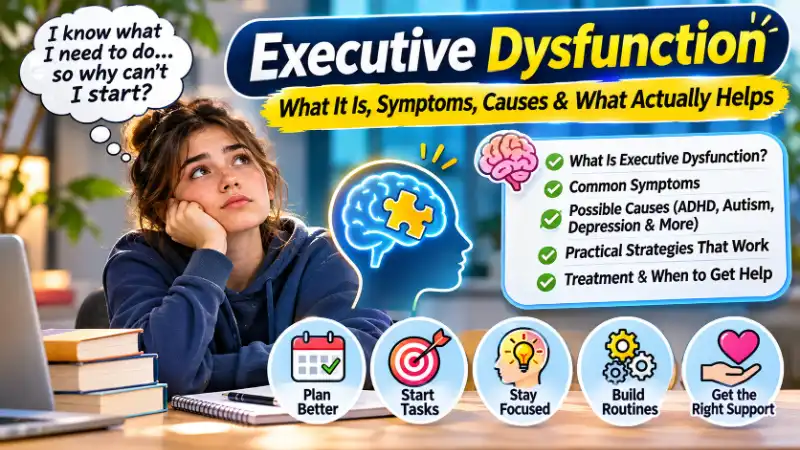
Executive dysfunction means having trouble using the mental skills that help you plan, start, organize, and finish everyday tasks.
You might know exactly what you need to do but still struggle to begin. A simple assignment may feel too big. You may forget appointments, lose track of time, or jump between tasks without finishing them.
These difficulties can happen with ADHD, autism, depression, and other conditions. They can also appear without an ADHD diagnosis.
The good news is that there are ways to make daily tasks more manageable. The right approach depends on what is causing the difficulty.
Do you keep putting off tasks even when you want to finish them? Maybe your room needs cleaning, homework is piling up, or a five-minute job feels impossible to start. You might also wonder whether you’re experiencing ADHD paralysis, depression, or something else.
If this sounds familiar, this guide will help you understand what may be happening, recognize common symptoms, try practical strategies, and know when professional support may help.
FIND YOUR AGE - IN YEARS, MONTHS, DAYS, HOURS & SECONDS!
What Is Executive Dysfunction, and Why Does Getting Things Done Feel So Hard?
Executive dysfunction happens when the mental skills that help you manage thoughts, actions, and emotions aren’t working as smoothly as you need them to.
These skills are called executive functions.
They help you decide what matters, remember instructions, control distractions, and move toward a goal.
For example, imagine you need to complete a school project.
You have to understand the assignment, collect materials, make a plan, begin working, manage your time, and check your work.
Executive functioning helps you handle all those steps.
When these skills become difficult to use, even a familiar task can feel confusing or overwhelming.
Executive dysfunction is not a separate formal medical diagnosis. It describes difficulties that may occur with different health or developmental conditions.
Which Brain Skills Help You Start, Plan, and Finish Tasks?
Three important executive function skills are working memory, cognitive flexibility, and inhibitory control.
Working memory helps you hold information in mind while using it.
For example, you rely on working memory when following directions, remembering what someone just said, or completing a task with several steps.
Cognitive flexibility helps you change plans or switch between activities.
You use it when an unexpected problem appears and you need to try another approach.
Inhibitory control helps you manage impulses and distractions.
It allows you to focus on your assignment instead of responding to every notification.
These skills work together with planning, time management, emotional regulation, and task initiation.
The brain’s prefrontal cortex and connected networks play important roles in executive control.
When these systems aren’t functioning effectively, knowing what to do and actually doing it can become very different experiences.
Could Your Daily Struggles Be Executive Dysfunction Symptoms?
Executive dysfunction symptoms can look different from person to person.
Some people struggle most with starting tasks. Others have trouble remembering instructions, organizing their time, or changing activities.
The key is noticing patterns rather than judging yourself based on one difficult day.
What Does Executive Dysfunction Feel Like in Everyday Life?
People often describe feeling stuck, overwhelmed, distracted, or unable to organize their thoughts.
Here are common examples.
| Executive Function Difficulty | Everyday Example |
|---|---|
| Task initiation | You sit down to work but cannot get started |
| Working memory | You forget what you were doing after an interruption |
| Planning | You have a big project but don’t know which step comes first |
| Time management | You underestimate how long homework or chores will take |
| Organization | You repeatedly misplace important items |
| Task switching | You struggle to stop one activity and begin another |
| Attention control | Small noises or notifications interrupt your work |
| Emotional regulation | A minor change feels unusually frustrating or overwhelming |
| Self-monitoring | You lose track of your progress or miss mistakes |
You don’t need to experience every symptom.
For example, someone may remember information well but struggle with starting tasks. Another person may begin easily but have trouble finishing.
These difficulties can affect school, work, relationships, household responsibilities, and personal routines.
When Is It More Than Ordinary Procrastination?
Almost everyone delays tasks sometimes.
You might postpone cleaning because you’d rather watch a movie. That alone doesn’t mean you have executive dysfunction.
The concern becomes greater when difficulties are frequent, persistent, and interfere with everyday life.
For example, you may repeatedly miss important deadlines even after making serious efforts to stay organized.
Or you may feel unable to begin an important task despite wanting to complete it.
Procrastination and executive dysfunction can overlap, but they aren’t identical.
Procrastination can have many causes, including boredom, fear of failure, stress, and difficulty managing attention.
Executive dysfunction involves difficulties with the mental processes needed to carry out actions.
If the pattern is affecting your education, job, relationships, or basic responsibilities, a healthcare professional can help identify possible causes.
What Causes Executive Dysfunction—and Can It Happen Without ADHD?
Yes, you can experience executive dysfunction without having ADHD.
ADHD is strongly associated with executive functioning difficulties, but it isn’t the only possible explanation.
Different conditions can affect attention, planning, memory, and self-control in different ways.
How Are ADHD, Autism, Depression, and Anxiety Connected?
ADHD and executive dysfunction
People with attention-deficit/hyperactivity disorder (ADHD) often experience difficulties with working memory, task initiation, organization, time management, and impulse control.
For example, a student with ADHD may understand an assignment but struggle to begin it, remember the required steps, or manage the deadline.
However, executive dysfunction alone doesn’t prove someone has ADHD.
Autism and executive dysfunction
Some autistic people experience difficulties with planning, shifting attention, adapting to unexpected changes, or moving between activities.
These challenges vary widely. Not every autistic person experiences the same executive function difficulties.
Depression and executive dysfunction
Depression can affect concentration, motivation, mental energy, memory, and decision-making.
Someone experiencing depression may struggle to complete tasks that previously felt manageable.
Anxiety and executive dysfunction
Anxiety can interfere with attention, working memory, and decision-making.
For example, worrying about making a mistake may make it harder to begin an assignment.
These conditions can overlap, so symptoms alone cannot identify the underlying cause.
Can Stress, Poor Sleep, or Medical Conditions Affect Executive Function?
Yes.
Long-term stress, insufficient sleep, and certain medications may affect attention, memory, and mental performance.
Executive functioning difficulties may also occur with neurological conditions, traumatic brain injuries, and illnesses affecting the brain.
For example, someone recovering from a concussion may have trouble concentrating or remembering information.
If your difficulties are new, think about when they started.
Ask yourself:
- Have I been sleeping poorly?
- Did the problem begin after an illness or injury?
- Have my stress levels changed?
- Did symptoms appear after starting or changing a medication?
- Are my difficulties getting worse?
These questions won’t diagnose the cause, but they can help you explain the problem to a clinician.
Important: Sudden confusion, trouble speaking, facial drooping, one-sided weakness, or sudden loss of balance may be signs of a medical emergency such as a stroke. Call 911 immediately in the United States.
Don’t treat sudden neurological symptoms as ordinary executive dysfunction.
Stuck on a Task Right Now? Try These Executive Dysfunction Strategies
If you’re struggling to start something right now, you don’t need to solve your entire schedule first.
Start by making the next action smaller and easier to identify.
There is no single technique that fixes executive dysfunction for everyone, but external reminders, simpler steps, and reduced distractions may help.
How to Start When Your Brain Feels Stuck
Try this five-step approach.
Step 1: Choose one task.
Instead of thinking about everything you need to finish, select just one thing.
For example, choose “start my science assignment” rather than “finish all my homework.”
Step 2: Find the smallest possible action.
Break that task into something you can see and do.
Instead of “write an essay,” your first action might be “open the document.”
Instead of “clean my room,” it could be “put three items in the laundry basket.”
Step 3: Prepare what you need.
Place your notebook, laptop, supplies, or cleaning materials nearby.
This reduces the number of extra decisions required before starting.
Step 4: Try a short work period.
Set a timer for a manageable amount of time, perhaps two to five minutes.
The goal is to begin, not to force yourself to finish everything immediately.
If timers make you more anxious, skip the timer and focus on completing one small step.
Step 5: Decide on the next action.
When you finish the first step, choose another small action.
If you’re too tired or overwhelmed to continue, take a break and return when you can.
These strategies aren’t a cure. They’re ways to reduce the mental effort involved in getting started.
What If You Keep Forgetting, Switching Tasks, or Losing Focus?
Different problems may need different tools.
| Your Difficulty | Strategy to Try |
|---|---|
| Forgetting tasks | Write them in one notebook or task app |
| Missing appointments | Use calendar alerts |
| Getting distracted | Put your phone away or silence notifications |
| Losing your place | Use a short checklist |
| Switching tasks too often | Finish one defined step before changing activities |
| Feeling overwhelmed | Reduce the task to one clear action |
| Forgetting instructions | Ask for written directions |
| Struggling to begin alone | Try working beside a supportive person |
Working beside another person is sometimes called body doubling.
For example, you may find it easier to begin homework while a friend quietly works on their own assignment nearby.
The other person doesn’t need to do the task for you. Their presence may help provide structure and accountability.
Try one or two strategies first. You can adjust them based on what actually helps.
How Can You Manage Executive Dysfunction at School, Work, or Home?
Managing executive dysfunction isn’t only about getting through one difficult task.
It’s also about creating systems that reduce the number of things you have to remember, plan, and organize every day.
How to Build a Routine That Uses Less Mental Effort
Start with one reliable place to record important tasks.
This might be a paper planner, phone calendar, or simple task-management app.
Then create a routine around it.
Each morning:
Check your schedule and choose the most important tasks for the day.
During the day:
Write down new responsibilities instead of trying to remember everything.
In the evening:
Review unfinished tasks and prepare what you need for tomorrow.
You can also create fixed places for important belongings.
For example, keeping your keys, wallet, and school bag in the same location reduces the need to search for them every morning.
Visual schedules, recurring reminders, and written routines can help make planning more predictable.
Start small. A complicated organization system may become another task that’s difficult to maintain.
What Support Can Help When You Cannot Manage Everything Alone?
Sometimes personal strategies aren’t enough.
You may benefit from help at school, work, or home.
For students, useful support might include written instructions, clear assignment milestones, or help organizing longer projects.
At work, you might request written task priorities, clear deadlines, or a quieter work environment.
A trusted friend, family member, counselor, or coach may also help with planning and accountability.
For example, instead of asking someone to remind you about everything, you could request a short weekly planning session.
Formal school or workplace accommodations depend on individual needs and applicable eligibility requirements.
The goal is to find support that makes daily responsibilities more manageable without taking away your independence.
Is There an Executive Dysfunction Test, and How Do You Get Evaluated?
If you recognize several symptoms, you may wonder whether an online executive dysfunction test can tell you what’s happening.
Online checklists may help you describe your difficulties, but they cannot confirm a diagnosis by themselves.
Executive dysfunction is a description of problems with executive skills, not a standalone formal disorder diagnosed using one universal test.
Can an Online Executive Dysfunction Test Diagnose You?
No.
An online questionnaire may ask whether you struggle with planning, attention, memory, organization, or task completion.
Your answers may help identify areas where you experience difficulties.
However, similar symptoms can occur with ADHD, depression, anxiety, sleep problems, and medical conditions.
A quiz cannot reliably determine which explanation applies to you.
It also cannot replace a professional assessment.
Treat an online test as a starting point for discussion, not proof that you have a specific condition.
What Happens During a Professional Evaluation?
A healthcare professional will usually begin by asking about your symptoms and medical history.
They may want to know:
- When the difficulties started
- How often they happen
- Whether they affect school, work, or home
- Whether you have attention, mood, or sleep problems
- Whether you’ve experienced a head injury
- Which medications you take
- Whether you’ve had similar difficulties since childhood
Depending on the situation, the clinician may recommend psychological testing, ADHD assessment, or neuropsychological evaluation.
These assessments may examine attention, working memory, planning, cognitive flexibility, and other thinking skills.
Not everyone needs extensive testing.
Before your appointment, write down three or four real examples of difficulties you’ve experienced. Include how long they have been happening and how they affect your life.
This can help the professional understand your concerns and decide what evaluation is appropriate.
What Treatments Can Help Executive Dysfunction?
Executive dysfunction can improve in some situations, but treatment depends on what’s causing it.
There isn’t one medication or therapy designed to fix every type of executive functioning difficulty.
A healthcare professional can help determine whether treatment should focus on ADHD, depression, anxiety, sleep problems, a neurological condition, or another cause.
Can Therapy, Medication, or Coaching Improve Executive Function?
Several approaches may help, depending on individual needs.
Cognitive behavioral therapy (CBT)
CBT is a form of psychological therapy that can help people identify unhelpful thinking patterns and develop practical coping strategies.
When appropriate, it may also support planning, problem-solving, and managing difficult emotions.
Medication
If executive functioning difficulties are related to ADHD, a clinician may recommend ADHD medication.
Medication may help certain symptoms, but it isn’t suitable or necessary for everyone.
Other conditions may require different treatments.
Never start, stop, or change prescribed medication without guidance from your healthcare professional.
Occupational therapy or rehabilitation
For some people, occupational therapy or cognitive rehabilitation can help develop ways to manage everyday activities.
This may be particularly relevant when difficulties follow an injury or neurological condition.
Executive function coaching
Coaching may provide practical support with routines, organization, goal-setting, and accountability.
It can be helpful for some people, but it doesn’t replace appropriate medical or psychological care.
Treatment of underlying conditions
If poor sleep, depression, anxiety, or another health problem is contributing to executive dysfunction, addressing that condition may improve daily functioning.
The best plan depends on the cause and the person’s needs.
When Should You Ask a Healthcare Professional for Help?
Consider an evaluation if executive functioning difficulties regularly interfere with your daily life.
For example:
- You repeatedly miss important responsibilities.
- School or work performance is suffering.
- Everyday planning feels increasingly difficult.
- Memory or attention problems are getting worse.
- Your symptoms are causing significant distress.
- Your difficulties started after an injury or illness.
You can begin with a primary care clinician, mental health professional, or another relevant specialist.
If symptoms are sudden or include stroke warning signs, seek emergency medical care rather than waiting for an appointment.
Is Executive Dysfunction the Same as ADHD Paralysis or a Disability?
Executive dysfunction, ADHD paralysis, and disability are related terms in some conversations, but they don’t mean the same thing.
Understanding the difference helps you describe your experiences more clearly.
ADHD Paralysis vs. Executive Dysfunction—What’s the Difference?
ADHD paralysis is an informal term people use to describe feeling stuck, overwhelmed, or unable to begin an activity.
It is not a separate formal medical diagnosis.
Executive dysfunction is a broader term describing difficulties with executive function skills.
| Executive Dysfunction | ADHD Paralysis |
|---|---|
| Broad difficulty with planning, memory, inhibition, or task management | Informal description of feeling unable to act or decide |
| Can occur with ADHD and other conditions | Usually discussed in relation to ADHD |
| May affect many parts of daily functioning | Often describes a specific stuck or overwhelmed experience |
| Not a standalone formal diagnosis | Not a standalone formal diagnosis |
A person experiencing ADHD paralysis may also have executive functioning difficulties.
However, the two terms shouldn’t be treated as identical.
Can Executive Dysfunction Qualify as a Disability?
In the United States, executive dysfunction alone does not automatically establish legal disability status.
However, a person with a qualifying underlying condition and significant functional limitations may be eligible for protections or accommodations.
For example, a student with ADHD may qualify for support under applicable education laws.
An employee with a qualifying disability may be able to request reasonable workplace accommodations under the Americans with Disabilities Act (ADA).
Eligibility depends on individual circumstances and applicable legal standards.
If you need support, speak with your school’s disability services office, an appropriate healthcare professional, or your employer’s accommodation contact.
Frequently Asked Questions About Executive Dysfunction
Can Executive Function Skills Improve Over Time?
Yes, some executive functioning difficulties can become easier to manage with appropriate treatment, practical strategies, supportive environments, and time.
Improvement depends on the underlying cause and individual circumstances.
For example, treating ADHD or improving a persistent sleep problem may help certain executive function difficulties.
However, there is no guaranteed timeline or universal cure.
How Can I Help Someone With Executive Dysfunction?
Start by asking what kind of help they would find useful.
You might offer written instructions, help break a large task into smaller steps, or work quietly beside them.
Avoid assuming that repeated reminders or pressure will solve the problem.
Clear communication, patience, and practical support can make daily responsibilities easier to manage.
Is Executive Dysfunction Different in Children and Adults?
The same basic executive function skills support people at different ages, but the difficulties may appear in different situations.
Children may struggle with homework, school supplies, classroom instructions, or changing activities.
Adults may have trouble managing bills, appointments, work projects, household responsibilities, or competing deadlines.
Support should match the person’s age, responsibilities, and specific difficulties.
Final Thoughts: What Should You Do Next?
Executive dysfunction can make planning, starting, remembering, and finishing tasks harder than expected.
It may be associated with ADHD, depression, autism, stress, sleep difficulties, or other conditions. Understanding the cause matters because different people need different types of support.
If you’re struggling today, choose one task and make the first step smaller. Use a reminder, checklist, or supportive routine if it helps.
If the difficulties keep interfering with your daily life, consider a professional evaluation.
You don’t have to solve everything at once. Start with one manageable action, learn what helps, and seek support when you need it.
BMI & BMR CALCULATOR - CHECK YOUR HEALTH