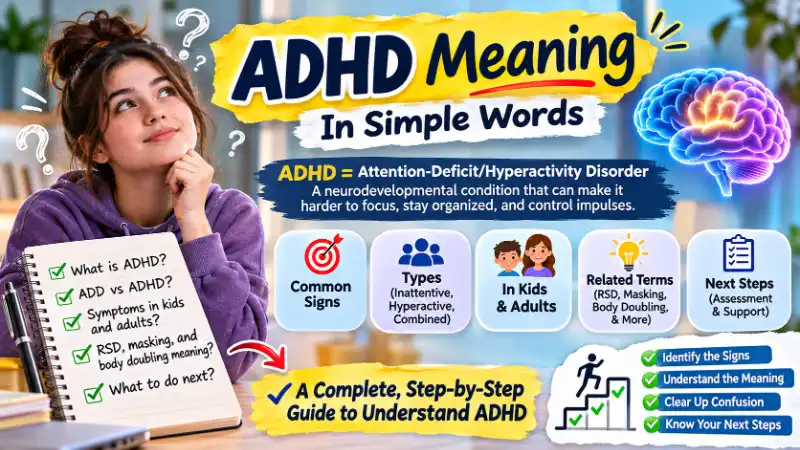
ADHD stands for Attention-Deficit/Hyperactivity Disorder. It is a neurodevelopmental disorder that affects how a person manages attention, activity, and impulses. In simple words, ADHD can make it harder to stay focused, organize tasks, sit still, or think before acting.
ADHD can affect both children and adults. Some people seem very active, while others struggle quietly with forgetfulness, distractions, or unfinished tasks.
But having trouble concentrating sometimes doesn’t automatically mean you have ADHD.
Are you wondering whether your difficulty focusing could be ADHD? Maybe your child keeps forgetting instructions, or you’ve heard terms like ADD, RSD, masking, and body doubling but don’t understand what they mean. You might also be wondering whether ADHD is a mental disorder or simply a behavior problem.
If these questions sound familiar, you’re in the right place. This guide explains ADHD in everyday language, helps you understand its signs, clears up confusing terms, and shows you what to do if you think you or your child may need an evaluation.
FIND YOUR AGE - IN YEARS, MONTHS, DAYS, HOURS & SECONDS!
What Does ADHD Mean in Simple Words, and Is It a Disorder?
ADHD is a recognized neurodevelopmental disorder. That means it involves differences in brain development and functioning that can affect attention, self-control, and behavior.
It isn’t simply a bad habit or a lack of effort.
To understand the medical meaning of ADHD, start with its three main features.
| ADHD Feature | Simple Meaning | Everyday Example |
|---|---|---|
| Inattention | Difficulty staying focused or organized | Forgetting instructions or losing important items |
| Hyperactivity | Excessive movement or inner restlessness | Constant fidgeting or feeling unable to relax |
| Impulsivity | Acting before fully thinking about the result | Interrupting others or making rushed decisions |
Not everyone with ADHD experiences all three features equally.
For example, one person may struggle with attention but rarely appear physically restless. Another may have difficulty controlling movement and impulsive behavior.
That’s why ADHD looks different from person to person.
What Does ADHD Look Like in Everyday Life?
Imagine a student who wants to finish homework but keeps getting distracted. They may understand the lesson yet struggle to begin, organize, or complete the assignment.
Now imagine an adult who plans their day carefully but repeatedly forgets appointments, loses track of time, or leaves important projects unfinished.
These difficulties can occur with ADHD, particularly when they are frequent and interfere with daily life.
ADHD can affect executive functions, which include skills such as planning, organizing, managing time, and controlling responses.
The important point: ADHD doesn’t mean someone is unintelligent, lazy, or unwilling to try. It means certain everyday tasks may require different strategies or additional support.
However, one example alone cannot establish an ADHD diagnosis.
How Can You Tell If ADHD Symptoms Are More Than Normal Distraction?
Everyone forgets things, gets distracted, or feels restless sometimes.
The difference is that ADHD involves an ongoing pattern of symptoms that can interfere with school, work, relationships, or other daily activities.
For example, forgetting your keys once isn’t strong evidence of ADHD.
But repeatedly losing important items, missing deadlines, and struggling to organize everyday responsibilities may deserve closer attention.
Healthcare professionals consider several factors when evaluating ADHD:
- Symptoms have continued for at least six months.
- Several symptoms were present before age 12.
- Difficulties appear in two or more settings, such as home, school, or work.
- Symptoms interfere with everyday functioning.
- Another condition doesn’t better explain the difficulties.
These are parts of a wider clinical assessment, not a checklist for diagnosing yourself.
Sleep problems, anxiety, depression, stress, and learning difficulties can also affect concentration.
What Does ADHD Look Like in Children?
If you’re a parent, you may wonder whether your child’s behavior is typical for their age or a possible sign of ADHD.
A child with ADHD may frequently:
- Forget homework or classroom instructions.
- Lose school supplies, books, or personal belongings.
- Have difficulty finishing tasks.
- Fidget or move around when expected to sit.
- Interrupt conversations or struggle to wait their turn.
- Make careless mistakes despite understanding the work.
For example, a child might start cleaning their room, notice a toy, begin playing, and forget the original task.
That alone doesn’t prove ADHD. The concern becomes stronger when similar difficulties happen repeatedly and affect learning, friendships, or home life.
What should parents do?
Start by observing when the behavior happens. Ask teachers whether they notice similar difficulties at school. Write down specific examples and discuss them with your child’s pediatrician.
This helps a professional understand the full picture instead of relying on one behavior.
What Does ADHD Look Like in Adults?
ADHD doesn’t always disappear after childhood.
Some adults were never diagnosed as children because their symptoms were overlooked, misunderstood, or less noticeable.
Adult ADHD may involve:
- Chronic procrastination and unfinished projects.
- Poor time management.
- Frequently missing appointments or deadlines.
- Difficulty organizing bills, paperwork, or responsibilities.
- Restlessness during meetings or quiet activities.
- Interrupting others or making impulsive decisions.
- Trouble switching between tasks.
For example, you may know that an important project is due tomorrow but feel unable to start until the last moment.
This difficulty may involve task initiation and executive functioning, not necessarily a lack of motivation.
If these challenges regularly affect your job, education, or relationships, a professional ADHD evaluation may help identify the cause.
Is ADD the Same as ADHD, and What Do the Three ADHD Types Mean?
If someone says they have ADD while another person says ADHD, you might think they’re describing two different disorders.
ADD is an older term. ADHD is the current medical name.
Today, clinicians use ADHD to describe the condition, even when a person doesn’t show obvious hyperactivity.
Why Is ADD Now Called ADHD?
ADD stands for Attention Deficit Disorder.
The term was used in older diagnostic systems. It is no longer a separate official ADHD diagnosis.
People sometimes still use ADD when referring to attention difficulties without noticeable hyperactivity.
For example, someone who frequently daydreams, forgets details, and struggles to organize tasks may have predominantly inattentive ADHD.
So, if you hear someone say “ADD versus ADHD,” remember that the difference usually comes from older terminology rather than two separate modern diagnoses.
What Do Inattentive, Hyperactive-Impulsive, and Combined ADHD Mean?
Healthcare professionals recognize three ADHD presentations.
| ADHD Presentation | Main Difficulties | Simple Example |
|---|---|---|
| Predominantly Inattentive | Attention, memory, and organization | Frequently losing track of assignments |
| Predominantly Hyperactive-Impulsive | Restlessness and impulse control | Interrupting others or struggling to remain seated |
| Combined | Significant symptoms from both groups | Being easily distracted while also frequently restless and impulsive |
What does combined ADHD mean?
It means the person meets the diagnostic criteria for both inattentive and hyperactive-impulsive symptoms.
What does inattentive ADHD mean?
It means difficulties with attention and organization are the main pattern, even if obvious hyperactivity is limited.
These presentations aren’t separate diseases. A person’s presentation can also change over time as symptoms develop or become more noticeable.
What Do RSD, Masking, and Other Common ADHD Terms Actually Mean?
If you’ve been reading about ADHD online, you’ve probably come across words that sound medical but aren’t always part of an official diagnosis.
Understanding these terms can help you describe experiences more clearly without confusing them with ADHD’s diagnostic symptoms.
What Do RSD, Masking, and Hyperfixation Mean in ADHD?
RSD — Rejection Sensitive Dysphoria
RSD describes intense emotional distress connected to feeling rejected, criticized, or excluded.
For example, someone might feel deeply upset after receiving mild criticism about their work.
RSD is widely discussed in ADHD communities, but it is not an officially recognized standalone diagnosis or an ADHD diagnostic criterion.
If rejection-related feelings are overwhelming or interfere with relationships, a mental health professional can help explore what is happening.
Masking in ADHD
ADHD masking means hiding, controlling, or compensating for behaviors that might reveal attention or self-regulation difficulties.
For example, a student may work very hard to appear organized while privately struggling to manage assignments.
Masking can sometimes make a person’s difficulties less visible to others. However, masking isn’t unique to ADHD.
Hyperfixation
Hyperfixation is a commonly used term for becoming intensely absorbed in an activity, topic, or interest.
Someone might spend hours researching a favorite game while struggling to begin a less interesting task.
It is not an official ADHD diagnostic symptom, and intense interests can occur in people without ADHD.
Overstimulation
Feeling overstimulated means becoming overwhelmed by too much sensory or mental input.
For example, bright lights, overlapping conversations, and background noise may make it difficult to concentrate.
Overstimulation can happen for many reasons and isn’t enough to identify ADHD.
What Do Body Doubling, Stimming, and Vocal Stims Mean?
Body doubling in ADHD
Body doubling is a productivity strategy in which another person works or stays nearby while you complete a task.
For example, two students might sit together in a library and work quietly on separate assignments.
The other person’s presence may provide structure and make it easier to get started or stay on task.
To try body doubling:
- Choose one task you want to finish.
- Ask a friend to work alongside you, in person or online.
- Agree on a short work period, such as 20 minutes.
- Check your progress at the end.
The other person doesn’t need to complete your task or constantly remind you what to do.
Body doubling helps some people, but research on its specific effectiveness is still limited.
Stimming in ADHD
Stimming means self-stimulatory behavior, such as repeating movements or sounds.
Examples include tapping fingers, rocking, or repeatedly playing with an object.
Some people use repetitive behaviors to manage emotions, sensory input, or restlessness.
Stimming occurs in people with and without ADHD.
Vocal stims
Vocal stimming involves repeated sounds, words, or vocal patterns.
For example, someone may hum or repeat a sound because it feels regulating or comforting.
It should not automatically be treated as evidence of ADHD.
How Are AuDHD, PDA, and Neurodivergence Related to ADHD?
These terms often appear in discussions about ADHD, but they have different meanings.
| Term | Meaning | What You Should Know |
|---|---|---|
| AuDHD | Community term for having both autism and ADHD | Not a separate official diagnosis |
| Neurodivergent | Broad term for people whose brain functioning differs from typical expectations | Not a specific medical diagnosis |
| PDA | In some autism discussions, pathological demand avoidance or persistent drive for autonomy | Not an official ADHD presentation |
| On the spectrum | Usually refers to the autism spectrum | Doesn’t automatically mean ADHD |
| Limerence | Intense romantic infatuation or preoccupation | Not a recognized ADHD symptom |
ADHD and autism are different neurodevelopmental conditions, although someone can have both.
You may also see people connect limerence with ADHD-related emotional experiences. That doesn’t mean ADHD causes limerence or that it belongs to the diagnostic criteria.
A useful rule: If you recognize yourself in one of these terms, use it to start a conversation or explore an experience—not to confirm a diagnosis.
What Causes ADHD, and Can Someone Develop It as an Adult?
If you or your child has attention difficulties, you might wonder whether too much screen time, poor parenting, or bad habits caused them.
ADHD doesn’t have one confirmed cause.
Researchers have found that genetics plays an important role. Brain development and several environmental or biological risk factors may also contribute.
ADHD is not simply caused by laziness, poor discipline, or someone choosing not to pay attention.
Can ADHD Start in Adulthood?
ADHD is considered a childhood-onset condition.
Under current diagnostic standards, several symptoms must have been present before age 12.
However, someone can receive their first ADHD diagnosis as an adult.
For example, a person may have managed their difficulties throughout childhood but struggled more when college, work, or family responsibilities increased.
This doesn’t necessarily mean ADHD suddenly began in adulthood.
It may mean earlier symptoms weren’t recognized or became harder to manage.
If attention problems first appear suddenly in adulthood, a healthcare professional should also consider sleep difficulties, stress, mood disorders, medications, and other possible explanations.
What Should You Do If You Think You or Your Child May Have ADHD?
Recognizing possible ADHD symptoms can leave you with an important question: “What should I do now?”
You don’t need to diagnose yourself or your child before asking for help.
Instead, follow these steps.
Step 1 — Notice When and Where the Difficulties Happen
Start by writing down specific examples of the problems you’re experiencing.
Focus on:
- What happens?
- How often does it happen?
- When did you first notice it?
- Where does it happen?
- How does it affect everyday life?
For example, instead of writing “I can’t focus,” write:
“I’ve missed three work deadlines this month because I repeatedly lost track of tasks and couldn’t organize my schedule.”
For a child, you might record:
“My child frequently forgets homework instructions, and their teacher has noticed similar difficulties during class.”
These observations can make a medical appointment more useful.
You can keep a simple record for a week or two, but don’t delay seeking help if the difficulties are serious.
Step 2 — Talk With a Qualified Healthcare Professional
If the difficulties are persistent or interfere with daily life, arrange an appointment.
For children, start with a pediatrician or qualified mental health professional.
For adults, a primary care clinician, psychiatrist, psychologist, or another appropriately trained professional may help with an evaluation or referral.
Explain the symptoms you’ve noticed and how they affect everyday activities.
You may also come across the ASRS, which stands for Adult ADHD Self-Report Scale.
The ASRS is a screening questionnaire designed to identify symptoms that may deserve further evaluation.
It is not a stand-alone ADHD diagnostic test.
Online quizzes can help you organize your concerns, but they cannot confirm whether you have ADHD.
Step 3 — Understand the Evaluation and Support Options
An ADHD evaluation usually involves more than answering a few questions.
A healthcare professional may:
- Ask about current symptoms and daily difficulties.
- Review childhood behavior and developmental history.
- Use ADHD rating scales or questionnaires.
- Gather information from parents, teachers, or other people when appropriate.
- Check whether another condition could explain or contribute to the symptoms.
There is no single blood test, brain scan, or online questionnaire that diagnoses ADHD on its own.
If ADHD is diagnosed, support may include behavioral therapy, skills training, school or workplace accommodations, and medication when appropriate.
For younger children, parent training in behavior management is especially important. Treatment recommendations vary with age and individual needs.
The next step isn’t to find a label as quickly as possible. It’s to understand what’s causing the difficulties and choose support that fits.
What Can Help With ADHD Challenges While You Seek Support?
You don’t have to wait for a diagnosis to try simple, low-risk ways to make everyday tasks easier.
These approaches may help with organization and attention, whether your difficulties come from ADHD or another cause.
1. Make large tasks smaller.
Instead of writing “finish my science project,” break it into smaller actions:
Choose the topic, find two sources, write the outline, and complete one section.
Starting with a specific step can feel easier than facing an entire project at once.
2. Use visible reminders.
Keep important tasks where you can see them.
A wall calendar, phone reminder, or short daily checklist can help reduce the need to remember everything mentally.
Try keeping your list short enough to use.
3. Create a simple starting routine.
Choose one task, clear unnecessary distractions, and work for a manageable period.
For example, put your phone away and spend 15 minutes reviewing your notes.
You can adjust the time depending on what works for you.
4. Try body doubling.
Ask a friend or study partner to work quietly alongside you.
You can share your goal at the beginning and briefly report your progress afterward.
5. Protect sleep and regular breaks.
Poor sleep can make attention and emotional control harder for anyone.
A consistent sleep schedule and realistic rest breaks may help you manage daily demands.
These strategies aren’t a cure, and they don’t replace professional care when symptoms significantly affect your life.
But they can give you a practical place to start.
What Should You Remember About ADHD Before Labeling Yourself or Someone Else?
After learning about ADHD, it’s easy to start connecting every distraction, restless moment, or intense emotion to the condition.
But ADHD isn’t identified through one behavior or an online trend.
Remember these points:
- ADHD is a recognized neurodevelopmental disorder.
- It can affect children and adults in different ways.
- A person doesn’t need obvious hyperactivity to have ADHD.
- ADD is an older term, not a separate current diagnosis.
- RSD, masking, hyperfixation, and body doubling are not official ADHD presentations.
- Persistent symptoms that interfere with daily life deserve proper evaluation.
- Effective treatment and practical support are available.
If you’re unsure whether your experiences fit ADHD, you don’t have to figure it out alone. A qualified professional can help you understand the full picture.
Frequently Asked Questions About ADHD Meaning
What Is ADHD Called in Spanish?
ADHD is commonly called TDAH in Spanish. It stands for trastorno por déficit de atención e hiperactividad.
The meaning is the same: a condition involving ongoing difficulties with attention, hyperactivity, and impulsivity.
What Is the Meaning of ADHD in Tagalog?
In Tagalog or Filipino, the abbreviation ADHD is commonly retained.
A simple explanation is:
“Ang ADHD ay isang kondisyon na maaaring makaapekto sa atensyon, pagkilos, at pagkontrol sa biglaang mga desisyon.”
In English, this means ADHD is a condition that may affect attention, activity, and impulse control.
Is ADHD the Same as Autism?
No. ADHD and autism are different neurodevelopmental conditions.
ADHD primarily involves patterns of inattention and/or hyperactivity-impulsivity. Autism involves differences in social communication and interaction, along with restricted or repetitive patterns of behavior or interests.
Some people have both conditions. The informal term AuDHD is sometimes used to describe this combination.
What Does Passive Suicidal Ideation Mean, and Is It an ADHD Symptom?
Passive suicidal ideation means having thoughts about death or wishing you were not alive, without necessarily having a specific plan to end your life.
For example, someone may wish they could disappear or not wake up.
Passive suicidal ideation is not an ADHD diagnostic criterion. Such thoughts can occur alongside depression, other mental health conditions, or serious emotional distress.
They should always be taken seriously, even when there is no specific plan.
If you’re experiencing these thoughts, tell a trusted person and contact a mental health professional. In the United States, you can call or text 988 for confidential crisis support. If there is immediate danger, call 911 or seek emergency medical care.
Final Thoughts: What ADHD Means and What to Do Next
ADHD means Attention-Deficit/Hyperactivity Disorder. It affects attention, activity, and impulse control, but it doesn’t look the same in every person.
Understanding its meaning is the first step. The next is recognizing whether ongoing symptoms are interfering with daily life.
If you’re concerned about yourself or your child, document the difficulties and speak with a qualified healthcare professional. You don’t need to rely on online labels or guesswork.
ADHD can create real challenges, but with the right understanding, strategies, and support, people with ADHD can build ways to manage everyday life.
Medical Sources and Further Reading
- CDC — Symptoms of ADHD
- CDC — Diagnosing ADHD
- CDC — ADHD in Adults
- National Institute of Mental Health — ADHD: What You Need to Know
- Cleveland Clinic — Rejection Sensitive Dysphoria
- 988 Suicide & Crisis Lifeline
BMI & BMR CALCULATOR - CHECK YOUR HEALTH