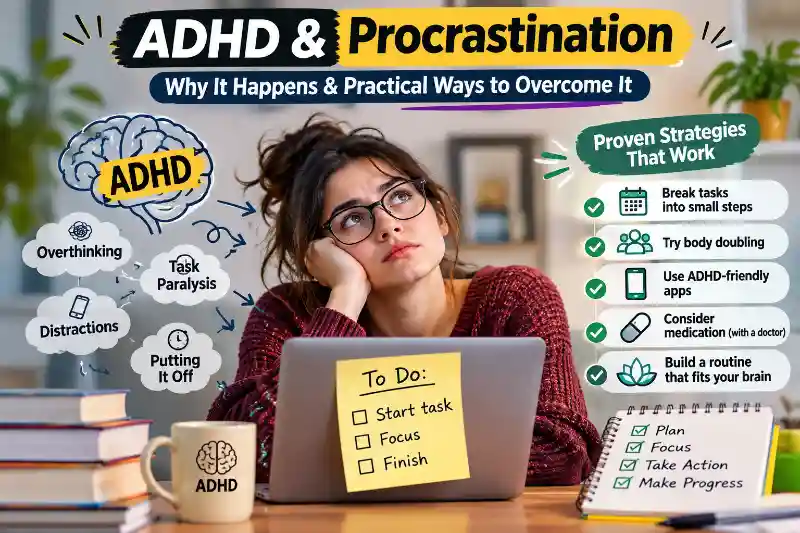
You sit down to finish an important assignment. Your laptop is open, your notes are ready, and you know the deadline is getting closer.
But somehow, you still can’t start.
You check your phone, rearrange your desk, or decide to do something easier first. Before you know it, another hour is gone.
Sound familiar?
For people with ADHD, this can happen even when they really want to get things done. The problem isn’t always a lack of effort. Sometimes, the brain has trouble organizing tasks, managing attention, or taking that first step.
ADHD procrastination happens when difficulties with attention, planning, emotional regulation, or starting tasks make it harder to get things done. It can affect schoolwork, jobs, household chores, and everyday responsibilities. Small changes, such as breaking tasks into steps, using timers, and getting support, may help.
Let’s look at why it happens, how to recognize it, and what you can do when your to-do list feels impossible.
FIND YOUR AGE - IN YEARS, MONTHS, DAYS, HOURS & SECONDS!
What Is ADHD Procrastination?
ADHD procrastination means putting off tasks in ways that may be connected to attention-deficit/hyperactivity disorder (ADHD).
ADHD is a condition that affects attention, organization, activity levels, and impulse control. It can also make it difficult to plan, start, and finish certain tasks.
Imagine you need to write a two-page report.
You know what the report is about. You have enough time to finish it. You may even care about getting a good grade.
Still, starting feels strangely difficult.
You might open several browser tabs, look for the perfect information, or spend too much time choosing a title.
The problem isn’t necessarily that you don’t care about the report. You may be struggling with task initiation, which means getting yourself started on an activity.
This is one reason ADHD-related procrastination can feel so frustrating.
You want to do something, but doing it doesn’t feel as simple as deciding to begin.
It’s also important to understand that ADHD procrastination isn’t a separate medical diagnosis. It’s a common way of describing procrastination that may be linked to ADHD-related difficulties.
Is Procrastination a Sign of ADHD?
Yes, frequent procrastination can be associated with ADHD, but procrastination alone doesn’t mean someone has ADHD.
Almost everyone puts things off sometimes.
You might delay cleaning your room because you’re tired. Another person might postpone a difficult conversation because they’re nervous.
Those experiences don’t automatically suggest ADHD.
The difference becomes more important when procrastination happens repeatedly alongside other difficulties with attention, organization, and everyday responsibilities.
When Procrastination May Be Related to ADHD
ADHD-related procrastination may happen alongside behaviors such as:
- Having trouble starting tasks that require mental effort.
- Forgetting assignments, appointments, or deadlines.
- Getting distracted while working.
- Starting several activities without finishing them.
- Struggling to organize everyday responsibilities.
- Underestimating how much time tasks will take.
- Finding it difficult to follow multi-step instructions.
For example, a college student might repeatedly forget assignments, lose track of study materials, and struggle to finish projects even when trying hard to stay organized.
An adult might face similar problems with emails, bills, meetings, and work deadlines.
According to the National Institute of Mental Health (NIMH), disorganization, procrastination, and poor time management can occur in adults with ADHD.
However, ADHD diagnosis requires a broader evaluation. Clinicians look at symptoms that began in childhood, continued over time, occurred in more than one setting, and interfered with daily functioning.
When Procrastination May Have Other Causes
Not every case of chronic procrastination is related to ADHD.
Other possible reasons include:
- Anxiety: You keep delaying a task because you’re worried about making mistakes.
- Depression: Low energy, difficulty concentrating, or loss of interest makes everyday activities harder.
- Poor sleep: You’re too tired to think clearly or stay focused.
- Perfectionism: You feel unable to start unless you can do everything perfectly.
- Stress: Too many responsibilities make it difficult to decide what comes first.
Sometimes, several of these problems happen together.
If you’re wondering whether severe or chronic procrastination is a sign of ADHD, look at the bigger picture rather than one habit.
A healthcare professional can help you understand what’s causing the problem.
Why Does ADHD Cause Procrastination?
ADHD can contribute to procrastination through difficulties with executive functioning, attention regulation, motivation, and emotions.
These problems don’t affect everyone with ADHD in the same way.
A 2026 systematic review published in Research in Developmental Disabilities examined 11 studies involving 2,788 people. It found a consistent association between ADHD symptoms and procrastination, especially symptoms involving inattention.
The researchers also noted that the studies couldn’t establish a clear cause-and-effect relationship.
Still, several processes may help explain why putting off tasks is common among people with ADHD.
Executive Dysfunction Makes Starting Tasks Hard
Executive functions are mental skills that help you plan, organize, remember instructions, and control your actions.
Think of them as the skills that help turn a plan into something you actually do.
When these skills are difficult to use, even a simple task can feel complicated.
For example, answering an email may involve several steps:
- Open your inbox.
- Find the correct message.
- Read what the person needs.
- Decide what to say.
- Write the response.
- Check it and press send.
Someone who struggles with executive dysfunction may feel overwhelmed before completing the first step.
This doesn’t mean the task is impossible.
It means the process of organizing and starting it may require extra support.
Time Blindness Makes Deadlines Feel Far Away
Have you ever thought a task would take ten minutes, only to spend an hour doing it?
Or told yourself you had plenty of time until suddenly the deadline was tomorrow?
People often call this experience time blindness.
It’s an informal term for difficulty noticing, estimating, or managing the passage of time.
For someone with ADHD, a deadline next week may not feel urgent enough to act on today.
Then, when the deadline gets close, the pressure becomes hard to ignore.
This can create a pattern of waiting until the last minute.
Visual timers, calendar reminders, and smaller deadlines can help make time easier to track.
Motivation and Reward Processing Affect Boring Tasks
Some tasks are naturally more interesting than others.
Watching a favorite show might feel easy. Filling out a long form might feel exhausting.
ADHD can affect how people respond to motivation and rewards.
The brain uses several systems to manage attention, effort, and the expectation of rewards. Dopamine is one chemical involved in these processes.
But ADHD is more complicated than simply having too little dopamine.
For some people, tasks with immediate rewards feel easier to engage with than tasks where the reward comes much later.
That’s one reason checking social media may feel easier than working on a project due next month.
Adding small rewards or visible progress can sometimes make less interesting tasks easier to approach.
Overwhelm, Fear of Failure, and Perfectionism Lead to Avoidance
Procrastination isn’t always about attention.
Sometimes, it’s about how a task makes you feel.
Imagine you have an important presentation tomorrow.
You worry that it won’t be good enough. You don’t know where to start, and every possible idea seems wrong.
Instead of beginning, you avoid the presentation.
For a little while, you feel better because you aren’t facing the stressful task.
But the work is still there.
That temporary relief may make avoidance more likely the next time.
This can happen with or without ADHD. When ADHD-related planning difficulties are also present, the task may feel even harder to manage.
ADHD Procrastination vs. Regular Procrastination: What’s the Difference?
Everyone procrastinates sometimes, including people who don’t have ADHD.
The difference often involves the pattern, the reasons behind it, and how much it affects daily life.
| Feature | Regular Procrastination | ADHD-Related Procrastination |
|---|---|---|
| Frequency | May happen occasionally or often | May be frequent and persistent |
| Common reasons | Stress, boredom, fear, or task avoidance | May also involve attention and executive function difficulties |
| Starting tasks | Can be difficult | Task initiation may be especially difficult |
| Time management | May cause occasional missed deadlines | May involve ongoing problems estimating time and meeting deadlines |
| Daily life | Impact varies | May occur alongside difficulties at work, school, and home |
| Diagnosis | Doesn’t prove ADHD | Doesn’t prove ADHD by itself |
These differences aren’t strict rules.
A person without ADHD can experience severe procrastination. Someone with ADHD may also start certain tasks without any difficulty.
For example, a person might spend hours working on a favorite hobby but struggle to begin a short homework assignment.
That difference doesn’t mean they are choosing to fail.
Interest, mental effort, environment, and emotional stress can all affect how easy a task feels.
The important question isn’t simply how often you procrastinate.
It’s whether several ongoing symptoms are interfering with your life and whether an ADHD evaluation may be helpful.
ADHD Procrastination Paralysis: Why You Feel Stuck
Sometimes procrastination feels like more than putting something off.
You know you need to act, but you feel completely stuck.
People often describe this experience as ADHD paralysis or task paralysis.
These are informal terms, not separate medical diagnoses.
What Does ADHD Paralysis Feel Like?
Imagine waking up with five things on your to-do list.
You need to finish homework, clean your room, reply to a message, schedule an appointment, and prepare for tomorrow.
Instead of picking one task, you keep thinking about all five.
You can’t decide where to start.
You may sit there worrying about how much work you have to do while accomplishing very little.
ADHD paralysis can feel like:
- Being overwhelmed by several tasks.
- Thinking about work without starting it.
- Having trouble making simple decisions.
- Feeling mentally frozen when a task seems too big.
- Wanting to act but struggling to choose the first step.
This experience can be upsetting, especially when other people assume you aren’t trying.
ADHD Paralysis vs. Procrastination
ADHD paralysis and procrastination can happen together, but they describe slightly different experiences.
Procrastination means delaying a task.
ADHD paralysis describes a feeling of being stuck, overwhelmed, or unable to begin or choose an action.
For example, watching videos because you’d rather avoid homework is procrastination.
Feeling overwhelmed by homework and unable to decide which question to start with may be described as task paralysis.
Both can lead to unfinished work, but understanding what you’re experiencing can help you choose a useful response.
What to Do When You Cannot Start Anything
When you feel stuck, don’t begin by trying to finish everything.
Try these three steps instead.
Step 1: Choose one tiny action.
If your room is messy, pick up one piece of clothing.
If you have an essay to write, open the document.
Step 2: Set a five-minute timer.
Tell yourself you’re only working for five minutes.
You don’t have to promise to finish the entire project.
Step 3: Ask someone to work beside you.
A friend, roommate, or family member can sit nearby while you start.
You may find it easier to begin when someone else is quietly working too.
If these steps don’t work immediately, that doesn’t mean you’ve failed. Try a smaller action, take a short break, or ask for more support.
The ADHD Procrastination Cycle: Why Delaying Tasks Creates More Stress
One difficult part of ADHD procrastination is how easily it can turn into a repeating pattern.
Here’s an example.
You receive an assignment on Monday.
It feels difficult, so you decide to start tomorrow.
Avoiding it gives you a little relief.
By Wednesday, you remember the assignment and feel stressed.
By Friday, the deadline is close, and you’re upset that you haven’t started.
Now the task feels even more unpleasant than it did on Monday.
The pattern may look like this:
Difficult task → Delay → Temporary relief → More pressure → Guilt or stress → More avoidance
This is one possible ADHD procrastination cycle.
Not everyone experiences it, but it helps explain why putting something off can make starting it harder later.
The way to interrupt the cycle is to make the first action easier.
Instead of thinking about completing a three-hour project, focus on doing one small part.
A short period of progress can help you approach the next step with less pressure.
How to Stop ADHD Procrastination: 7 Practical Strategies
If you’re searching for ways to stop ADHD procrastination, you probably want something more useful than being told to work harder.
The good news is that you can try different strategies to make tasks easier to begin and manage.
No single method works for everyone.
Start with one or two ideas that match the problem you’re facing.
1. Make the First Step Small Enough to Start
Big tasks can feel overwhelming because they involve many smaller actions.
Instead of writing “finish my essay” on your to-do list, try:
- Open the document.
- Write a working title.
- Find one source.
- Write two sentences.
You don’t need to think about the entire essay while completing the first step.
The goal is to make starting less demanding.
If even the first step feels too difficult, break it down again.
2. Use Short Timers Instead of Waiting for Motivation
Waiting until you feel motivated can lead to more delays.
Instead, choose a small amount of time and begin.
A five-minute timer is a simple place to start.
If five minutes works, you might try the Pomodoro technique, which usually involves short work sessions separated by breaks.
For example, work for 25 minutes and then take a five-minute break.
But you don’t have to follow those numbers exactly.
Some people prefer ten minutes of work followed by a short break. Others need longer sessions.
Use a schedule that helps you start without feeling trapped by the clock.
3. Turn Vague Plans Into Clear Next Actions
A vague to-do list can make procrastination worse.
Imagine seeing this task:
“Get organized.”
What does that actually mean?
You might spend more time deciding what to do than doing anything.
Try writing clear actions instead.
| Vague Task | Clear Next Action |
|---|---|
| Study for exams | Review five flashcards |
| Clean my room | Put dirty clothes in the basket |
| Find a job | Update one section of my resume |
| Finish project | Write the first three bullet points |
| Manage money | Open my budget and check this week’s spending |
Clear instructions reduce the number of decisions you need to make.
4. Make Time Visible With Reminders and Checkpoints
If you regularly underestimate how long things take, use tools that make time easier to see.
You could:
- Set an alarm before starting homework.
- Add reminders to your phone calendar.
- Use a visual countdown timer.
- Set smaller deadlines before the final due date.
- Check your progress at planned times.
For example, if a presentation is due Friday, you could plan to choose the topic Monday, make an outline Tuesday, and create slides Wednesday.
This spreads the workload across several days instead of leaving everything for the final evening.
5. Reduce Distractions Before You Begin
You don’t need a perfectly quiet room to be productive.
But removing one or two distractions may make focusing easier.
Try putting your phone across the room, closing unnecessary browser tabs, or turning off notifications.
If music helps you concentrate, you might use instrumental music or background noise.
If noise makes things worse, choose a quieter place.
Think about the specific things that interrupt your attention most often.
Then change one part of your workspace instead of trying to create the perfect environment.
6. Use Body Doubling or an Accountability Partner
Body doubling means doing a task while another person is present, either in person or online.
The other person doesn’t need to help with your work.
They might be studying, reading, or completing their own project.
For example, you and a friend could agree to study together for 30 minutes.
At the beginning, each person says what they plan to finish.
At the end, you check in about your progress.
This creates a little structure and accountability.
Body doubling is popular in ADHD communities, although research on it as a specific ADHD intervention is still limited. It’s a strategy to try, not a guaranteed treatment.
7. Reward Progress and Reset After Setbacks
People sometimes focus so much on unfinished work that they forget to notice what they’ve completed.
Small rewards can make progress feel more satisfying.
You might take a short walk after finishing your homework, enjoy a favorite snack after a difficult chore, or check off tasks on a visible list.
The reward doesn’t need to be expensive or complicated.
It should simply give you something pleasant to look forward to.
And when a day doesn’t go as planned, avoid turning it into a week of missed tasks.
You can start again with one small action.
Consistency doesn’t mean doing everything perfectly.
Adult ADHD Procrastination: What It Looks Like in Daily Life
ADHD procrastination doesn’t end when someone leaves school.
For adults, it can affect jobs, finances, relationships, and household responsibilities.
The tasks may change, but the difficulty with starting or organizing them can remain.
At Work — Emails, Reports, and Deadlines
Imagine you need to prepare a report for your manager.
You know the deadline, but you keep responding to smaller emails instead.
Those emails feel easier because you can finish them quickly.
Meanwhile, the report keeps getting delayed.
A practical approach is to schedule a short work session and decide on the first action before it begins.
For example:
“At 9:00 a.m., I’ll open the report and write the first section heading.”
Adults with ADHD may also benefit from workplace accommodations, depending on their needs and circumstances.
In College — Studying and Assignments
College students often manage several classes, changing deadlines, and large assignments.
That can make organization difficult.
Instead of waiting until the night before an exam, try creating short study sessions throughout the week.
You could review ten flashcards, summarize one reading, or work with a study partner.
Students with documented ADHD may also be eligible for support through their college’s disability services office.
At Home — Chores, Bills, and Appointments
Everyday responsibilities can create their own challenges.
You might forget to pay a bill, leave laundry unfinished, or put off scheduling an appointment.
A simple routine may help.
For example, choose one day each week to review bills and appointments.
Use a recurring reminder so you don’t have to remember the task on your own.
For household chores, try matching a short task with an existing routine, such as putting dishes away after breakfast.
The goal is to make daily responsibilities easier to remember and begin.
Can ADHD Medication or Therapy Help With Procrastination?
Self-help strategies can be useful, but they aren’t always enough.
If ADHD symptoms are affecting your education, work, finances, or relationships, professional treatment may help.
Does ADHD Medication Help With Procrastination?
ADHD medications can help some people manage symptoms such as inattention and impulsivity.
When those symptoms improve, planning and completing tasks may become easier.
However, medication isn’t a guaranteed cure for procrastination.
A person may still need routines, organization strategies, or therapy to manage everyday responsibilities.
According to the National Institute of Mental Health, medication and psychotherapy are common approaches used to treat ADHD.
Treatment should be selected and monitored by a qualified healthcare professional.
Never start, stop, or change prescribed ADHD medication without discussing it with your clinician.
How CBT and ADHD-Focused Therapy May Help
Cognitive Behavioral Therapy, or CBT, is a form of therapy that helps people recognize unhelpful thinking and behavior patterns.
For someone with ADHD, CBT may focus on:
- Breaking large tasks into manageable steps.
- Building organization skills.
- Planning daily responsibilities.
- Managing negative thoughts about unfinished work.
- Improving coping strategies for stress.
For example, someone who regularly thinks, “I’ll never finish this project,” may learn to replace that thought with a more practical one:
“I can start by working on the first section.”
ADHD-focused coaching may also help some people build routines and accountability systems, although coaching isn’t a replacement for medical treatment.
When Should You Seek Professional Help?
Consider speaking with a healthcare professional if procrastination and other attention-related problems repeatedly interfere with your life.
This may be especially helpful when you:
- Regularly miss important deadlines.
- Struggle with responsibilities in several areas of life.
- Have ongoing problems with attention, memory, or organization.
- Feel overwhelmed by tasks most days.
- Experience significant anxiety or depression alongside these difficulties.
A healthcare professional can review your symptoms, childhood history, sleep, mental health, and other possible causes.
You can also find ADHD information and support through organizations such as CHADD and the American Psychiatric Association.
Can ADHD Procrastination Make Anxiety or Depression Worse?
Putting things off can create more than a messy schedule.
It can also affect how you feel about yourself.
Imagine missing an important deadline after spending several days worrying about it.
You might feel guilty, embarrassed, or frustrated.
If this happens often, the emotional pressure can become difficult to manage.
ADHD procrastination and depression can also overlap.
Depression may cause low energy, difficulty concentrating, reduced motivation, and loss of interest in everyday activities.
Anxiety can make tasks harder to begin when you’re worried about failure or possible consequences.
These conditions can occur alongside ADHD, but they are not the same condition.
It’s also important not to assume that procrastination causes depression or that depression always causes procrastination.
The relationship can be complicated.
If you’re experiencing persistent sadness, loss of interest, or emotional distress that affects daily life, speak with a healthcare or mental health professional.
Getting support for your emotional well-being can be just as important as improving your productivity.
What Tools and Apps Can Help With ADHD Procrastination?
You don’t need an expensive productivity app to manage procrastination.
Sometimes, a simple phone timer or calendar reminder is enough.
The best app for ADHD procrastination depends on what you’re having trouble doing.
| Your Main Problem | Tool That May Help | Example |
|---|---|---|
| Getting started | Focus timer | Forest or a phone timer |
| Forgetting deadlines | Reminder app | Google Calendar or Apple Reminders |
| Managing big projects | Task manager | Todoist or Microsoft To Do |
| Feeling stuck alone | Virtual body-doubling tool | Focusmate |
| Staying interested in tasks | Gamified task app | Habitica |
These are examples, not clinically proven treatments or a ranking of the best apps.
Features, prices, and availability can change.
Before paying for an app, try its basic features and check its privacy settings.
Start by identifying your biggest problem.
If you forget deadlines, a reminder app may be more useful than a focus timer.
If you remember your tasks but can’t begin them, a timer or body-doubling session may be a better fit.
The right tool should make your day simpler, not create another task you have to manage.
Frequently Asked Questions About ADHD Procrastination
What Is ADHD Procrastination Called?
ADHD-related procrastination is often discussed in connection with executive dysfunction, task initiation difficulties, and sometimes task paralysis.
These terms describe related difficulties, but they don’t all mean exactly the same thing. ADHD procrastination itself isn’t a separate medical diagnosis.
Is Severe or Chronic Procrastination Always a Sign of ADHD?
No. Severe or chronic procrastination can happen for several reasons, including anxiety, depression, sleep problems, stress, and perfectionism.
ADHD becomes a possibility when procrastination occurs alongside a wider pattern of persistent attention or executive functioning difficulties.
Why Do People With ADHD Sometimes Work Better Under Pressure?
Some people with ADHD find it easier to focus when a deadline creates immediate urgency.
A task that seemed distant suddenly feels important.
However, relying on last-minute pressure can increase stress, reduce sleep, and make mistakes more likely. Smaller deadlines and planned work sessions may provide structure without the same level of pressure.
Does Body Doubling Really Help ADHD Procrastination?
Body doubling may help some people start or continue tasks by adding structure, company, and accountability.
You can try working beside a friend or joining a virtual focus session.
Results vary, and body doubling shouldn’t be treated as a replacement for ADHD treatment when treatment is needed.
Can You Overcome ADHD Procrastination Completely?
Many people can improve how they manage procrastination through practical strategies, treatment, and support.
But ADHD affects people differently, and there isn’t one method that permanently removes every difficulty.
The goal is to build habits and supports that make everyday tasks easier to manage.
What Should I Do If ADHD Procrastination Keeps Affecting My Life?
If ongoing procrastination is causing serious problems at school, work, home, or in relationships, consider speaking with a healthcare professional.
They can assess whether ADHD or another condition may be contributing and help you explore appropriate treatment and support options.
Start Small: Your Next Step With ADHD Procrastination
ADHD procrastination can be frustrating, especially when you know what needs to be done but can’t seem to begin.
Difficulties with attention, planning, time management, and emotions can all play a part.
The answer isn’t always to push yourself harder.
Sometimes, you need to make the task smaller, use a reminder, change your environment, or ask for support.
So here’s one thing you can try today.
Choose a task you’ve been avoiding. Write down the smallest action you could take toward finishing it.
Then give yourself five minutes to start.
You don’t need to finish everything right now.
One small step is a good place to begin.
Medical Sources and Further Reading
- National Institute of Mental Health — ADHD: What You Need to Know
- NIMH — ADHD in Adults: 4 Things to Know
- CDC — ADHD in Adults
- CDC — Diagnosing ADHD
- Suriano, R. (2026) — A Systematic Review on the Association Between ADHD and Procrastination
Medical note: This article is for general education. It is not a diagnosis or a substitute for advice from a qualified healthcare professional.
BMI & BMR CALCULATOR - CHECK YOUR HEALTH