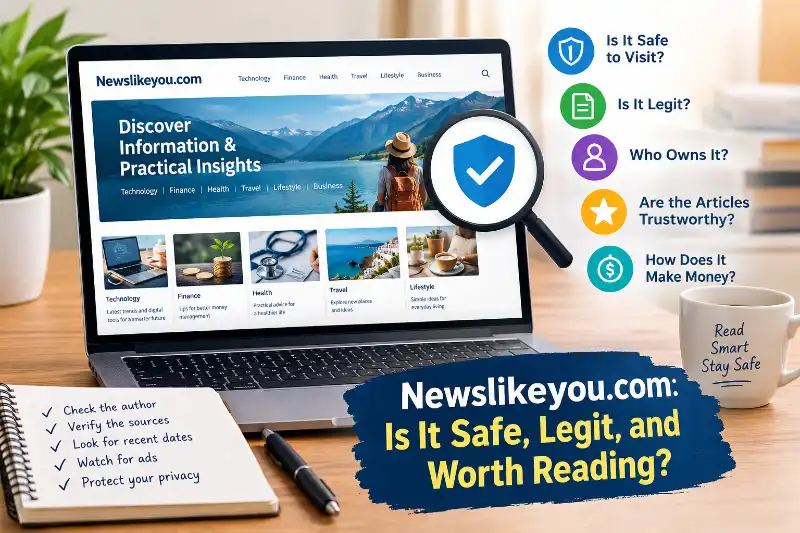
Have you found Newslikeyou.com in Google search results or seen a link to it on social media? Before reading its articles, you may want to know what the website does, whether it is safe to visit, and whether its information deserves your trust.
The name sounds like a news website, but that alone does not tell you how the site works. You also need to look at its authors, sources, contact information, and the way it handles sponsored content.
This review explains what Newslikeyou.com offers, what its public pages reveal, and how you can check an article before relying on it. By the end, you should have a clearer idea of when the site may be useful and when you should look elsewhere.
What Is Newslikeyou.com?
Newslikeyou.com is an online content website that publishes articles about several subjects, including technology, finance, health, travel, lifestyle, and business. Its homepage presents the site as a place to discover information and practical insights across different topics.
This makes it a general-interest publishing website rather than a website focused on one subject. You might find an article about digital trends alongside a lifestyle guide or a general educational piece.
However, publishing articles across several categories does not automatically make a website a reliable news source. To judge its reliability, you need to examine how the information is researched, who writes it, and whether readers can verify its claims.
Is Newslikeyou.com a News Website or a Blog?
The website uses news-related language in its branding, but its published material also includes general informational articles and content-related services. Its homepage promotes content writing and SEO or blog optimization alongside its articles.
These details suggest that the site has a broader publishing purpose than simply reporting breaking news. It can be more useful to think of it as a general-interest content platform unless a particular article demonstrates original news reporting.
A traditional news report usually identifies its sources and explains where important information came from. When an article on Newslikeyou.com does not provide that information, you should verify its main claims independently.
What Topics Can You Find on the Website?
The site’s public pages describe coverage across several areas. The exact subjects available to readers may change as new articles are published.
- Technology: Digital tools, online trends, and technology-related explanations.
- Finance and business: General financial topics and business information.
- Health: Health-related subjects that require careful checking before you act on the advice.
- Travel and lifestyle: Everyday topics, travel ideas, and practical suggestions.
- General information: Articles covering subjects that do not fit into one specific category.
The variety gives readers several reasons to visit the website. However, a broad range of topics also makes it important to assess each article individually because expertise in one subject does not establish expertise in another.
Who Owns Newslikeyou.com?
The site’s public pages provide information about its publishing purpose, but a website’s description of itself is not the same as independently verified ownership information.
The available information does not establish the identity and professional background of every person responsible for the site’s content. For that reason, it would be premature to name a specific individual or company as the verified owner without supporting records.
If ownership matters to you, look for a named publisher, a clear business identity, and contact details that can be independently checked. These details help you understand who is accountable for the information being published.
What this means: Newslikeyou.com is a multi-topic content website. Its broad coverage may help you explore different subjects, but the website’s name and appearance are not enough to establish the accuracy of its articles.
Is Newslikeyou.com Safe to Visit?
When people ask whether a website is safe, they often mean two different things. They want to know whether visiting the site could put their device or personal information at risk, and they want to know whether the information published there is trustworthy.
These questions need separate answers. A website can use an encrypted connection and still publish inaccurate information. Likewise, an article can contain useful facts even when the website provides limited information about its publisher.
Does the Website Have Basic Security Protection?
Start by checking the website address in your browser. A connection beginning with HTTPS indicates that the connection is encrypted between your browser and the website, helping protect information while it travels between them.
However, HTTPS does not certify the honesty of a website or the accuracy of its content. Fraudulent and legitimate websites can both use encrypted connections.
You should also pay attention to browser security warnings, unexpected downloads, suspicious pop-ups, and requests for sensitive information. If the site asks you to install unfamiliar software or enter payment details without a clear reason, stop and investigate before continuing.
Does That Mean Newslikeyou.com Is Completely Safe?
No security check can guarantee that a website will always be safe. Website content, advertisements, external links, and security conditions can change over time.
The draft’s earlier claim that Newslikeyou.com had a particular security score should not be treated as a permanent guarantee. Security ratings can change, and different checking services may use different methods.
For ordinary browsing, avoid downloading unknown files or sharing unnecessary personal information. If your browser displays a warning, do not ignore it simply because the website has been online for several years.
Is Technical Safety the Same as Content Reliability?
No. Technical safety concerns possible risks to your device, connection, and information. Content reliability concerns whether the article is accurate, current, balanced, and supported by credible evidence.
For example, an article might explain a financial term correctly but provide an outdated interest rate. Another article might describe a health condition in simple language while leaving out important medical context.
That is why you should check the article itself instead of relying entirely on a website safety score. The MedlinePlus guide to evaluating health information explains how to assess a website’s purpose, authorship, sources, review process, and updates.
What this means: Do not assume Newslikeyou.com is dangerous without evidence, but do not interpret basic security signals as proof that every article is trustworthy. Browse carefully and verify important claims before acting on them.
Can You Trust the Articles Published on Newslikeyou.com?
The main question is not whether the website publishes readable articles. It is whether a particular article provides enough evidence for you to rely on its claims.
A clear writing style can make information easier to understand, but it cannot prove that the information is correct. To judge an article fairly, look for identifiable sources, accurate details, relevant dates, and evidence that supports its main conclusions.
Are the Authors Qualified to Explain Their Topics?
Check the author’s name and biography, especially when the article covers health, finance, law, or personal safety. A useful biography should explain the writer’s relevant experience or qualifications rather than simply describe them as an expert.
If an article uses a generic author name or provides no author biography, you may not be able to confirm who prepared it. That creates uncertainty about the writer’s expertise, although it does not prove that the article is false.
The next step is to examine the evidence. An article with transparent sources and verifiable facts may still offer useful information, even if the author is not well known. An article with no sources and no identifiable expertise needs more careful checking.
Does the Article Link to Reliable Sources?
A reliable informational article should make it possible for readers to check important claims. Depending on the subject, useful sources might include government publications, scientific research, official documentation, or statements from recognized professional organizations.
Open the links instead of assuming that their presence makes the article reliable. Check whether the linked material actually supports the claim and whether it is recent enough for the topic.
Be particularly careful with phrases such as “experts agree” or “research proves” when no expert, study, or report is identified. Without supporting evidence, those phrases do not give you a meaningful way to verify the information.
Are the Articles Current and Correct?
Some information remains useful for years, while other details become outdated quickly. A basic explanation of a common term may remain accurate, but a guide about software features, financial rules, or medical recommendations may need regular updates.
Look for a publication date and, where appropriate, a review or update date. Then check whether the article reflects the latest information from relevant official sources.
A recent date is not proof of accuracy, either. The important question is whether the content has been checked against dependable evidence and whether any changes have been incorporated correctly.
When Should You Be Cautious About an Article?
Use extra care when an article makes strong promises without evidence, recommends a product without discussing limitations, or presents a complicated subject as if there is only one possible answer.
Health and finance articles deserve particular attention because inaccurate advice can affect your well-being or money. Do not change a treatment, invest your savings, or make a legal decision solely because a general-interest website recommends it.
For low-risk subjects, such as basic travel inspiration or everyday ideas, an article may still be useful as a starting point. You should judge its specific claims rather than automatically accepting or rejecting everything on the website.
What this means: Newslikeyou.com may help you learn about a topic, but the reliability of each article depends on its evidence, accuracy, and relevance. Verify important claims instead of treating a readable article as an authoritative source.
How Does Newslikeyou.com Make Money?
A website that publishes articles needs a way to cover its operating costs. It may earn money from advertisements, sponsored articles, content services, affiliate links, or other business activities.
Newslikeyou.com publicly promotes content writing and SEO or blog optimization services. Its contact page also lists advertising, sponsored content, brand features, promotional content, and business collaborations as commercial opportunities.
These details show that the website has a commercial side in addition to publishing articles. However, they do not establish how much revenue it earns from each activity or prove that every article is paid for by an advertiser.
Does the Website Publish Paid Articles?
The site lists sponsored content and promotional opportunities among its services. This means that paid publishing or brand-related content is part of the business activities it advertises.
That information does not prove that a specific article is sponsored. To determine whether an individual post is promotional, look for a sponsorship disclosure, a description of the commercial relationship, or language that clearly identifies the content as an advertisement.
Pay attention to articles that repeatedly recommend one company without explaining the reasons for the recommendation. Check whether the article discusses alternatives, acknowledges limitations, and supports its claims with evidence.
How Can Paid Content Affect Readers?
Sponsored content is not automatically false or useless. A company can pay to publish an article that contains accurate and helpful information.
The concern is whether the commercial relationship influences what the reader is told. For example, a promotional article might highlight a product’s benefits while leaving out its costs, limitations, or competitors.
When you notice a promotional tone, separate the factual information from the recommendation. Verify important claims independently before buying a product or signing up for a service.
What this means: Newslikeyou.com advertises content-related services and commercial publishing opportunities. That makes it sensible to check for sponsorship disclosures, but you should not assume that every article is paid content without evidence.
How Does Newslikeyou.com Compare With Established News and Information Sources?
Newslikeyou.com covers multiple subjects, while established news organizations and specialist information providers may have dedicated editorial teams, subject experts, or formal review procedures.
The important difference is not simply website size or popularity. It is whether the source explains where its information comes from and provides a clear way to check important claims.
What Should You Look for in a News Source?
A useful news source identifies the people or organizations responsible for its reporting, links to relevant evidence, and distinguishes confirmed facts from claims that remain uncertain.
It should also provide a way to report errors and explain how corrections are handled. These practices help readers understand how information was gathered and what happens when a mistake is discovered.
You can look for these features on any website, including large publications. A familiar brand name does not guarantee that every article is accurate, so checking the evidence remains important.
When Is Newslikeyou.com Useful?
The website may be useful when you want an introduction to a subject, a general explanation, or ideas for further research. Its multi-topic format gives you an opportunity to explore subjects without visiting a specialist website for every initial question.
For example, you might read a general article about a technology term and then consult official documentation to confirm how the technology works. This approach allows you to use an introductory article without assuming that it provides every detail.
When Should You Use Another Source?
Choose a more specialized source when the information could affect your health, finances, legal rights, or personal safety. In those situations, you need evidence that is appropriate for the decision you are making.
For medical questions, look for qualified health professionals and recognized medical institutions. For financial or legal matters, consult relevant official guidance or an appropriately qualified professional.
This does not mean that every general-interest article is inaccurate. It means that the consequences of an error should influence how carefully you verify the information.
What this means: Newslikeyou.com can be a starting point for general reading. For decisions that carry real consequences, use sources with relevant expertise, clear evidence, and a suitable review process.
Newslikeyou.com Article Checklist: How to Check a Page Before Trusting It
You do not need professional research skills to carry out a basic credibility check. A few simple steps can help you identify missing evidence and decide whether an article needs further verification.
Step 1: Check Who Wrote the Article
Look for the author’s name, biography, qualifications, and relevant experience. These details matter most when the article discusses a specialized subject.
If the author is not identified, do not immediately assume the article is false. Instead, check the sources and evidence more carefully because you have less information about the writer’s expertise.
Step 2: Find the Evidence Behind the Main Claims
Identify the article’s central claim and look for the source supporting it. Open any cited studies, official documents, or expert statements to make sure they actually support what the article says.
If you cannot find evidence for an important claim, search for it independently. Do not treat repeated statements across several websites as confirmation if those sites all rely on the same unsupported information.
Step 3: Check the Publication Date
Find out when the article was published and whether it has been reviewed or updated. This is particularly important for subjects that change frequently, such as technology, financial rules, and medical recommendations.
Compare time-sensitive claims with current information from a relevant official source. If the article contains outdated details, do not rely on it until you have confirmed the correct information.
Step 4: Look for Commercial Interests
Check whether the article promotes a particular product, service, company, or website. Look for a sponsorship label and examine whether the content explains disadvantages as well as benefits.
A commercial connection does not automatically invalidate an article. However, knowing about that connection helps you judge the recommendation in context.
Step 5: Protect Your Personal Information
Reading an article normally should not require you to provide sensitive personal information. Be cautious if a page unexpectedly asks for passwords, banking details, identity documents, or payment information.
Also, avoid opening suspicious attachments or downloading unfamiliar files. The Federal Trade Commission’s guide to recognizing phishing scams explains how deceptive messages and links can be used to obtain personal or financial information.
Step 6: Contact the Website if You Find an Error
Newslikeyou.com has a public contact page that describes ways to submit editorial enquiries, correction requests, and business enquiries. This gives readers a stated route for raising concerns about published material.
If you report an error, include the article title, its URL, the exact statement you believe is incorrect, and evidence supporting your concern. A clear report makes it easier for the publisher to understand the issue.
However, having a contact page does not guarantee that every report will receive a response or that every correction will be made. Check the information independently while waiting for clarification.
What this means: Before trusting an article, check its author, evidence, date, commercial purpose, and handling of personal information. If an important claim cannot be verified, find another source before acting on it.
Frequently Asked Questions About Newslikeyou.com
Is Newslikeyou.com a scam?
The information reviewed here does not establish that Newslikeyou.com is a scam. Its public pages describe publishing activities, content services, and ways to contact the website.
However, those details alone cannot prove that every business activity is legitimate or that every article is accurate. Assess any suspicious offer, payment request, or unsupported claim separately rather than relying on the website’s name or appearance.
Who owns Newslikeyou.com?
The public information reviewed for this article does not independently establish the verified identity of the person or legal entity that owns the website. Its About page explains the site’s purpose, but that is not the same as independently confirming ownership.
If you need to establish ownership for a business or legal reason, seek verifiable company information and other reliable records rather than relying solely on a website description.
Does Newslikeyou.com use AI to write its articles?
The available information does not establish whether the site’s articles are written by humans, generated with AI, or produced through a combination of methods.
Writing style alone cannot reliably answer that question. Unless the publisher provides a clear disclosure or other supporting evidence is available, its content creation process should be treated as unconfirmed.
Can I trust the health advice on Newslikeyou.com?
Do not rely on an unverified article as the sole basis for a medical decision. First check whether the article identifies qualified contributors, cites reliable medical evidence, and provides current information.
For diagnosis, treatment, or medication questions, consult a qualified healthcare professional. General online information can help you prepare questions, but it cannot determine what treatment is appropriate for your individual circumstances.
Does Newslikeyou.com have a contact page?
Yes. The website has a public contact page describing editorial enquiries, corrections, contributor submissions, advertising, and business enquiries.
You can use the details published there to raise a question about an article. Still, the existence of a contact page does not by itself establish the site’s overall reliability.
Is Newslikeyou.com worth reading?
That depends on the article and what you need from it. A clear introductory explanation or general-interest article may be useful for learning about an unfamiliar subject.
If you need verified facts for an important decision, check the article’s evidence and compare its claims with a qualified or authoritative source. The usefulness of the content depends on its quality, not just the website that publishes it.
Final Verdict: Is Newslikeyou.com Safe, Legit, and Worth Reading?
Newslikeyou.com is a multi-topic content website that publishes general information and promotes content-related services. Its public pages provide details about its publishing activities and offer contact routes for editorial and commercial enquiries.
Is it safe to visit? The information discussed in this review does not establish that the website is malicious. However, no website can be guaranteed safe under all circumstances, so pay attention to browser warnings, suspicious downloads, and unexpected requests for sensitive information.
Is it legitimate? The site has a public online presence and describes its services, but those facts do not independently verify every aspect of its ownership, business practices, or content quality.
Is it worth reading? It may be useful for general information, introductory explanations, and discovering topics you want to explore further. The value of an individual article depends on whether its claims are accurate, current, and supported by evidence.
The most practical approach is to judge each article on its own merits. Check the author, follow the sources, look for relevant dates, and consider whether commercial interests could affect the information presented.
For health, financial, legal, and safety decisions, verify important claims with qualified professionals or authoritative sources. That way, you can use Newslikeyou.com as a starting point for research without treating it as the final authority.