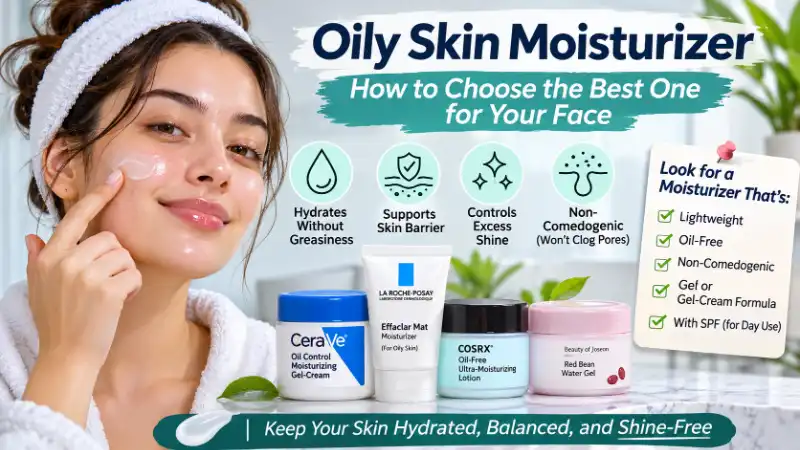
Your face looks shiny by noon, and the last thing you want is another layer of cream making it feel greasy. So, should you skip moisturizer altogether?
No. Oily skin still needs moisture. The secret is choosing a lightweight formula that hydrates your face without leaving a heavy, sticky feeling.
A good oily skin moisturizer should feel comfortable, support your skin barrier, and suit your skin’s needs. Gel moisturizers, oil-free lotions, and non-comedogenic formulas are good places to start.
But not every product works the same way. Let’s find out what your skin needs, which ingredients matter, and how to choose a moisturizer without wasting money.
FIND YOUR AGE - IN YEARS, MONTHS, DAYS, HOURS & SECONDS!
Does Oily Skin Really Need Moisturizer?
Yes, oily skin can benefit from moisturizer, even if your face produces plenty of oil.
Your skin makes a natural oil called sebum. Tiny glands called sebaceous glands produce it to help protect and lubricate your skin.
But oil and hydration are different things.
Sebum helps protect your skin’s surface. Hydration refers to the water your skin needs to stay comfortable and work properly.
You can have oily skin that still feels dehydrated, tight, or rough.
Skipping moisturizer may make these problems more noticeable, especially if you use strong cleansers or acne treatments.
The American Academy of Dermatology (AAD) explains that moisturizers can help reduce dryness caused by acne treatments, including benzoyl peroxide, salicylic acid, and retinoids.
A suitable moisturizer can:
- Help your skin retain water.
- Support the skin’s protective barrier.
- Reduce uncomfortable dryness and tightness.
- Make certain acne treatments easier to tolerate.
- Keep your skin feeling softer and smoother.
However, moisturizer does not automatically stop your skin from producing excess oil. It also does not replace acne medication.
The takeaway: Don’t avoid moisture because your skin is oily. Choose a formula that gives your skin the hydration it needs without unwanted heaviness.
How to Choose a Moisturizer for Oily Skin Without the Greasy Feel
The best oily skin moisturizer isn’t always the most expensive or the most popular one.
Start by checking the formula, its finish, and how your skin normally reacts to skincare products.
Check for Lightweight, Oil-Free, and Non-Comedogenic Labels
When shopping for a good oily skin moisturizer, look for these terms:
- Oil-free: Formulated without added oils. This may help if you dislike oily textures.
- Non-comedogenic: Designed to be less likely to clog pores.
- Water-based: Often useful when you prefer a lighter feel.
- Fragrance-free: Worth considering if your skin gets irritated easily.
- Lightweight or fast-absorbing: Helpful if you dislike thick products or wear makeup.
According to Mayo Clinic, water-based and non-comedogenic facial products can be useful for acne-prone skin.
Still, no label guarantees that a product will never cause breakouts. Your skin may react differently from someone else’s.
Also, don’t assume every moisturizer containing oil is bad. The complete formula matters more than one ingredient.
Match the Finish to How Your Skin Feels
Think about what bothers you most.
If your forehead and nose become shiny quickly, a mattifying gel-cream may be a good choice.
If your skin feels oily but tight after washing, choose a hydrating gel or lightweight lotion with ingredients such as glycerin or hyaluronic acid.
If your face gets irritated easily, a gentle, fragrance-free moisturizer may suit you better than a product packed with active ingredients.
And if you wear foundation, look for something that absorbs comfortably and layers well under makeup.
A simple rule: Choose hydration first, then decide how much shine control you want.
Gel, Gel-Cream, or Lotion: Which Texture Works Best?
If regular face creams feel too heavy, changing the texture may solve the problem.
Here’s how the main options compare.
| Moisturizer type | Good starting point for | What to expect |
|---|---|---|
| Gel moisturizer | Very oily skin | Light, refreshing feel |
| Gel-cream | Oily or combination skin | Hydration with a lighter finish |
| Lightweight lotion | Normal-to-oily or dehydrated skin | Comfortable moisture without a thick cream |
| Rich cream | Oily skin with very dry patches | More moisture protection, but may feel heavy |
Is Gel Moisturizer Good for Oily Skin?
Yes. A gel moisturizer is often a good choice because many gel formulas feel light and absorb quickly.
They can be especially comfortable during hot, humid weather or under sunscreen and makeup.
But gel isn’t automatically better than lotion. Some gels may not provide enough moisture for dehydrated skin.
Is an Oil-Free Moisturizer Better?
An oil-free moisturizer can be useful if rich products leave your face shiny.
However, oil-free doesn’t mean irritation-free or acne-proof.
You should still consider the ingredients, finish, and how your skin feels after application.
For most people with oily skin, a lightweight gel, gel-cream, or lotion is a sensible starting point.
Which Moisturizer Ingredients Help Oily Skin?
You don’t need to memorize a long ingredient list. Understanding a few useful ingredients can make shopping much easier.
Hydrating Ingredients That Support the Skin Barrier
Hyaluronic acid helps attract and hold water, keeping skin hydrated without needing a heavy texture.
Glycerin is another water-attracting ingredient. It’s found in many affordable face moisturizers.
Ceramides help support your skin barrier, which reduces unwanted moisture loss.
Panthenol can help with hydration and skin comfort, making it useful in formulas designed for sensitive skin.
Other ingredients worth knowing include beta-glucan and allantoin, which are often used in soothing skincare products.
Dimethicone and squalane are emollients that can help skin feel smoother. Dimethicone also helps reduce moisture loss. Their finished texture depends on the complete formula.
Some moisturizers also contain petrolatum, an ingredient that helps seal in moisture. It can be useful for dry patches, although richer products may not suit everyone who prefers a very light finish.
Ingredients for Shine Control and Acne-Prone Skin
If your main concern is excess shine, look for formulas containing ingredients such as:
- Niacinamide: Supports the skin barrier and may help improve the appearance of oily skin.
- Silica: Absorbs some surface oil and can give skin a more matte finish.
- Salicylic acid: Helps treat clogged pores and certain types of acne, but can cause dryness or irritation.
Remember that salicylic acid is an acne-treatment ingredient, not a basic moisturizer requirement.
If you’re already using benzoyl peroxide or a retinoid, you may be better off with a simple moisturizer instead of adding more acne-fighting ingredients.
You don’t need ten active ingredients. You need a formula your skin can tolerate.
Best Oily Skin Moisturizers to Consider by Skin Concern
So, what is the best moisturizer for oily skin?
There isn’t one product that works best for everyone. Someone who wants a matte finish may need something different from a person with oily, dehydrated skin.
The following are real product examples, selected by their advertised formulas and intended uses. They are not personal testing results or a ranked list of clinical winners.
| Moisturizer | Best reason to consider it |
|---|---|
| CeraVe Ultra-Light Moisturizing Gel | Lightweight everyday hydration |
| CeraVe Oil Control Moisturizing Gel-Cream | Hydration with shine control |
| La Roche-Posay Effaclar Mat | Matte finish for shiny skin |
| La Roche-Posay Toleriane Double Repair Matte | Matte hydration with barrier-supporting ingredients |
| Beauty of Joseon Red Bean Water Gel | Lightweight Korean gel |
| COSRX Oil-Free Ultra-Moisturizing Lotion | Light lotion for oily or combination skin |
| SkinCeuticals Daily Moisture | Premium moisturizer for normal-to-oily skin |
Lightweight Everyday Moisturizers
CeraVe Ultra-Light Moisturizing Gel
This is worth considering if you want a simple, lightweight face moisturizer.
Its formula contains ceramides, hyaluronic acid, and niacinamide. CeraVe describes it as oil-free, fragrance-free, and non-comedogenic.
It may be especially useful if heavy creams feel uncomfortable or you want something that layers under sunscreen.
CeraVe Oil Control Moisturizing Gel-Cream
If you want hydration with a more matte finish, this product takes a different approach.
It contains barrier-supporting ingredients along with oil-absorbing materials, including silica.
According to CeraVe, the formula is designed for combination-to-oily skin and helps manage shine.
Which CeraVe moisturizer should you choose?
Choose Ultra-Light Gel if your priority is weightless hydration. Consider Oil Control Gel-Cream if excess shine is your bigger concern.
Mattifying Options for Excess Shine
La Roche-Posay Effaclar Mat
This oil-free moisturizer is designed for oily, shiny skin.
Its main appeal is a mattifying finish that can make skin look less shiny. It also contains a lipo-hydroxy acid ingredient.
If your skin is very sensitive or you’re already using exfoliating acne products, review the ingredient list before adding it to your routine.
La Roche-Posay Toleriane Double Repair Matte
This is another option if you prefer lightweight gel hydration with a matte finish.
Its formula includes ceramide-3, niacinamide, and glycerin.
It may appeal to people who want moisture and barrier support while avoiding a visibly greasy finish.
The better La Roche-Posay oily skin moisturizer depends on whether you mainly want shine control or a barrier-focused formula.
Korean and Premium Moisturizers for Oily Skin
Beauty of Joseon Red Bean Water Gel
Looking for a Korean oily skin moisturizer?
Beauty of Joseon Red Bean Water Gel is a lightweight formula made for oily and combination skin.
It contains red bean extract and peptides. The brand describes it as non-greasy and fragrance-free.
This could be worth considering if you enjoy simple-feeling K-beauty gel moisturizers.
COSRX Oil-Free Ultra-Moisturizing Lotion
This Korean skincare option contains birch sap and comes in a lightweight lotion texture.
COSRX markets it for oily and combination skin as well as other skin types.
The brand notes that the formula has been updated, so check the current ingredient list if you have sensitivities.
SkinCeuticals Daily Moisture
If you’re looking at premium skincare, SkinCeuticals Daily Moisture is formulated for normal-to-oily skin.
It includes vitamin E, algae extracts, and botanical ingredients. The brand says it provides hydration with a non-greasy finish.
Its higher price doesn’t automatically mean it’s more effective for your skin than a less expensive product.
Before buying: Compare current ingredients, product size, your budget, and your skin’s reaction. A good moisturizer is one you’ll actually feel comfortable using.
What If Your Skin Is Oily but Also Acne-Prone, Sensitive, or Dry?
Oily skin isn’t the same for everyone. Choosing a moisturizer becomes easier when you identify your second skin concern.
Oily and Acne-Prone Skin
If you deal with pimples, blackheads, or whiteheads, start with a gentle, non-comedogenic moisturizer.
Avoid using a moisturizer as your only acne treatment if you have persistent acne.
Products containing benzoyl peroxide, salicylic acid, or retinoids can help treat acne, but they may also dry or irritate your skin.
A basic moisturizer can make that routine more comfortable.
The AAD recommends choosing products that are less likely to clog pores. The NHS acne guidance also supports using non-comedogenic skincare products.
If you have painful, deep, scarring, or persistent acne, speak with a board-certified dermatologist rather than relying only on cosmetic products.
Oily T-Zone With Dry or Sensitive Areas
Does your forehead get shiny while your cheeks feel dry?
You may have combination skin.
Your T-zone includes your forehead, nose, and chin. These areas often produce more visible oil than the rest of your face.
Try a lightweight lotion or gel-cream for your whole face. If your cheeks still feel dry, use a little extra moisturizer there or choose a richer formula just for those areas.
You may also have dehydrated oily skin if your face feels tight even though it looks shiny.
In that case, focus on ingredients such as glycerin, hyaluronic acid, and ceramides instead of only choosing mattifying products.
For sensitive skin, fragrance-free formulas with fewer unnecessary active ingredients are often a reasonable starting point.
Should You Use an Oily Skin Moisturizer With SPF?
Yes, a moisturizer with SPF can be a convenient daytime option, as long as it gives adequate protection and you apply enough.
The American Academy of Dermatology recommends broad-spectrum SPF 30 or higher, along with water resistance for outdoor activities.
One product to consider is Cetaphil DermaControl Oil Absorbing Moisturizer SPF 30.
It’s marketed for oily skin and combines moisturizing, oil-control benefits, and sun protection.
You can also use a regular lightweight moisturizer followed by a separate sunscreen.
Whichever option you choose, apply the amount needed for the labeled sun protection. A tiny dab of SPF moisturizer isn’t enough.
When outdoors, reapply sunscreen about every two hours and after swimming or sweating, following the product directions.
If your SPF moisturizer isn’t water-resistant, use a suitable water-resistant sunscreen for swimming or sweaty activities.
How to Apply Moisturizer Without Making Oily Skin Look Shinier
Even a good moisturizer can feel heavy when you apply too much or layer several products that don’t work well together.
Here’s a simple routine.
Morning routine
- Wash your face gently with a mild cleanser.
- Apply any morning treatment as directed.
- Smooth on a suitable amount of lightweight moisturizer.
- Apply broad-spectrum SPF 30 or higher sunscreen, unless you’re using an SPF moisturizer correctly and it provides the protection you need.
Night routine
- Remove makeup and cleanse your face.
- Apply prescribed or over-the-counter treatments according to their directions.
- Follow with a suitable moisturizer.
For a regular moisturizer, a small amount may be enough to start. Adjust it based on your skin and the product’s directions.
Applying moisturizer while skin is slightly damp can help retain water. If an acne medication must be applied to fully dry skin, follow that treatment’s instructions first.
Don’t scrub your face or wash it repeatedly just because it gets shiny. Gentle cleansing up to twice a day, and after sweating, is usually a better approach.
Why Does Your Moisturizer Still Feel Greasy or Cause Breakouts?
If a new moisturizer leaves your face sticky or you notice more pimples, don’t assume all moisturizers are bad for oily skin.
Look at what changed.
When the Formula Feels Too Heavy
A moisturizer may feel greasy because:
- You’re applying more than your skin needs.
- The formula has a rich, heavy texture.
- You’re layering several thick skincare products.
- Your moisturizer and sunscreen don’t sit comfortably together.
- Hot or humid weather makes the finish less pleasant.
What should you do?
Start by using an appropriate amount and letting each layer settle.
If your skin still looks overly shiny, try a lighter gel or gel-cream, or choose a mattifying formula.
If the moisturizer feels greasy but your skin also feels tight, don’t focus only on removing oil. You may need better hydration with a different texture.
When You Notice Pimples or Irritation
A new product may not agree with your skin, even when it’s labeled non-comedogenic.
Try introducing one new skincare product at a time. You can also patch-test it on a small area according to dermatologist guidance before using it across your face.
If you notice burning, an itchy rash, swelling, or repeated irritation, stop using the suspected product. Get medical advice for significant or persistent symptoms.
For ongoing breakouts, check your full routine, including makeup, sunscreen, hair products, and acne treatments.
Changing your moisturizer every few days can make it difficult to identify the actual problem.
FAQs About Oily Skin Moisturizers
Is an oil-free moisturizer always better for oily skin?
No. Oil-free moisturizers are often a comfortable choice, but they aren’t automatically better for everyone. The full formula, texture, and your skin’s reaction matter more than one label.
Can oily skin use moisturizer twice a day?
Yes. Many people use a lightweight moisturizer morning and night, especially after washing. If your skin feels uncomfortable, too greasy, or irritated, adjust the product or routine rather than forcing yourself to use a formula that doesn’t suit you.
Can a moisturizer reduce oily skin permanently?
No. A moisturizer cannot permanently change your skin’s natural oil production. Some products can absorb surface oil or reduce the appearance of shine for a period of time, but that isn’t the same as permanently stopping sebum production.
Which clean moisturizer works best for oily skin?
The word “clean” doesn’t have one universal meaning in skincare. Rather than choosing a product because it uses that label, check its ingredients, fragrance content, non-comedogenic claims, and suitability for your skin.
A gentle, lightweight formula that your skin tolerates is a better goal than a marketing term.
Final Takeaway: Choose Hydration Without the Heavy Feel
Finding a good oily skin moisturizer doesn’t have to be complicated.
Start with a lightweight, non-comedogenic formula that gives your skin comfortable hydration. Choose a gel if you prefer a fresh, weightless feel, or a gel-cream if you also want help managing shine.
If your skin is acne-prone, sensitive, or dehydrated, choose ingredients and textures that address those needs.
The right moisturizer should make your skin feel comfortable, not weighed down. Pay attention to the formula, introduce new products carefully, and let your skin’s response guide your choice.
BMI & BMR CALCULATOR - CHECK YOUR HEALTH