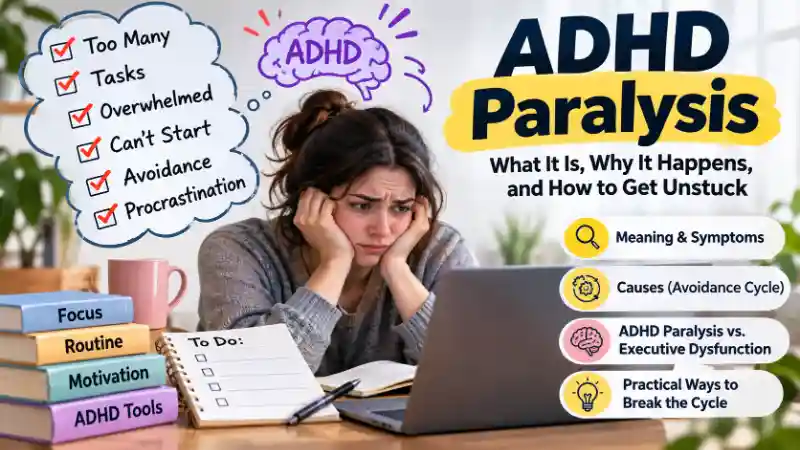
You have something important to do. Maybe it’s a college assignment, a work email, or a pile of laundry that has been sitting there for days. You know it needs to get done. You even want to do it.
But somehow, you can’t get started.
You sit there thinking about the task. Minutes turn into hours. You might check your phone, clean something else, or stare at your screen. The longer you wait, the more stressful the task becomes.
This frustrating feeling is often called ADHD paralysis.
If you’ve experienced it, you may wonder why starting something simple can feel so hard.
Let’s look at what ADHD paralysis means, why it happens, how it connects to ADHD avoidance, and what you can do when your brain seems stuck.
FIND YOUR AGE - IN YEARS, MONTHS, DAYS, HOURS & SECONDS!
What Is ADHD Paralysis, and Is It a Real Thing?
ADHD paralysis is a term people use to describe feeling mentally stuck, overwhelmed, or unable to start or move forward with a task. It is often connected to difficulties with executive functioning, attention, and decision-making.
For example, imagine you need to write a short email.
You open your laptop. You know exactly who needs the email and why. But then you start thinking about what to say, how to begin, and whether your message will sound right.
Before you know it, 30 minutes have passed, and the email is still blank.
That’s one way ADHD paralysis can feel.
But there’s an important detail.
ADHD paralysis is not an official medical diagnosis. It is an informal term used to describe experiences that some people with attention-deficit/hyperactivity disorder (ADHD) report.
According to Cleveland Clinic, ADHD paralysis isn’t actual physical paralysis. Instead, it describes situations in which a person feels overwhelmed, distracted, or unable to move forward.
It also doesn’t mean someone is lazy or doesn’t care.
A person might care deeply about finishing a task while still having real trouble getting started.
The Three Common Forms: Task, Mental, and Choice Paralysis
People often describe ADHD paralysis in three ways. These are useful everyday descriptions, not separate medical diagnoses.
1. Task paralysis
Task paralysis happens when starting or continuing a task feels unusually difficult.
You may know what needs to happen, but taking the first step feels like a major effort.
For example, you need to clean your bedroom, but you don’t know where to begin. Instead of picking something up, you spend an hour thinking about the entire mess.
2. Mental paralysis
Mental paralysis describes feeling overwhelmed by too many thoughts, responsibilities, or pieces of information.
Your mind may feel busy, yet you struggle to focus on one useful action.
A student might have three assignments, two exams, and several unread messages. Thinking about everything at once makes it harder to work on anything.
3. Choice paralysis
Choice paralysis, sometimes called analysis paralysis, happens when making a decision feels difficult.
Even a small choice can lead to overthinking.
For example, you need to choose which project to work on first. You keep comparing your options until you run out of time.
These experiences can overlap. Someone may struggle with choosing a task and then have trouble starting it.
What Are the Signs of ADHD Paralysis?
ADHD paralysis doesn’t look the same for everyone.
Some people feel mentally frozen. Others appear busy but keep avoiding the task that matters most.
Common experiences include:
- Knowing what you need to do but struggling to begin.
- Feeling overwhelmed by everyday responsibilities.
- Spending too much time deciding where to start.
- Putting off important tasks despite approaching deadlines.
- Getting distracted by smaller, easier activities.
- Feeling mentally overloaded or experiencing brain fog.
- Starting several things but finishing very few.
- Feeling frustrated when tasks take longer than expected.
- Worrying about making mistakes before even beginning.
- Avoiding tasks that require long periods of concentration.
For some people, these difficulties appear occasionally. For others, they can interfere with daily life.
However, these signs are not a medical checklist for ADHD paralysis. Similar problems can happen because of anxiety, depression, poor sleep, stress, or other health conditions.
What ADHD Paralysis Can Look Like at Work, School, and Home
Sometimes it’s easier to understand the problem through everyday examples.
At work
You have an important report due tomorrow.
Instead of working on it, you organize your desktop, answer less important messages, and check your calendar.
You’re doing things, but not the thing you planned to finish.
At school
A college student has five days to complete an assignment.
They understand the instructions but feel overwhelmed by choosing a topic, finding information, and writing the introduction.
They keep saying, “I’ll start in an hour.”
Suddenly, the deadline is tomorrow.
At home
You want to clean your apartment.
But there are dishes in the sink, clothes on the floor, and things scattered across the living room.
Everything seems equally important, so you don’t know where to begin.
These examples help explain why ADHD paralysis in adults can affect work, education, household chores, and personal responsibilities.
Why Does ADHD Paralysis Happen?
ADHD paralysis doesn’t have one simple cause.
For some people, the main difficulty is getting started. Others struggle with decisions, distractions, emotional pressure, or several problems at once.
ADHD can make certain executive functioning skills harder to manage. Stress and other mental health conditions may add to those difficulties.
Understanding what is making you feel stuck can help you choose a better way to respond.
Executive Function and Difficulty Starting Tasks
Executive functions are mental skills that help you plan, organize, remember instructions, manage attention, and complete tasks.
Think of them as the skills that help turn an intention into action.
For example, writing a college paper involves several steps:
- Understanding the assignment.
- Choosing a topic.
- Finding information.
- Planning what to write.
- Starting the first paragraph.
- Staying focused long enough to finish.
When executive functioning is difficult, any of these steps may create problems.
One common challenge is task initiation, which means getting started on an activity.
You may understand the task completely but still struggle to begin it.
Executive dysfunction is a broader term for problems involving executive skills. ADHD paralysis is one informal way people describe feeling stuck when some of these skills become difficult to use.
Executive dysfunction can also occur with conditions other than ADHD.
Too Many Tasks, Decisions, or Distractions
Imagine someone hands you a list of 20 things to finish today.
Where do you start?
Which one matters most?
How long will each take?
What if something goes wrong?
Having too many questions to answer can create mental overload.
People with ADHD may already struggle with planning, working memory, prioritization, or shifting attention.
A large number of tasks can make these difficulties more noticeable.
Even an ordinary to-do list may feel overwhelming when every item requires several decisions.
This doesn’t mean the person is incapable of completing the work. It means the process of choosing and starting may require extra support.
Anxiety, Perfectionism, and Fear of Making Mistakes
Sometimes the task itself isn’t the biggest problem.
It’s how you feel about doing it.
Maybe you’re worried that your work won’t be good enough. Maybe you made a mistake on a similar task before. Or perhaps someone expects you to finish quickly.
These worries can make starting more uncomfortable.
For example, a student might delay writing an essay because they think the first paragraph must be perfect.
The longer they wait, the more anxious they feel.
This can create a pattern where anxiety encourages avoidance, and avoidance adds more pressure later.
Not everyone with ADHD experiences anxiety or perfectionism. But when these problems are present, they may make task initiation more difficult.
Why Inattentive ADHD Can Make Task Avoidance Harder
ADHD has three recognized presentations: predominantly inattentive, predominantly hyperactive-impulsive, and combined.
People with inattentive ADHD may have particular difficulty staying organized, maintaining attention, following instructions, and completing tasks that require sustained mental effort.
For example, someone may keep forgetting the next step of a project or lose track of what they were doing.
Over time, tasks that require a lot of concentration may begin to feel unpleasant or exhausting.
That can contribute to ADHD avoidance of tasks.
However, avoidance isn’t limited to inattentive ADHD. People with other ADHD presentations may experience similar difficulties.
ADHD symptoms can look different from person to person, and they may become more noticeable as adult responsibilities increase. That is one reason some people do not recognize their ADHD-related difficulties until adulthood.
How to Get Out of ADHD Paralysis When You Feel Stuck
If you’re wondering how to get out of ADHD paralysis, start with something small.
You don’t need to fix your entire schedule in one afternoon.
The goal is to make your next action easier.
Here are five practical strategies you can try.
Step 1 — Name the One Task You Need to Start
When everything feels important, deciding what to do can become its own problem.
Instead of thinking about ten responsibilities, pick one.
Ask yourself:
“What is one useful thing I can do next?”
It doesn’t have to be the biggest task.
If you need to study for an exam, your first task might simply be opening your notes.
If you need to clean your room, choose one area.
If choosing is difficult, start with a small task that has a clear beginning and end.
The idea is to reduce the number of decisions you need to make.
Step 2 — Make the First Action Almost Effortless
Large tasks often hide many smaller actions.
“Finish my research paper” sounds difficult because it includes planning, reading, organizing, writing, and editing.
Try making the first step much smaller.
| Instead of This | Try This |
|---|---|
| Clean my bedroom | Pick up five pieces of clothing |
| Write my essay | Open a document and type the title |
| Study for my exam | Read one page of notes |
| Answer all my emails | Open one important message |
| Organize my finances | Find my latest bank statement |
| Start exercising | Put on my walking shoes |
A tiny step won’t solve every problem, but it may make beginning feel more manageable.
Once you’ve started, you can decide whether to continue.
If you’re still struggling, try reducing the task again.
Step 3 — Reduce Distractions and Decision-Making
Sometimes your surroundings make it harder to focus.
A phone notification, noisy room, or crowded computer screen can pull your attention away.
Before starting, try removing one or two distractions.
You might:
- Silence notifications for a short period.
- Close browser tabs you don’t need.
- Put your phone somewhere less distracting.
- Keep only the materials needed for your current task.
- Write down your next action so you don’t have to keep remembering it.
You don’t need a perfect workspace.
Just try to make the task easier to see and begin.
Step 4 — Try a Short Timer or Work Alongside Someone
If starting feels uncomfortable, you might find it easier to commit to a short amount of time.
For example, set a timer for five minutes.
Tell yourself that you only need to work until the timer ends.
When it rings, you can take a break, continue, or decide on another small step.
Some people also find body doubling helpful.
Body doubling means doing a task while another person works nearby or stays present, either in person or online.
You could study alongside a friend, clean while someone else works in the room, or join a virtual study session.
Having another person present may provide structure and accountability.
These methods are practical coping ideas. They aren’t guaranteed treatments for ADHD.
Step 5 — Decide Your Next Small Step Before You Stop
Starting is one challenge. Restarting after a break can be another.
Before you finish a work session, leave yourself a clear instruction.
Instead of writing:
“Continue assignment tomorrow.”
Write:
“Tomorrow, open the document and add two examples to paragraph three.”
Now you won’t need to figure out where to begin all over again.
You can also mark completed steps on a checklist.
Small signs of progress may help you recognize that you are moving forward, even when the entire task isn’t finished.
A quick reminder: If a strategy doesn’t help, that doesn’t mean you failed. Different tasks and situations may require different kinds of support.
Why ADHD Avoidance Can Turn Into a Repeating Cycle
ADHD paralysis and ADHD avoidance are closely related experiences, but they aren’t exactly the same.
Paralysis describes the feeling of being stuck.
Avoidance describes putting distance between yourself and a task, situation, or demand.
Sometimes avoidance happens because starting feels overwhelming. Other times, someone avoids a task because they’re anxious, bored, frustrated, or unsure what to do.
Understanding this difference is helpful if you keep postponing the same responsibilities.
What Does ADHD Avoidance Behavior Look Like?
ADHD avoidance behavior can involve repeatedly delaying tasks that require planning, concentration, or sustained effort.
For example, you might:
- Avoid opening messages related to an important responsibility.
- Postpone making a phone call.
- Choose easy chores instead of a difficult assignment.
- Keep researching a task without actually beginning it.
- Wait until a deadline becomes urgent.
- Distract yourself whenever a task feels stressful.
Some ADHD avoidance behaviors look like ordinary procrastination.
But the reasons behind them may be different.
A person might want to complete the task yet struggle with organizing the steps, handling the emotional pressure, or maintaining attention.
In adults, these patterns can affect work projects, college assignments, bills, appointments, and household responsibilities.
Not every instance of avoidance is caused by ADHD, though. It helps to look at the specific reason a task feels difficult.
How Anxiety and Procrastination Can Feed the Avoidance Loop
Have you ever delayed something and felt better for a moment?
Maybe you needed to make an uncomfortable phone call.
You decided to do it tomorrow.
The immediate pressure eased.
But the next day, the call was still waiting. Now you had another day of worry attached to it.
This is one way an ADHD avoidance cycle, sometimes called an ADHD avoidance loop, can develop.
A possible pattern looks like this:
Difficult task → Stress or overwhelm → Avoidance → Temporary relief → More pressure → Greater difficulty starting
Avoidance may reduce uncomfortable feelings in the short term.
The problem is that the unfinished task often remains.
As deadlines approach or responsibilities pile up, the task may begin to feel even harder.
That doesn’t mean everyone with ADHD follows this exact cycle. It simply explains one common way task avoidance anxiety and procrastination can reinforce each other.
The important part is recognizing the pattern before it takes over your day.
Why You May Avoid a Task When Someone Asks You to Do It
Some people notice something strange.
They were planning to do a task on their own, but as soon as someone tells them to do it, they no longer want to start.
This experience is sometimes discussed as ADHD avoidance when asked to do something.
Several factors may contribute.
Perhaps the request interrupts your current focus. Maybe you already feel overloaded, or the instructions aren’t clear.
You might also feel pressure because someone expects you to respond immediately.
For example, imagine you’re preparing to wash the dishes.
Just as you’re about to begin, someone says, “You need to wash those dishes right now.”
Suddenly, the task feels more stressful.
This reaction doesn’t automatically mean you have ADHD, and it isn’t proof of a separate demand-avoidance disorder.
People can respond strongly to demands for many reasons, including stress, anxiety, conflict, or difficulty changing tasks.
If it happens regularly, identifying the trigger can be more useful than judging yourself for the reaction.
How to Break the ADHD Avoidance Cycle
If you keep avoiding the same task, try figuring out what makes it difficult.
Ask yourself:
- Am I unsure how to start?
- Am I worried about doing it wrong?
- Does this task have too many steps?
- Am I tired or mentally overloaded?
- Is there something uncomfortable about completing it?
Your answer can help you choose a different approach.
For example, if you don’t understand an assignment, ask for clarification instead of repeatedly trying to force yourself to start.
If you’re worried about making mistakes, allow yourself to create an imperfect first draft.
If the task feels too large, reduce its scope.
And if anxiety repeatedly stops you from working, a mental health professional may help you address the thoughts and feelings behind that avoidance.
The goal isn’t to push harder every time.
It’s to understand the obstacle and make the next action more manageable.
ADHD Paralysis vs. Executive Dysfunction, Procrastination, and Depression
ADHD paralysis shares features with several other experiences.
That overlap can make it hard to understand what you’re dealing with.
Here is a simple comparison.
| Term | What It Means | Main Difference |
|---|---|---|
| ADHD paralysis | Informal description of feeling mentally stuck | Often describes difficulty starting, deciding, or moving forward |
| Executive dysfunction | Difficulties with executive skills | Broader than ADHD paralysis |
| Procrastination | Delaying something that needs to be done | Can happen for many different reasons |
| Depression | Mental health condition affecting mood and functioning | Often involves wider, persistent symptoms |
| Anxiety-related avoidance | Avoiding situations linked to worry or fear | Fear or worry may be the main barrier |
These experiences can overlap. The differences aren’t always obvious without a professional evaluation.
ADHD Paralysis vs. Executive Dysfunction
Executive dysfunction is a broader concept than ADHD paralysis.
It can affect planning, time management, working memory, emotional regulation, organization, and the ability to begin or finish activities.
ADHD paralysis is a more informal description of moments when someone feels stuck.
For example, forgetting appointments or losing track of instructions may involve executive functioning difficulties without necessarily feeling like paralysis.
On the other hand, someone who sits in front of a task but cannot figure out how to start may describe that moment as ADHD paralysis.
Executive dysfunction can appear with ADHD and other conditions, so the terms shouldn’t be treated as identical.
ADHD Paralysis vs. Procrastination
Procrastination means delaying a task, often despite knowing that postponing it may cause problems.
People procrastinate for many reasons, including low interest, anxiety, uncertainty, or a desire to do something more enjoyable.
ADHD-related task difficulties may involve problems with attention, planning, and task initiation.
Still, the two can overlap.
Someone with ADHD may procrastinate partly because getting started requires more effort.
Someone without ADHD may also feel stuck before an unpleasant task.
The behavior alone doesn’t tell you the cause.
Instead of asking whether something is “just procrastination,” it may be more helpful to ask what is making the task hard to start.
ADHD Paralysis vs. Depression or Anxiety
Depression can make everyday tasks difficult.
But depression often includes additional symptoms, such as persistent low mood, reduced interest or pleasure, changes in energy, sleep or appetite, and feelings of hopelessness.
ADHD-related task difficulties may occur even when someone feels interested in the task and wants to complete it.
Anxiety can create a different barrier.
A person may avoid a task because they’re worried about failing, being judged, or facing an uncomfortable outcome.
It’s also possible to have ADHD alongside depression or an anxiety disorder.
If you’re frequently struggling to function, especially when you notice changes in mood, energy, sleep, or daily interests, consider speaking with a healthcare professional.
How Can You Make ADHD Paralysis Less Likely to Happen Again?
Getting unstuck today is helpful.
But what if the same problem returns tomorrow?
You may not be able to prevent every difficult moment. Still, building a few simple systems can reduce the number of decisions you face throughout the day.
The aim is to make starting tasks easier, not to create a perfect routine.
Plan the First Step Before the Task Begins
When you finish your day, write down one clear starting action for tomorrow.
Don’t just write:
“Work on my project.”
Try:
“Open the project file and review the first two pages.”
Specific instructions reduce uncertainty.
You can also prepare anything you’ll need in advance.
If you’re studying, leave your notebook ready.
If you’re going for a walk, put your shoes somewhere visible.
These small changes may make getting started feel less demanding.
Use Visual Reminders and Manageable Routines
Remembering everything in your head can be tiring.
Try using tools that keep important information visible.
A short checklist, phone reminder, calendar notification, or sticky note may help.
For college students, this might mean keeping assignment deadlines in one calendar.
For working adults, it might mean using a simple task list with no more than a few priorities for the day.
Some people also find it useful to connect tasks to existing routines.
For example:
“After breakfast, I’ll check today’s schedule.”
Or:
“After I finish lunch, I’ll spend ten minutes reviewing my notes.”
A routine should support you, not become another source of pressure.
If your schedule changes, adjust the plan instead of abandoning it completely.
Notice Your Personal Triggers
Not every task creates the same problem.
You might find it easy to clean your kitchen but difficult to respond to messages.
Or perhaps you can focus well in a quiet library but struggle in a noisy apartment.
Pay attention to situations where you feel stuck.
For a week, try keeping a short note of:
- The task you were trying to complete.
- What made starting difficult.
- How you were feeling.
- What helped you move forward.
You may notice that unclear instructions, interrupted sleep, anxiety, or competing responsibilities often appear before a difficult moment.
This kind of personal record isn’t an ADHD test. It’s simply a way to identify patterns that may help you plan better.
Can ADHD Paralysis Be Treated With Therapy or Medication?
If ADHD-related task difficulties regularly affect your life, self-help strategies may not be enough.
Professional treatment can help manage ADHD symptoms and improve daily functioning.
However, treatment is aimed at ADHD and any other contributing conditions, not at a separate diagnosis called ADHD paralysis.
How ADHD Medication May Help With Related Symptoms
ADHD medication can help some people improve attention, reduce impulsivity, and manage related symptoms.
There are two broad medication categories.
Stimulant medications
Stimulants are commonly prescribed for ADHD. They can improve attention and other ADHD symptoms for many people.
Nonstimulant medications
Nonstimulant ADHD medications are another option. A healthcare professional may consider them based on a person’s symptoms, medical history, response to treatment, and other factors.
There is no medication specifically approved to treat “ADHD paralysis” as a separate condition.
Still, when difficulty starting tasks is connected to ADHD symptoms, effective ADHD treatment may make everyday responsibilities easier to manage.
Medication does not work the same way for everyone.
It can also cause side effects and requires appropriate medical supervision.
If you’re considering ADHD meds or changing an existing prescription, discuss the decision with your healthcare provider. Don’t adjust or stop prescribed medication on your own.
How CBT and Professional Support Can Help
Cognitive behavioral therapy, or CBT, is one form of psychotherapy that can help people with ADHD develop practical coping skills.
It may focus on:
- Breaking large tasks into manageable steps.
- Improving planning and organization.
- Identifying unhelpful thought patterns.
- Developing realistic routines.
- Managing avoidance and procrastination.
- Responding to frustration and negative expectations.
For example, someone who repeatedly thinks, “If I can’t do this perfectly, there’s no point starting,” may learn to challenge that thought and practice a more manageable approach.
Some adults also benefit from behavioral support, ADHD coaching, or help creating systems that fit their daily responsibilities.
According to the National Institute of Mental Health, treatment for ADHD commonly includes medication, psychotherapy, and behavioral interventions.
The right approach depends on the individual.
Is There an ADHD Paralysis Test, and When Should You Seek Help?
If you’ve been struggling with task initiation for a long time, you may wonder whether there’s an ADHD paralysis test.
There is no separate, established clinical test that diagnoses ADHD paralysis.
The term isn’t a standalone disorder in the Diagnostic and Statistical Manual of Mental Disorders, Fifth Edition, Text Revision (DSM-5-TR).
However, healthcare professionals can evaluate someone for ADHD.
An ADHD assessment may include:
- Questions about current symptoms.
- A review of childhood experiences.
- Information about difficulties at school, home, or work.
- Standardized ADHD symptom rating scales.
- A review of medical and mental health history.
- Assessment of other conditions that may explain or contribute to symptoms.
A screening questionnaire can suggest whether further evaluation may be useful, but it cannot confirm ADHD by itself.
The CDC explains that no single test can diagnose ADHD. Anxiety, depression, sleep disorders, and certain learning difficulties can also cause similar problems.
When Is It Time to Talk to a Professional?
Consider seeking an evaluation if you regularly:
- Miss important deadlines despite repeated efforts to stay organized.
- Struggle to start or finish basic responsibilities.
- Experience ongoing difficulties at school or work.
- Avoid necessary activities because they feel overwhelming.
- Feel significant distress about your ability to manage daily life.
- Notice that task difficulties are affecting relationships or your well-being.
A primary care provider or qualified mental health professional can help you decide what kind of assessment or support may be appropriate.
One important safety point: ADHD paralysis does not mean actual loss of muscle movement. Sudden physical weakness, trouble speaking, facial drooping, or loss of movement needs emergency medical attention rather than being treated as an ADHD symptom.
Frequently Asked Questions About ADHD Paralysis
How Long Does ADHD Paralysis Last?
There is no fixed duration for ADHD paralysis. Some people describe brief periods of feeling stuck, while others struggle with a task for hours or longer. The experience can depend on the task, stress, sleep, and other factors. If task difficulties are frequent or seriously affecting your life, consider professional support.
Can You Have ADHD Paralysis Without ADHD?
People without ADHD can also struggle to start tasks, make decisions, or feel mentally overwhelmed. Anxiety, depression, stress, and sleep problems may contribute to similar experiences. ADHD paralysis is an informal term associated with ADHD, but feeling stuck does not mean you necessarily have the condition.
Is Decision Paralysis a Symptom of ADHD?
Difficulty making decisions can be connected to executive functioning challenges that occur with ADHD. Someone may struggle to compare options, choose priorities, or move forward. However, decision paralysis is not a separate official ADHD diagnostic criterion, and decision difficulties can have other causes.
Can ADHD Paralysis Happen With Small, Easy Tasks?
Yes. A task that looks simple may still involve planning, attention, decisions, or uncomfortable feelings. Replying to a short message, scheduling an appointment, or putting away clothes may feel harder than expected. The size of a task doesn’t always reflect how difficult it feels to start.
Is ADHD Avoidance Disorder a Real Diagnosis?
ADHD avoidance disorder is not a separate recognized clinical diagnosis. People may use the phrase to describe task avoidance behaviors related to ADHD symptoms, anxiety, or executive functioning difficulties. A healthcare professional can help identify the actual reasons behind persistent avoidance.
You Can Start With One Small Step
ADHD paralysis can be frustrating, especially when you know exactly what needs to get done but can’t seem to begin.
The good news is that you don’t have to solve every problem at once.
Understanding your triggers, breaking tasks into smaller actions, and finding ways to manage ADHD avoidance may make daily responsibilities easier.
Some people also benefit from therapy, medication, or other professional support.
For now, choose one task you’ve been putting off. Find the smallest useful action you can take toward it.
You don’t have to finish everything today.
Sometimes, getting started is enough to move things forward.
Medical note: This article is for general educational purposes and does not provide a medical diagnosis or replace advice from a qualified healthcare professional.
BMI & BMR CALCULATOR - CHECK YOUR HEALTH