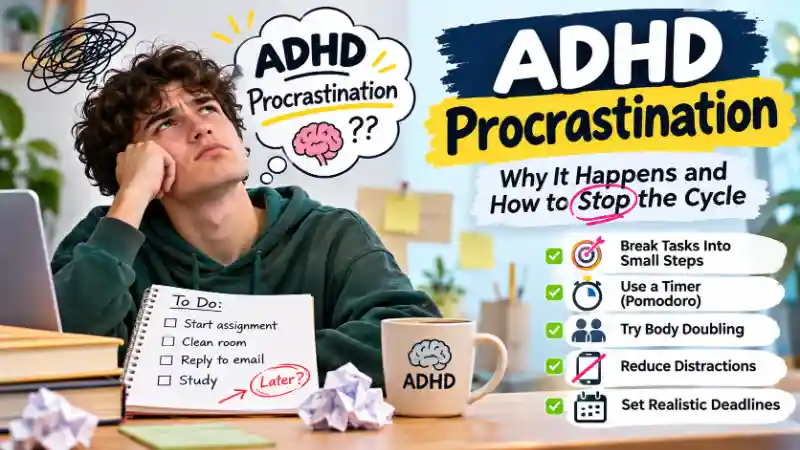
You sit down to finish an important task. You know it needs to get done. Maybe it’s a school assignment, a work project, or an email you’ve been avoiding for days.
But instead of starting, you check your phone, clean your desk, or suddenly remember something else you need to do.
An hour passes. The task is still waiting.
If this sounds familiar, ADHD procrastination might help explain what you’re experiencing.
For some people with attention-deficit/hyperactivity disorder (ADHD), procrastination isn’t simply about choosing something fun over something boring. Difficulties with attention, planning, emotional regulation, and starting tasks can make even simple responsibilities feel overwhelming.
The good news? You can learn ways to make starting easier and reduce the pressure that builds when tasks keep piling up.
Quick Answer: ADHD procrastination happens when ADHD-related difficulties, such as executive dysfunction, poor time management, and trouble regulating attention, contribute to delaying tasks. Breaking work into smaller steps, using visual timers, reducing distractions, and trying body doubling may help. However, procrastination alone doesn’t mean someone has ADHD.
FIND YOUR AGE - IN YEARS, MONTHS, DAYS, HOURS & SECONDS!
Is Procrastination a Sign of ADHD?
Yes, procrastination can be associated with ADHD, particularly when a person struggles with organization, attention, planning, or task initiation.
But there’s something important to understand.
Procrastination isn’t a specific diagnostic symptom of ADHD, and procrastinating doesn’t automatically mean you have the condition.
Everyone puts things off sometimes. You might delay doing laundry because you’re tired or avoid an assignment because it’s boring.
With ADHD, though, delays may happen repeatedly, even when someone understands the consequences and genuinely wants to finish the task.
ADHD can affect executive functions, which help you organize your thoughts, manage time, remember instructions, and move from planning something to actually doing it.
When these skills are difficult to manage, everyday responsibilities may become harder than expected.
Chronic or severe procrastination can sometimes be connected to ADHD, but it can also happen because of anxiety, depression, sleep problems, stress, or other factors.
A healthcare professional looks at a broader pattern of symptoms, how long they’ve been present, and how they affect daily life before considering an ADHD diagnosis.
How ADHD Procrastination Can Show Up in Adults
Adult ADHD procrastination doesn’t always look like someone sitting around doing nothing.
Sometimes, you’re busy all day but still avoid the one task that matters most.
Here are a few examples:
- At work: You spend an hour organizing files instead of starting an important report.
- At college: You understand an assignment but keep delaying it until the deadline is close.
- At home: You walk past a pile of laundry for several days because sorting and putting it away feels overwhelming.
- With money: You forget or avoid paying bills even though you have enough money to cover them.
- With communication: You keep telling yourself you’ll answer an important message later, but days pass.
Some adults also jump between several tasks without finishing any of them.
Others struggle with getting started but find that once they begin, they can work for a long time.
These patterns aren’t exclusive to ADHD. What matters is whether difficulties are persistent, occur alongside other ADHD symptoms, and interfere with daily functioning.
ADHD Procrastination vs. Regular Procrastination: What’s Different?
You might wonder whether ADHD procrastination is really different from the kind everyone experiences.
The truth is that the two can look similar from the outside.
The difference often involves the difficulties contributing to the delay.
For example, someone without ADHD might postpone cleaning because they would rather watch a movie.
Someone with ADHD might want to clean but struggle to decide where to begin, stay focused, or manage the steps involved.
Here’s a simple comparison.
| Situation | General Procrastination | ADHD-Related Procrastination |
|---|---|---|
| Starting work | May delay an unpleasant task | May struggle to initiate tasks despite wanting to begin |
| Managing time | May occasionally underestimate time | Time estimation and time management may be persistently difficult |
| Staying focused | Distractions can interfere | Attention regulation may make distractions harder to manage |
| Organizing tasks | May avoid planning | Executive-function difficulties may affect planning and prioritizing |
| Meeting deadlines | May work better under pressure | May repeatedly struggle to begin until pressure increases |
| Emotional response | May experience guilt or frustration | May also experience intense overwhelm, frustration, or avoidance |
These are possible patterns, not strict rules.
People without ADHD can experience executive-function difficulties, too. And not everyone with ADHD experiences procrastination in the same way.
The key is to understand what’s causing your delays rather than judging yourself for having them.
Why Does ADHD Make Procrastination Harder to Manage?
If you’ve ever thought, “I know exactly what I need to do, so why can’t I just do it?” you’re asking an important question.
ADHD-related procrastination can involve several overlapping challenges.
Understanding those challenges makes it easier to choose a strategy that actually fits your problem.
Executive Dysfunction Makes Starting and Planning Harder
Executive functions help your brain manage goals and actions.
Think of them as the mental skills that help you decide what to do, organize the steps, and keep moving toward the finish line.
ADHD can make some of these skills harder to use consistently.
For example, imagine you need to write a five-page report.
You know the deadline. You understand the topic. You even have the information you need.
But your brain is trying to handle everything at once:
- Where should I start?
- What should the first paragraph say?
- How should I organize everything?
- What if I do it wrong?
The task starts feeling much bigger than it actually is.
This is one reason task initiation difficulty is often connected to ADHD procrastination.
The problem isn’t necessarily a lack of knowledge or effort. Getting from intention to action can be difficult.
Working memory challenges may also make it harder to keep track of steps, especially during complicated tasks.
Time Blindness and Distractions Can Delay Progress
People often use the term time blindness to describe difficulty sensing how much time has passed or estimating how long something will take.
It’s not a separate ADHD diagnosis, but time-management difficulties are common among people with ADHD.
You might tell yourself:
“I’ll start in five minutes.”
Then you open social media, read a few messages, and suddenly 40 minutes have disappeared.
Or you assume an assignment will take 30 minutes when it actually requires two hours.
Attention regulation can add another challenge.
A notification, unexpected thought, or noise in the room may pull your attention away from the task.
Returning to the original work can then require additional effort.
Over time, these interruptions may contribute to missed deadlines and unfinished responsibilities.
Stress, Perfectionism, and Rewards Can Influence Avoidance
Not all procrastination is caused by distraction.
Sometimes, emotions play a major role.
Imagine opening a difficult assignment and immediately worrying that you’ll get it wrong.
Avoiding the task might temporarily reduce that uncomfortable feeling.
But the unfinished work hasn’t disappeared.
This can create a pattern of stress and avoidance.
Perfectionism may make starting especially difficult because the first step feels like it has to be perfect.
ADHD is also associated with differences in attention and reward processing.
Tasks offering immediate interest or feedback may feel easier to engage with than activities whose benefits come much later.
Dopamine plays a role in motivation and reward-related brain processes, but it’s too simple to say that ADHD procrastination happens only because of low dopamine.
ADHD-related behavior involves several interacting factors.
Understanding the ADHD Procrastination Cycle
For some people, the pattern looks like this:
- A task feels overwhelming. You aren’t sure how to begin.
- You avoid it. Doing something easier brings temporary relief.
- Pressure builds. The deadline gets closer, and guilt or stress increases.
- Starting feels even harder. The task now carries more emotional pressure.
You may eventually finish the task in a last-minute rush.
That doesn’t mean procrastination is helpful or that pressure is the only way you can work.
It means urgency may sometimes make starting easier, even though the overall experience is stressful.
Breaking this ADHD procrastination cycle often starts with reducing the difficulty of the first step.
ADHD Procrastination Paralysis: What to Do When You Feel Stuck
Sometimes procrastination feels more intense than putting things off.
You might sit in front of your laptop, stare at an unfinished assignment, and feel unable to begin.
Your thoughts are moving, but your actions aren’t.
People often call this ADHD procrastination paralysis or ADHD task paralysis.
ADHD paralysis is an informal description of feeling mentally stuck or overwhelmed. It isn’t a separate medical diagnosis.
It may involve several experiences:
- Task paralysis: You know what needs to happen but struggle to start.
- Decision paralysis: Too many choices make selecting the next action difficult.
- Mental overwhelm: Thoughts, responsibilities, and distractions compete for your attention.
These experiences can overlap with executive dysfunction and task avoidance.
But feeling stuck isn’t always caused by ADHD. Anxiety, depression, exhaustion, and other conditions may contribute.
A Simple Reset for When You Can’t Begin
When you’re frozen, trying to force yourself to finish everything at once may increase the pressure.
Instead, try this short reset.
Step 1: Pick one task.
Don’t think about your entire to-do list. Choose a single responsibility.
Step 2: Find the smallest visible action.
If you need to write an assignment, your first action might simply be opening the document.
Step 3: Make a two-minute attempt.
Set a timer for two minutes and focus only on that first action.
Step 4: Make it smaller if necessary.
If two minutes feels like too much, try something even easier.
Step 5: Ask for support when needed.
A friend, classmate, coworker, or trusted family member might help you get started.
The goal isn’t to finish the task immediately.
It’s to make the beginning feel more manageable.
How to Stop ADHD Procrastination: Strategies for Different Problems
If you’ve searched for how to stop ADHD procrastination, you’ve probably seen advice like “just make a schedule” or “stay disciplined.”
That advice doesn’t explain what to do when planning, focus, and task initiation are exactly the things you’re struggling with.
A better approach is to match the strategy to the problem.
Not every ADHD procrastination tip works for everyone, so start with one method and see whether it helps.
If You Can’t Start, Make the First Step Smaller
Large tasks can feel overwhelming because they involve several decisions and actions.
Instead of writing “clean my room” on your to-do list, break it into smaller steps:
- Pick up three pieces of clothing.
- Put one item in the laundry basket.
- Clear one corner of the desk.
- Throw away one piece of trash.
Each step should be easy to understand without additional planning.
You can use the same approach for work or school.
Instead of “finish the presentation,” write “open the presentation file and add the title.”
A simple first action reduces the number of decisions needed to begin.
You can also try a five-minute work session.
Promise yourself only five minutes of effort, not completion.
If you want to continue afterward, great. If not, you’ve still practiced starting.
If You Keep Getting Distracted, Reduce the Friction Around Focus
When distractions keep interrupting your work, relying on willpower alone may not be enough.
Try changing your environment.
Put your phone somewhere you can’t easily reach it.
Close unnecessary browser tabs.
Keep only the materials needed for your current task on the desk.
You can also create a small “later list.”
Whenever an unrelated thought appears, write it down instead of immediately acting on it.
For example:
“Look up new headphones.”
Rather than opening a shopping website, add the thought to your list and return to your assignment.
This doesn’t mean distractions will disappear.
It simply creates fewer opportunities for your attention to move away from the task.
If Deadlines Sneak Up on You, Make Time Visible
Time management can be difficult when you don’t have a clear sense of how long tasks take.
A visual timer can help you see time passing.
You might try the Pomodoro technique, which traditionally uses 25 minutes of focused work followed by a five-minute break.
But you don’t have to follow those exact numbers.
Some people prefer:
- 10 minutes of work and a short break
- 15 minutes of work and five minutes of rest
- One small task followed by a planned pause
Choose a schedule that feels realistic.
For longer projects, create smaller deadlines.
If an assignment is due Friday, you might plan to gather your sources Tuesday, write an outline Wednesday, and prepare a draft Thursday.
Calendar reminders can also help, especially when you set them before the deadline rather than at the last moment.
If Working Alone Is Difficult, Try Body Doubling
Body doubling for ADHD procrastination means working while another person is present, either physically or virtually.
They don’t need to do your task.
Their presence may provide structure, accountability, or a sense of shared focus.
For example, you and a friend could sit at the same table while working on separate assignments.
You could also arrange a virtual study session.
A simple setup might look like this:
- Tell the other person what you plan to work on.
- Agree on a short work period.
- Work independently during that time.
- Check in when the session ends.
Some people find this makes starting less intimidating.
However, body doubling isn’t a guaranteed treatment, and the evidence behind it is still developing.
You can experiment with it and decide whether it helps you.
If Motivation Fades, Use Small Rewards and Realistic Breaks
A task with no immediate reward can be difficult to stick with.
One option is to connect progress with something pleasant.
For example:
“After I finish reviewing these notes, I’ll watch one episode of my favorite show.”
You might also listen to background music if it helps rather than distracts you, work in a comfortable environment, or use a simple checklist to track progress.
Small rewards aren’t meant to replace responsibility.
They make progress easier to notice.
And don’t forget breaks.
Trying to work for several hours without rest may leave you more exhausted and frustrated.
Planned breaks can help you return to work with a clearer head.
One more thing: avoid turning every unfinished task into proof that you’ve failed.
Harsh self-criticism can add stress and make avoidance harder to manage.
A more useful question is:
“What made this task difficult, and what could make the next attempt easier?”
A Simple Daily Plan to Break the Procrastination Cycle
Knowing how to overcome ADHD procrastination is one thing.
Remembering to use the strategies every day is another.
You don’t need a complicated productivity system to start.
Try this simple routine.
| Step | What to Do | Example |
|---|---|---|
| 1. Choose | Pick one important task | Finish a homework assignment |
| 2. Prepare | Identify the first small action | Open the document |
| 3. Begin | Set a short work timer | Work for 10 minutes |
| 4. Reset | Take a planned break | Get water and stretch |
| 5. Continue | Return to one clear action | Write the next paragraph |
| 6. Review | Notice what worked | Record the progress you made |
You can adjust the length of each work session.
Some days, 10 minutes might feel manageable.
On other days, you might need to start with only two minutes.
The important part is having a plan that’s simple enough to follow.
What If the Plan Doesn’t Work?
Don’t immediately assume you’re doing something wrong.
Look at where things became difficult.
If you couldn’t start, the first step may have been too large.
If you kept checking your phone, you may need fewer distractions.
If you forgot about the task, a reminder might help.
If you felt overwhelmed, you may need support or a smaller goal.
This turns your daily routine into an opportunity to understand which ADHD procrastination strategies work for you.
Can Apps and Tools Help With ADHD Procrastination?
A productivity app can be useful, but downloading several apps won’t automatically solve procrastination.
The best app for ADHD procrastination depends on the specific problem you’re trying to manage.
Some people need reminders.
Others need help estimating time or organizing tasks.
And some find that a basic paper checklist works better than another notification on their phone.
Choose a Tool Based on What Keeps You Stuck
Here are a few options worth considering.
| Your Difficulty | Tool That May Help |
|---|---|
| Forgetting tasks | Reminder app or calendar alerts |
| Losing track of time | Visual timer |
| Feeling overwhelmed | Simple task manager |
| Starting work alone | Virtual body-doubling session |
| Managing deadlines | Calendar with multiple reminders |
| Getting distracted online | Website blocker or focus mode |
Apps such as Todoist, TickTick, and Forest are examples of productivity tools you can explore, depending on their current features and your needs.
You don’t need all of them.
Choose one tool that addresses a real problem, and use it consistently enough to see whether it helps.
If maintaining the app becomes another overwhelming task, a simpler system may be better.
When ADHD Procrastination May Need Professional Support
Self-help strategies can make everyday tasks more manageable.
But sometimes procrastination continues to affect your life even after you’ve tried changing your routines.
Maybe you’re repeatedly missing deadlines, struggling at work, falling behind in school, or feeling distressed about unfinished responsibilities.
If that’s happening, professional support may be useful.
A healthcare professional can help determine whether ADHD, another condition, or a combination of factors is contributing to the problem.
Can ADHD Medication Help With Procrastination?
ADHD medications may help some people manage symptoms involving attention, impulsivity, and other aspects of self-regulation.
As a result, some people may find it easier to begin tasks, stay engaged, or follow through on responsibilities.
However, ADHD medication isn’t a guaranteed cure for procrastination.
Its effects vary, and treatment may not address every difficulty related to planning, learned avoidance patterns, or emotional stress.
Medication decisions should be made with a qualified healthcare professional who can review symptoms, medical history, benefits, and potential risks.
Never start, stop, or adjust prescribed medication on your own.
For some adults, medication works best as part of a broader treatment plan that may include therapy and practical support.
What If Depression or Anxiety Is Making Things Worse?
ADHD procrastination and depression can sometimes overlap in how they affect daily life.
For example, depression may cause low energy, reduced motivation, and difficulty concentrating.
Anxiety can make starting tasks difficult because of worry, fear of mistakes, or feeling overwhelmed.
Sleep problems and prolonged stress may create similar difficulties.
These conditions can also occur alongside ADHD.
That’s why it’s important not to assume every delayed task comes from ADHD.
If procrastination is accompanied by persistent low mood, strong anxiety, exhaustion, or other concerning symptoms, talk with a healthcare professional.
Getting a clearer understanding of the underlying problem can help guide appropriate care.
How Therapy and ADHD Support Can Help
Cognitive behavioral therapy (CBT) is one approach that may help adults with ADHD address unhelpful thinking patterns and develop practical coping skills.
Depending on your needs, therapy may focus on:
- Managing avoidance and negative self-talk
- Building planning and organizational habits
- Breaking tasks into manageable steps
- Handling frustration and emotional stress
- Developing routines for daily responsibilities
Skills-based support and ADHD-focused behavioral interventions may also be helpful.
Students can ask their school or college disability services office about available accommodations.
Adults may also be able to request reasonable workplace accommodations when appropriate.
You don’t have to wait until every part of your life feels unmanageable before asking for support.
Frequently Asked Questions About ADHD Procrastination
What Is ADHD Procrastination Called?
ADHD-related procrastination doesn’t have one separate medical name. People may use terms like task avoidance, task initiation difficulties, or executive dysfunction to describe related challenges. These terms overlap but don’t mean exactly the same thing.
Can You Have ADHD Without Procrastinating?
Yes. ADHD affects people differently, and not everyone with ADHD struggles with procrastination. Some people have more difficulty with attention, organization, impulsivity, restlessness, or other symptoms. Procrastination isn’t required for an ADHD diagnosis.
Why Can I Finish Urgent Tasks but Not Everyday Ones?
Urgent tasks may create immediate consequences, clear deadlines, or stronger motivation. These factors can sometimes make it easier to focus and begin. Everyday responsibilities may offer less immediate feedback, which can make task initiation harder for some people with ADHD. However, this pattern isn’t universal or unique to ADHD.
Moving Forward With ADHD Procrastination
ADHD procrastination can be frustrating, especially when you genuinely want to get something done but keep struggling to start.
The answer isn’t always to push yourself harder.
Sometimes, it helps to make the task smaller, change your environment, use a timer, or ask someone to work alongside you.
Start with one strategy that matches your biggest difficulty. Pay attention to what improves, and adjust what doesn’t.
And if procrastination continues to interfere with your daily life, consider speaking with a healthcare professional.
You don’t need a perfect productivity routine. You need approaches that make everyday responsibilities more manageable.
Medical Sources and Further Reading
- National Institute of Mental Health (NIMH) — Attention-Deficit/Hyperactivity Disorder in Adults
- Centers for Disease Control and Prevention (CDC) — About ADHD
- Cleveland Clinic — Feeling Stuck? Here’s How To Overcome ADHD Paralysis
- Attention Deficit Disorder Association (ADDA) — ADHD Procrastination
- Healthline — How to Manage Procrastination if You Have ADHD
Medical note: This article provides general educational information. It is not a diagnostic tool or a substitute for personalized medical advice, evaluation, or treatment.
BMI & BMR CALCULATOR - CHECK YOUR HEALTH