
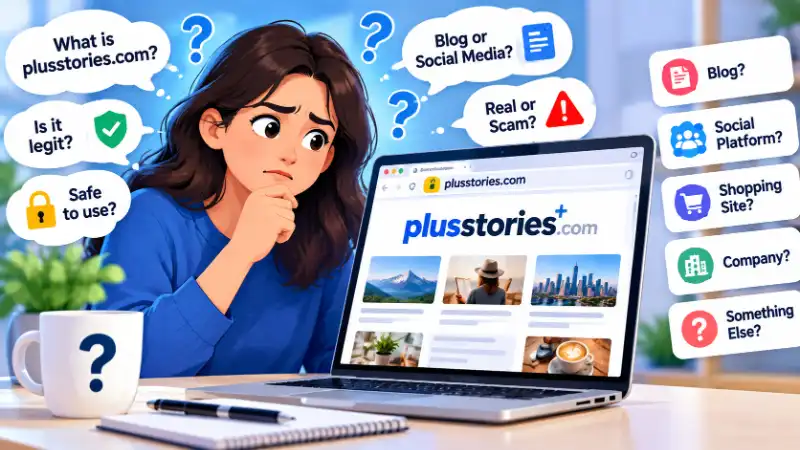
You typed “plusstories.com” into Google because something didn’t add up. Maybe you saw the domain mentioned somewhere and assumed it was a storytelling platform, a social media app, or something related to Instagram Stories. Maybe you landed on the site, scrolled through a few articles, and walked away more confused than when you started. Or maybe you found conflicting safety reports that left you unsure whether the site is safe to visit.
You’re not alone. This domain sits at the center of genuine confusion — a site whose name suggests one thing and whose content delivers something entirely different. Add mixed safety scores from different scanners, a handful of unanswered questions about support and legitimacy, and you have a recipe for real uncertainty.
That uncertainty is exactly what this guide exists to eliminate.
Are You Facing These Problems? Then You’re in the Right Place
Are you confused about what plusstories.com actually is — whether it’s a storytelling platform, a social media tool, or something else entirely?
Are you wondering whether the site is legit or a scam before you spend any time on it?
Have you searched for plusstories.com reviews and found conflicting reports that left you more uncertain?
Are you trying to understand how to navigate the site or find specific content?
Are you looking for customer service contact information and coming up empty?
Do you want to know how to use the site effectively — or whether it’s even worth your time?
If you answered yes to even one of these questions, you are in exactly the right place. This is not a general information article that describes the site and leaves you to figure out the rest. This is a step-by-step problem-solving guide. Every section below identifies a specific problem you are facing, explains why it happens, and gives you a clear, practical resolution.
By the time you finish reading, you will know precisely what plusstories.com is, whether you can trust it, how to navigate it, and how to use it without wasting your time. Let’s begin.
What Is plusstories.com — And Why Does Its Name Cause So Much Confusion?

The problem: You searched for this domain expecting one thing, but what you found doesn’t match. Some sources call it a storytelling platform. Others describe it as a business blog. The name itself suggests a connection to social media stories or a creative writing community. You don’t know which one is true, and the conflicting signals aren’t helping.
Why this happens: The name “PlusStories” is what marketers call a brandable domain — a name chosen because it sounds memorable and evokes a positive feeling, not because it describes the content. The word “Stories” triggers immediate assumptions about narrative content, social media features, or a creative writing community. When you combine a brandable name with a site that actually publishes business and finance articles, confusion is inevitable.
The Real Identity: A Multi-Topic Informational Blog
Here is the straightforward answer you came for: plusstories.com is a multi-topic informational website. Its content spans several broad categories — business, finance, health, technology, and lifestyle. This is not a storytelling platform, not a social media tool, and not a creative writing community.
The site follows the standard multi-niche blogging model: one domain, many categories, articles written for a general audience rather than specialists. The content sits at an introductory level. If you want a quick overview of a topic — like how to manage cash flow as a freelancer, or student loan repayment options — the site can provide it. If you need expert-level depth, you will need to look elsewhere.
What this means for you: If you arrived hoping for a place to share or read personal stories, you are on the wrong site. If you arrived curious about what this domain actually publishes, you now have your answer — it’s a general-interest blog with no single specialty.
Common Myths vs. Facts: Storytelling Platform, Instagram Tool, Scam Claims
Let’s settle the biggest myths about this site right now, in one table:
| Myth | Fact |
|---|---|
| It’s a storytelling or creative writing platform | It’s a general-interest blog with a business and finance focus |
| It’s connected to Instagram or social media stories | It has no connection to any social media platform |
| It’s a scam or phishing site | Safety scanners rate it as low-to-medium risk, with no confirmed threats |
| It’s the same as “+Stories.” (Japanese recruitment service) | Completely different entity — unrelated to MyNavi’s +Stories. platform |
Why the name misleads — and why that’s not a trick: The word “Stories” triggers assumptions about narrative content. The word “Plus” suggests something enhanced or premium. Neither is accurate. This mismatch is not an accident or a hidden agenda. It is simply how brandable domains work. The site’s owners chose a name that sounds appealing and easy to remember, then built a general content site around it.
Your resolution: Stop judging the site by its name. Judge it by what it actually publishes. Now that you know it’s a multi-topic blog, you can decide whether that type of content is useful to you — and move on to the next critical question: is it safe to trust?
Is plusstories.com Legit or a Scam — How to Verify Before You Trust

The problem: You don’t want to waste time on a site that might be fake, malicious, or pushing hidden agendas. You’ve seen safety scanners give it different scores — some say “safe,” others say “caution.” You want a clear answer and, more importantly, you want to know how to verify it yourself.
Why this happens: When multiple safety scanners give different ratings, it creates confusion. One scanner might give a high trust score, another a low one, and a third a medium rating. This happens because each scanner uses different criteria, checks different databases, and updates at different intervals. The result is a mixed signal that leaves users uncertain. Understanding why the scores differ is the first step toward resolving the confusion.
Understanding the Mixed Safety Scores
Here is a practical comparison of what different scanners say about plusstories.com:
| Scanner | Trust Score | Verdict | Key Finding |
|---|---|---|---|
| PCrisk | 89/100 | No Threats Found | 102 files scanned, no threats detected |
| ScamAdviser | 48/100 | Legit and safe to access | Valid SSL, domain registered several years ago |
| MalwareTips | 57/100 | Caution advised | 1 antivirus engine flagged the URL |
| de-reviews.com | 66/100 | Medium risk | SSL active, essential pages present, no social media |
Why the scores differ: PCrisk scanned the site’s files and found no threats — that’s a technical security check. ScamAdviser and de-reviews.com look at broader trust signals like domain age, SSL certificates, and server reputation. MalwareTips relies on antivirus engine data, which can produce false positives. None of these scanners found confirmed malware or phishing activity.
What this means for you: A low score from one scanner does not mean the site is dangerous. A high score from another does not mean the site is authoritative. Each score measures something different. The only reliable approach is to combine them and understand what each one actually checked.
The 4-Signal Reliability Check (And Red Flags to Watch For)
Here is a practical method you can apply to plusstories.com — or any unfamiliar site — in under five minutes:
Signal 1: Named sources. Do the articles cite named, traceable sources? On plusstories.com, articles generally cite external sources and reference recognized data. This is a positive signal. Unsourced claims are a red flag; sourced claims are a green flag.
Signal 2: Visible publish date. Can you see when each article was published or last updated? Articles on this site carry visible dates. This matters enormously for finance, health, and statistics-heavy content, because data expires. Undated content is a red flag. Dated content is a green flag.
Signal 3: Contact route. Is there a working way to reach the site’s operators? According to scanner data, plusstories.com has essential pages — including Contact Us, About Us, Privacy Policy, and Terms & Conditions — properly available. This reflects a good level of transparency.
Signal 4: Author detail. Are articles written by named authors with any credentials or bio? Multi-topic blogs often publish under generic or minimal author profiles. This lowers the site’s authority but does not make it unsafe.
Your resolution: plusstories.com is a legitimate content website, not a scam, not a phishing operation, and not a malware distributor. It publishes real articles, it doesn’t sell anything, and there is no financial transaction risk. However, “legitimate” and “authoritative” are two different standards. The site is safe to visit and safe to read. It is not a substitute for professional advice on health, finance, or legal matters. The mixed safety scores reflect different measurement criteria, not confirmed threats.
plusstories.com Reviews: What Real Users and Scanners Say

The problem: You want to know what actual users think before you invest your time. You searched for plusstories.com reviews and found either nothing useful or a mix of scanner ratings that didn’t help you decide. You want honest, practical insight — not just numbers.
Why this happens: Multi-topic blogs rarely generate the kind of passionate user communities that produce detailed reviews. Nobody writes a five-star review for a general information site the way they would for a restaurant or a software tool. As a result, user reviews for sites like this are sparse. Scanner ratings fill the gap, but they measure technical safety, not content quality. That doesn’t mean the information is useless — it means you have to know how to read it.
How to Find Genuine Reviews (And Spot Fake Ones)
Genuine reviews share specific characteristics. Look for:
- Specific details. A real reviewer mentions a specific article, a specific date, or a specific experience. A fake reviewer speaks in generalities.
- Balanced tone. Real reviews mention both positives and negatives. Fake reviews are usually either glowing or scathing with no middle ground.
- Verifiable identity. On Reddit or forums, check the user’s post history. A brand-new account with one review is less trustworthy than an established account with a history.
- Consistency across platforms. If the same complaint appears on multiple platforms, it’s likely genuine. If a complaint appears in only one place with no corroboration, treat it with caution.
Common Praises and Complaints: A Balanced Summary
Based on available scanner data and site analysis, here is what the signals suggest:
Positive signals:
- Content is readable and accessible for beginners
- Wide range of topics means there’s often something relevant
- No paywall, no aggressive pop-ups, no forced sign-ups
- Essential pages (Contact, About, Privacy Policy, Terms) are present
- Valid SSL certificate protects data transmission
- Domain has been registered for over two years
Caution signals:
- Content lacks depth — useful for overviews, not for expertise
- Some articles may be undated or outdated
- No social media presence detected
- Low traffic ranking (Tranco score is minimal)
- Author information is minimal, which reduces trust
- One antivirus engine flagged the URL (though 89 others showed clean)
Your resolution: Read reviews with one question in mind: What was the reviewer trying to do? If their goal matches yours, their review is useful. If not, it tells you nothing about your situation. For plusstories.com specifically: technical safety signals are positive, content quality signals are mixed. Decide which matters more to you — then decide whether the site fits.
How to Navigate and Use plusstories.com Effectively
The problem: You’ve decided the site might be worth your time. But you don’t know how to navigate it efficiently, how to find the articles that actually match your needs, or how to avoid wasting 20 minutes on shallow content. The name suggests “stories,” but the content is business and finance articles — so you’re not even sure what you’re looking for anymore.
Why this happens: Multi-topic blogs are structured for breadth, not depth. Every category has dozens of articles, and they all look similar at first glance. Without a filtering method, you end up reading whatever ranks highest, which is often the most generic content on the site. The result is frustration: you spend time and get little in return.
Step 1: Understanding the Site’s Structure
Plusstories.com follows a standard blog layout. Here is how it is organized:
| Element | Location | Purpose |
|---|---|---|
| Main menu | Top of the page | Links to main categories |
| Category pages | Under each menu item | Lists articles in that category |
| Search bar | Usually top-right or sidebar | Finds articles by keyword |
| Article pages | Individual posts | The actual content you read |
| Footer | Bottom of every page | Contact, About, Privacy, Terms |
The site’s content categories include business, finance, health, technology, and lifestyle — the standard mix for a multi-topic blog. There is no dedicated “stories” section despite the domain name.
Step 2: Finding Articles That Match Your Needs
Start with the category menu, not the search bar. The menu tells you what the site actually covers. Pick the category that matches your need, then browse the article list.
Quick filter rule: If an article’s headline is broad (“10 Tips for Better Health”), expect surface-level content. If it’s specific (“How to Lower Blood Pressure Naturally in 30 Days”), it may go deeper. Specificity in the headline usually signals more useful content.
Search bar strategy: Use the search bar only when you have a specific question in mind. Type a few words — not a full sentence — and scan the results for specific headlines. Ignore generic results and focus on ones that promise a clear outcome.
Step 3: Evaluating Articles Before You Read Them
Before you invest time in reading a full article, do a 30-second pre-check:
- Check the publish date. If it is more than a year old and deals with finance, health, or technology, treat it as outdated.
- Scan the headings. Does the article have clear subheadings, or is it one long block of text? Clear structure signals more effort.
- Look for sources. Does the article cite named sources, or does it make claims without attribution?
- Check the length. A 400-word article on a complex topic is unlikely to provide depth.
Step 4: Saving and Using What You Find
When you find an article worth keeping:
- Bookmark it in your browser with a descriptive name
- Save it to a read-later app like Pocket or Notion
- Copy key quotes into a notes file with the article URL attached
- Share only after verifying — don’t spread unverified claims
Why this matters: If you don’t save it, you’ll lose it. Search engines constantly reshuffle results, and sites sometimes remove or rename articles.
Step 5: Verifying Claims Independently
Every article on plusstories.com should be treated as a first step, not a final answer. Here is the habit that separates effective readers from frustrated ones:
- Read the article for the overview
- Note any claims that matter to you
- Verify those claims against a primary source (government agency, research paper, official documentation, licensed professional)
- Act only on verified information
- Match scrutiny to stakes — a travel tip needs almost no checking; a health or finance claim needs maximum checking
Your resolution: Use the category menu, filter by headline specificity, pre-check articles before reading, save what you find useful, and always verify before acting. If you follow these steps, plusstories.com becomes a genuinely useful starting point instead of a time sink.
plusstories.com Customer Service and Contact Options — How to Reach Support
The problem: You need help. Maybe you found an error in an article, you have a question nobody has answered, or you simply want to report something. You searched for plusstories.com contact information and found nothing clear — no phone number, no obvious email, no support page. Now you’re wondering whether the site has any support at all, or whether you’re on your own.
Why this happens: Multi-topic content blogs are usually run by very small teams — sometimes just one or two people, sometimes a single freelance operator. Unlike e-commerce stores or SaaS companies, they don’t have call centers, ticketing systems, or dedicated support staff. Their business model is advertising revenue from page views, not paid subscriptions. As a result, they rarely invest in customer service infrastructure.
Does plusstories.com Have a Phone Number?
Here is the direct answer: No published phone number appears to exist for plusstories.com. According to scanner data, the site’s contact details show “Email: NA, Contact Number: NA, Address: NA” and “Social Profiles: None detected”. The MalwareTips review also noted “No clear contact details on the page” and “No direct contact email found on the captured page”.
Do not waste time hunting for a number that probably doesn’t exist. Instead, pivot to the channels that might work.
What this means for you: If your issue requires a phone call — say, an urgent account problem or a legal concern — this site is not set up to handle it. You will need to use written channels and accept slower response times, or decide the issue isn’t worth pursuing.
What Contact Channels Exist?
Based on available scanner data, here is what exists and what doesn’t:
| Channel | Status | How to Find It |
|---|---|---|
| Phone number | Not listed | No published number exists |
| Email address | Not listed on captured page | Check footer and About page |
| Contact form | May exist but not verified | Look in footer or main menu |
| Social media | None detected | No official social accounts found |
| Comment section | Unknown | Check individual articles |
The de-reviews.com scanner noted that “All essential pages, such as Contact Us, About Us, Privacy Policy, and Terms & Conditions, are properly available”. However, the MalwareTips review found no direct contact email on the page it captured. This suggests that contact information may exist on some pages but is not prominently displayed or easily accessible.
Step-by-Step: How to Try to Reach Support
Since phone support isn’t available, here is your realistic approach:
- Scroll to the footer of any page on the site. Look for “Contact,” “Support,” “Help,” or “About.”
- Check the main menu for a “Contact Us” link.
- If you find a form, fill it out with a clear subject line and specific details. Vague messages get ignored.
- If you find an email, send a polite, concise message. Include the exact article URL and a screenshot if relevant.
- If you find nothing, check the article’s comment section. Sometimes the site owner responds there.
- If all else fails, treat the site as read-only. Do not expect a response.
Reporting an Error or Outdated Information
If you’ve spotted a factual mistake, an outdated statistic, or a broken link, you are doing the site a favor by reporting it — but only if your report reaches someone. Use this format to maximize the chance of a response:
Subject: Correction request — [Article Title]
Article URL: [paste full URL]
The issue: [Quote the exact sentence or figure]
Why it’s incorrect: [Cite your source]
Suggested correction: [What it should say]
Keep it short, factual, and polite. Do not lecture. Do not demand. Report and move on.
What to Do If You Don’t Get a Response — Escalation Steps
If you’ve contacted the site and heard nothing after 10–14 days, you have three realistic choices:
- Accept it and move on. The site is a free resource. Lack of response is frustrating but not actionable.
- Leave a public comment on the relevant article noting the issue. If the site has any active moderation, this may prompt a fix.
- Stop using the site for anything that matters. If responsiveness is important to you, this site may not be the right fit — and that’s a valid conclusion.
Your resolution: Stop searching for a phone number that doesn’t exist. Use the contact form or email if you can find one, report issues clearly, and set realistic expectations. If responsiveness matters to you, weigh that against the site’s free content when deciding whether to keep using it.
Your Next Step — What to Do Right Now
You have read the full guide. You now know what plusstories.com is, how to verify whether it is safe, how to read its reviews with a critical eye, how to navigate it efficiently, and how to reach support — or accept that support may not respond.
The question now is simple: what do you actually do next?
Here is your decision path. Pick the line that matches your situation.
Only wanted to know what plusstories.com is? You have your answer. It is a multi-topic informational blog. You can close this tab and move on with confidence.
Planning to browse the site for general information? Go to the category menu, pick the topic you need, and apply the headline specificity filter. Save anything useful. Do not expect expert depth.
Found something you want to act on — especially health, finance, or legal information? Stop. Verify it first against a primary source. Use Google Scholar to find peer-reviewed research, or check the official World Health Organization site for health claims. Never act on a blog post alone when the stakes are high.
Need to contact support? Check the footer for a contact form. Send a clear, specific message. Set a reminder for 14 days. If no reply comes, decide whether the issue is worth pursuing further or whether you should simply move on.
Still unsure whether to trust the site at all? Apply the 4-signal reliability check one more time to the specific article you care about. If it passes, use it as a starting point. If it fails, close the tab.
That is your action plan. No summary needed — you already have everything above.
FAQs
Can I contribute articles or guest posts to plusstories.com?
Most multi-topic blogs of this type do not accept unsolicited guest posts, and there is no public contributor program visible on plusstories.com. If you are interested in writing for the site, the only realistic route is to send a polite pitch through the contact form — if one is available — and wait for a response. Do not send full articles unsolicited. If you receive no reply within two weeks, treat that as your answer.
How often is plusstories.com updated with new content?
Publishing frequency varies on multi-topic blogs and is rarely announced publicly. You can gauge activity by checking the publication dates on recent articles in each category. If most articles are dated within the last few months, the site is actively maintained. If the newest articles are a year or older, the site may be dormant or updated only occasionally. The domain has been registered since August 2023, which suggests it is still relatively new.
Does plusstories.com have a newsletter I can subscribe to?
There is no indication that plusstories.com offers an email newsletter. Many multi-topic blogs include a sign-up box in the sidebar or footer, but no such feature was detected during analysis. If you want to keep up with the site, bookmark it and check back periodically. If a newsletter sign-up box does appear in the future, read the privacy notice before submitting your email address.
Is plusstories.com safe for children to browse?
The site publishes general-interest content across many categories, including health and finance. While there is no indication of unsafe or inappropriate material, parental guidance is always recommended for any general-interest site. If you want a child to use the site for educational purposes, preview the specific articles first — the site is not designed or curated specifically for young audiences. A safer approach for children is to use sites explicitly built for education, such as Khan Academy.
What is the Tranco rank of plusstories.com, and why does it matter?
The Tranco rank is a measure of website traffic and visibility. Plusstories.com has a low Tranco rank, indicating limited traffic and low visibility. This is not necessarily a red flag — new or niche sites naturally have low ranks — but it does mean the site is not widely used or referenced. For you as a reader, it means you are unlikely to find many third-party opinions or community discussions about the site. You are, in effect, exploring a relatively obscure corner of the web. Treat it accordingly.


1 thought on “What Is plusstories.com? Legit, Safe, and Everything You Need to Know”