If you searched for “fundraiser” because you were not sure what the word means, you are not alone. The word can describe a person or an event, depending on how it is used.
For example, someone can work as a fundraiser, while a school can hold a fundraiser. The word stays the same, but its meaning changes with the sentence.
This guide explains both meanings clearly. You will also learn how to recognize the correct meaning, how fundraiser differs from fundraising, and how to use the word correctly.
What Does “Fundraiser” Mean in Simple English?
In simple English, a fundraiser is either a person who helps raise money or an event created to raise money.
When it describes a person, the word tells you what that person does.
“She works as a fundraiser for a nonprofit.”
Here, fundraiser means a person who helps collect money.
When it describes an event, the word refers to the activity where money is being raised.
“The school held a fundraiser.”
Here, fundraiser means an event organized to collect money.
So, the basic meaning is not difficult once you separate these two uses:
Fundraiser = a person or an event involved in raising money.
The sentence around the word tells you which meaning is intended.
Why Can “Fundraiser” Mean Both a Person and an Event?
The word can describe both because a person and an event can have the same purpose: raising money.
A person may ask donors for support, contact potential donors, or organize fundraising activities. That person can be called a fundraiser.
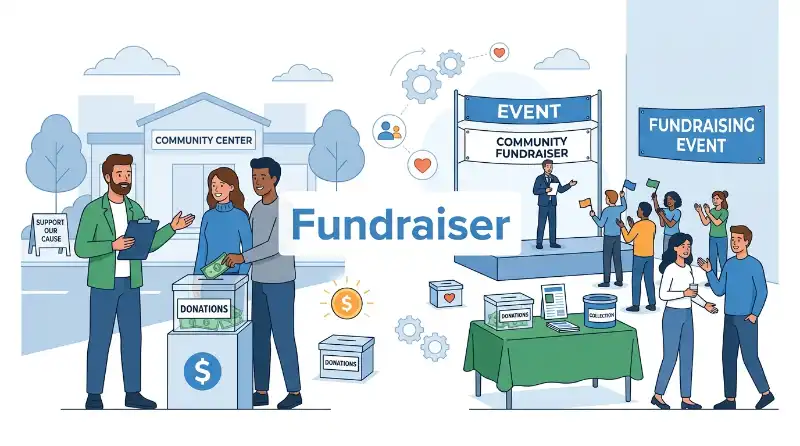
An event can also be created to collect money. A dinner, auction, bake sale, or charity walk may all be used for that purpose. Such an event can also be called a fundraiser.
The important point is that English is focusing on the money-raising purpose, not on whether the word refers to a person or an event.
For example:
“The organization hired a fundraiser.”
The organization hired a person.
But:
“The organization hosted a fundraiser.”
The organization hosted an event.
So, there is no contradiction in the word having two meanings. Both meanings are connected to the same basic idea: raising money for a particular purpose.
How Can You Tell Which Meaning of “Fundraiser” a Sentence Uses?
The easiest way is to look at the verb around the word.
Some actions normally happen to people. Other actions normally happen to events.
Consider this sentence:
“The charity hired a fundraiser.”
You can hire a person, so fundraiser means a person here.
Now consider:
“The charity held a fundraiser.”
You can hold an event, so fundraiser means an event here.
The same test works with other sentences.
“He became a fundraiser.”
A person can become a fundraiser.
“Hundreds of people attended the fundraiser.”
People attend events, so this fundraiser is an event.
If you are still unsure, replace fundraiser with person and then with event.
For example:
“The company hosted a fundraiser.”
“The company hosted a person” does not make sense.
“The company hosted an event” does make sense.
That tells you the word means event.
This simple context test is often enough. You do not need to memorize a complicated grammar rule.
What Does “Fundraiser” Mean When It Describes a Person?
When fundraiser describes a person, it means someone who raises or helps raise money for a particular purpose.
That person may work for a nonprofit, charity, school, political organization, community group, sports team, or another cause.
A fundraiser may contact donors, ask for financial support, organize fundraising activities, or help an organization reach its fundraising goals.
For example:
“The nonprofit hired a fundraiser.”
The sentence tells us that the nonprofit hired someone to help raise money.
A fundraiser does not always have to be a full-time professional.
A volunteer who spends time collecting money for a school or community project may also be described as a fundraiser.
The main idea is the person’s role in raising money.
So when fundraiser refers to a person, remember:
A fundraiser is someone who raises or helps raise money for a particular cause, organization, or purpose.
That meaning is complete on its own. The next meaning is different because now the word refers to the event, not the person.
What Does “Fundraiser” Mean When It Describes an Event?
When fundraiser refers to an event, it means an organized activity held to raise money for a particular purpose.
The event can be very simple or quite large.
A school might hold a bake sale to pay for new equipment. A charity might organize a dinner. A sports team might hold an auction to help cover travel costs.
All of these can be called fundraisers because their purpose is to collect money.
You can usually recognize this meaning from the verbs used with the word.
“The school held a fundraiser.”
“The charity hosted a fundraiser.”
“We attended a fundraiser.”
The words held, hosted, and attended point to an event.
It is also important to separate the event from the money collected at it.
The fundraiser is the event.
The money people give during the event is usually called donations, contributions, or funds raised.
For example:
“The charity held a fundraiser and received hundreds of donations.”
The fundraiser is the event. The donations are the money people gave.
That distinction makes the event meaning much easier to understand.
Is “Fundraiser” the Same as “Fundraising”?
No. Fundraiser and fundraising are related, but they describe different things.
Fundraiser can mean a person or an event.
Fundraising means the activity or process of collecting money.
For example:
“She works as a fundraiser.”
This describes a person.
Now compare it with:
“She works in fundraising.”
This describes the activity or field of work.
The difference becomes even clearer with an event:
“The school held a fundraiser.”
That means the school held a specific event.
But:
“The school started fundraising.”
That means the school started the broader activity of trying to collect money.
You can remember the difference like this:
Fundraiser = person or event.
Fundraising = the activity of raising money.
Fundraise = the action of raising money.
Cambridge Dictionary likewise defines fundraising as the act of collecting or producing money for a particular purpose.
Is a Fundraiser the Same as a Charity, Donation, or Campaign?
No. These words can appear in the same sentence, but they do not mean the same thing.
A charity is usually an organization or cause that provides help or works for a particular purpose.
A donation is something a person gives, usually money or goods, to support a cause.
Fundraising is the activity of trying to collect that support.
A fundraiser is the person or event involved in raising the money.
For example, imagine a local charity wants to help families in need.
The charity might organize a fundraiser. People attend the event and make donations. The whole effort is part of the charity’s fundraising.
Each word has a separate meaning:
- Charity = organization or cause
- Fundraiser = person or event
- Fundraising = activity of raising money
- Donation = money or other support given
This is why replacing one word with another can change the meaning of a sentence.
If you mean the money someone gives, use donation.
If you mean the activity of collecting money, use fundraising.
If you mean the person or event doing the money-raising, use fundraiser.
How Is “Fundraiser” Used in Real Sentences?
The best way to understand the word in everyday English is to see how the two meanings work in complete sentences.
When it means a person, you might see:
“The organization hired a fundraiser.”
The organization hired someone to help raise money.
“She has worked as a fundraiser for several years.”
Fundraising is part of her professional work.
“The fundraiser contacted several potential donors.”
The word refers to a person because that person is contacting donors.
When it means an event, you might see:
“The school held a fundraiser.”
The school organized an event to raise money.
“We attended a fundraiser last weekend.”
People attended an event.
“The charity hosted a fundraiser for its new program.”
The charity organized an event to collect money for the program.
The quickest way to understand these sentences is to focus on the action.
Hire, work as, or contact usually point toward a person.
Hold, host, or attend usually point toward an event.
What Is the Difference Between a Fundraiser and Similar Words?
Some words sound close to fundraiser, but they are not always interchangeable.
A fundraising event is an event specifically intended to raise money. In many situations, you can simply call it a fundraiser.
For example:
“The school held a fundraising event.”
You could also say:
“The school held a fundraiser.”
Both sentences describe an event created to raise money.
A charity event is slightly different. The phrase emphasizes that the event supports a charitable cause. A fundraiser can support a charity, but it can also support a school, sports team, community project, or another purpose.
A benefit can also describe an event held to raise money or provide support for a person or cause. However, fundraiser is the more direct word when the main idea is raising money.
So, before choosing a similar word, ask yourself:
What exactly am I trying to describe?
If you mean the person or event involved in raising money, fundraiser is usually the clearest choice.
How Do You Use “Fundraiser” Correctly?
The safest way to use fundraiser is to decide whether you mean a person or an event before writing the sentence.
For a person, use wording that clearly describes someone’s role.
“She is a fundraiser for the nonprofit.”
“The organization hired a professional fundraiser.”
For an event, use wording that shows people can attend, hold, host, or organize it.
“The school is planning a fundraiser.”
“The charity hosted a fundraiser.”
“Many people attended the fundraiser.”
You can also explain the purpose with for:
“They organized a fundraiser for the local shelter.”
Here, the phrase “for the local shelter” tells readers who or what the money will support.
One mistake to avoid is using fundraiser when you actually mean the money that someone gives.
“She made a donation.”
means she gave money.
“She organized a fundraiser.”
means she helped arrange an activity to collect money.
The two actions are related, but they are not the same.
Is “Fundraiser” Always Related to Charity?
No. A fundraiser is not limited to charities.
Charities use fundraisers often, but other groups can raise money too.
A school may hold a fundraiser to buy classroom equipment. A sports team may raise money for travel. A community group may collect money for a local project.
A fundraiser can even support an individual person.
The important part is the purpose of raising money. The group or person receiving the money does not have to be a registered charity.
This is why the broader meaning is more useful than simply thinking:
“Fundraiser means charity event.”
That is only one common use.
A better understanding is:
A fundraiser is a person or event involved in raising money for a particular purpose.
Can a Fundraiser Be Online?
Yes. A fundraiser does not have to happen in a physical location.
People can organize fundraising activities online through websites, social platforms, live events, or digital campaigns.
For example, someone might create an online fundraiser to help a family with unexpected expenses.
In that case, the word still refers to the money-raising effort or event. The fact that it happens online does not change the basic meaning of fundraiser.
The same idea applies to the person organizing it.
Someone who actively raises money online can also be described as a fundraiser.
So, online or offline does not determine the meaning. The sentence and context still tell you whether fundraiser refers to a person or an event.
Is “Fundraiser” One Word or Two?
The standard modern spelling is fundraiser, written as one word.
You will most commonly see it written this way in everyday English:
“The school organized a fundraiser.”
“She works as a fundraiser.”
If you are writing an article, email, school assignment, or social post, fundraiser is the simple spelling to use.
What Is the Plural of “Fundraiser”?
The plural form is fundraisers.
You simply add -s to the end.
For example:
“Several fundraisers were held during the summer.”
Here, fundraisers refers to multiple events.
It can also refer to multiple people:
“The organization employs several fundraisers.”
The sentence makes the meaning clear.
So, whether fundraisers means people or events depends on the surrounding words.
FAQ About “Fundraiser”
Can a fundraiser be for one person?
Yes. People can organize a fundraiser to collect money for an individual who needs financial support.
Can a school have a fundraiser?
Yes. Schools commonly use fundraisers to collect money for activities, equipment, trips, clubs, or other school needs.
Can a fundraiser be a bake sale?
Yes. A bake sale can be a fundraiser when the money collected from selling baked goods is used for a particular purpose.
Can a fundraiser be a job?
Yes. When fundraiser describes a person, it can refer to someone whose job involves raising money for an organization or cause.
What does “fundraiser event” mean?
A fundraiser event is an organized event intended to raise money. In many sentences, simply saying fundraiser already gives that meaning.
Conclusion
The word fundraiser has two main meanings, and the sentence usually tells you which one is intended.
It can mean a person who raises or helps raise money. It can also mean an event organized to raise money.
The easiest way to identify the meaning is to look at the action around the word.
If someone is hired, works as, or becomes a fundraiser, the word refers to a person.
If people hold, host, attend, or organize a fundraiser, it refers to an event.
Also remember that fundraiser, fundraising, and donation are not interchangeable. A fundraiser is the person or event, fundraising is the activity, and a donation is what someone gives.
Once you make that small distinction, “fundraiser” becomes a much easier word to understand and use correctly.
Useful reference: For another clear dictionary explanation of fundraiser and its person/event meanings, see Cambridge Dictionary — Fundraiser.
For the related word fundraising, you can also check Cambridge Dictionary — Fundraising.