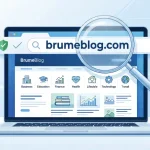
If you searched for BrumeBlog.com, you probably want three simple answers: What is this website? What does it publish? And can you trust the information you find there?
BrumeBlog.com is a multi-topic content website. It publishes articles about different subjects rather than focusing on one specialist field.
That answer is only the starting point. You may still wonder whether you are looking at the correct website, whether it is safe to visit, and whether its articles are reliable enough to use.
So, instead of mixing all these questions together, we will answer them one at a time.
What Is BrumeBlog.com, and What Is This Website Actually For?
If the name BrumeBlog.com is new to you, the first thing to understand is what kind of website it is.
BrumeBlog.com is a multi-topic content website that publishes articles across several areas.
Its visible categories include Business, Education, Finance, Health, Lifestyle, Technology, and Travel.
That means the site does not have one narrow purpose. It is not presented as a banking service, online store, social network, or software platform.
Its main role is to publish and organize written content for readers interested in different subjects.
Why Does Its Website Type Matter?
The type of website affects how you should judge its information.
A specialist website normally focuses on one particular field. A medical organization, for example, may concentrate mainly on health information. A financial institution may focus on financial products, services, and rules related to its work.
BrumeBlog.com takes a wider approach.
You can find articles about subjects that have little connection with one another. One page may discuss technology while another may cover travel, lifestyle, or finance.
That does not make the website good or bad by itself.
It simply tells you that you should not assume the site has specialist authority over every subject it covers.
Is BrumeBlog.com a Specialist Website?
No. It is better understood as a general-interest publication.
That distinction is important because a general website can provide useful information without being the strongest authority on every topic.
For example, an article may give you a simple explanation of a subject. That can be helpful when you are learning something for the first time.
However, if you need information for an important medical, financial, legal, or technical decision, you should look for a source with direct expertise in that field.
What Is the Clear Answer?
If your main question is “What is BrumeBlog.com?”, the answer is simple:
BrumeBlog.com is a multi-topic content website covering several subjects. It is a general-interest publication, not a website dedicated to one specialist field.
Now that its basic identity is clear, the next question is what you can actually find there.
What Topics Does BrumeBlog.com Cover, and What Will You Find There?
Knowing that BrumeBlog.com is a general-interest site does not tell you whether it covers the subject you are searching for.
The site’s visible navigation gives us a clearer picture.
It includes Business, Education, Finance, Health, Lifestyle, Technology, and Travel.
Each category points to a different type of reader need.
What Does the Business Category Cover?
The Business section is aimed at general subjects related to companies, work, business ideas, and related interests.
If you are researching a basic business topic, this section may give you an initial explanation.
However, a general business article should not automatically be treated as professional business advice. The exact subject and the evidence in the article still matter.
What Does the Education Category Cover?
The Education section focuses on topics connected with learning and educational interests.
This can be useful when you want a simple explanation or are exploring a subject before doing deeper research.
For academic work, however, you may need stronger sources such as educational institutions, research papers, or original studies.
Why Do Finance and Health Need More Care?
Finance and health are different from casual-interest topics because inaccurate information can have real consequences.
A finance article may discuss money, financial concepts, or other related subjects. Before making a financial decision, you should confirm important details with a current and appropriate source.
The same rule applies to health.
A general article can help you understand a health topic, but it should not automatically replace advice from a qualified professional. For basic health information, an additional reference such as MedlinePlus can help you check information against a trusted health resource.
What About Lifestyle, Technology, and Travel?
Lifestyle covers broader everyday interests.
Technology can help readers explore digital and technology-related subjects.
Travel can provide general information about destinations and travel topics.
Travel information needs one extra check because details can change. Prices, entry rules, opening hours, transportation information, and travel requirements may be different when you actually travel.
Does Having Many Categories Make BrumeBlog.com Unreliable?
No. A wide topic range does not automatically make a website unreliable.
The important question is whether the individual article is accurate, current, supported, and suitable for the reason you are reading it.
A broad website can publish a useful article.
It can also publish an article that needs more checking.
Those two things can exist at the same time.
What Is the Clear Answer?
BrumeBlog.com covers a wide range of subjects, including business, education, finance, health, lifestyle, technology, and travel.
That makes it useful for general exploration, but you should judge each article on its own quality instead of assuming that every topic receives specialist-level coverage.
Once you know what the site covers, there is another problem to solve first: making sure you are actually looking at the correct BrumeBlog website.
Are You Looking at the Real BrumeBlog.com or a Different Brume Blog Website?
A similar website name can create a surprisingly big problem.
If you search for “BrumeBlog,” you may come across another domain that looks almost identical.
That does not mean the two websites are connected.
For this article, the website being discussed is specifically brumeblog.com.
Why Does the Exact Domain Matter?
A domain identifies the website you are actually visiting.
Imagine two websites with similar names. One has a particular owner and contact information. The other has different people, policies, and content.
If you take information from the first website and apply it to the second, your conclusion will be wrong.
The same problem can happen with BrumeBlog.com.
What Should You Check?
Look at the full address in your browser.
Make sure it says:
brumeblog.com
Do not rely only on the title of a search result. Search results can contain similar names, descriptions, and pages from different domains.
The domain itself tells you which website you are evaluating.
What Information Should You Avoid Mixing?
Do not automatically transfer information about:
- ownership,
- authors,
- contact details,
- reviews,
- policies,
- reputation,
- or safety
from another website with a similar name.
First establish that the two websites are actually connected.
A similar name is not enough proof.
Why Should Domain Identity Come First?
You cannot fairly judge a website until you know which website you are judging.
If the domain is wrong, everything that follows can also be wrong.
That is why domain identity comes before reputation.
It is a small check, but it prevents a common research mistake.
What Is the Clear Answer?
If you are researching BrumeBlog, confirm that the website you are looking at is brumeblog.com.
Do not combine information from similarly named domains unless their connection has been verified.
Now that the domain itself is clear, we can deal with the next question: is the website safe to visit?
Is BrumeBlog.com Safe to Visit, and What Can You Actually Verify About It?
When someone asks whether BrumeBlog.com is safe, they may actually be asking two different questions.
The first is:
“Is it safe to visit this website?”
The second is:
“Can I trust the information published there?”
These questions should not be treated as the same thing.
What Does Website Safety Mean?
Website safety is mainly about technical and security-related risks.
You may want to know whether the site:
- triggers a browser security warning,
- sends you to suspicious pages,
- starts an unexpected download,
- asks for sensitive information without a clear reason,
- or shows other unusual behavior.
These are signs you can check while using the site.
Does HTTPS Prove the Site Is Trustworthy?
No.
HTTPS helps secure the connection between your browser and the website.
That is useful, but it does not prove that every article on the website is accurate.
A website can have HTTPS and still publish information that is outdated, poorly supported, or incorrect.
So HTTPS should be treated as a security feature, not as proof of editorial quality.
What Should You Do If Something Looks Suspicious?
Do not continue automatically.
If your browser displays a warning, take the warning seriously. If the website suddenly redirects you somewhere unexpected or begins a download you did not request, stop and investigate.
You can also use a reputable website-security or domain-checking service for an additional technical check.
But keep the purpose of that check clear.
A security scan may help you identify technical risks. It does not tell you whether an article’s claims are factually correct.
So, Is “Safe” the Same as “Reliable”?
No.
A safe-website question is about the risk of accessing the site.
A reliability question is about whether the information deserves your confidence.
Those require different evidence.
You could find no obvious technical warning and still decide to verify an important claim elsewhere.
What Is the Clear Answer?
If your concern is whether you can visit BrumeBlog.com, look for browser warnings, suspicious redirects, unexpected downloads, and other obvious security problems.
But do not use technical safety as proof that the site’s information is reliable.
Once those two issues are separated, we can ask the more useful question: what does the available evidence tell us about the site’s legitimacy?
Is BrumeBlog.com Legit, and What Does That Actually Tell You?
The word “legit” can mean different things to different readers.
Some people mean, “Is this a real website?”
Others mean, “Can I trust everything this website says?”
Those are not the same question.
Does BrumeBlog.com Appear to Be a Real Content Website?
Yes. BrumeBlog.com has a visible website structure, content pages, and multiple topic categories.
It is not simply an empty domain with no published material.
That establishes something useful: the website exists as an active content publication.
But it does not establish every other fact you might want to know.
Does the Website’s Existence Prove That Every Article Is Reliable?
No.
A real website can still contain information that is outdated, incomplete, opinion-based, or insufficiently supported.
The existence of a website tells you that the website exists.
It does not automatically prove the expertise of every writer or the accuracy of every claim.
That is why legitimacy and reliability should be judged separately.
What About Ownership and Author Expertise?
These details matter, but they should only be treated as verified when there is reliable evidence for them.
If you cannot clearly establish who owns a website or whether an author has specialist expertise, do not fill the gap with assumptions.
Simply describe the information as unclear.
That is more accurate than calling a site either “fully trustworthy” or “a scam” without enough evidence.
What Is the Clear Answer?
BrumeBlog.com is an active multi-topic publishing website.
However, being a real website does not prove that every article is authoritative or that every claim should be accepted without checking.
To judge the information properly, you now need to look at the individual article.
Can You Trust a BrumeBlog.com Article When You Need Accurate Information?
This is where the question becomes more specific.
Instead of asking, “Can I trust BrumeBlog.com?”, ask:
“Can I trust this particular article for the purpose I have in mind?”
That is a much better question because different articles can have different levels of evidence and usefulness.
Does the Article Name an Author?
Start with the author.
An author name gives you a way to understand who produced the information.
But a name alone does not prove expertise.
If the article discusses medicine, finance, law, science, or another specialist subject, check whether the writer has relevant knowledge or qualifications.
The more serious the topic, the more important this becomes.
Is the Article Current?
Next, look at the publication or update date.
This matters because information can change.
A basic explanation may remain useful for years. A travel rule, software feature, financial condition, or health recommendation may not.
If the information can change over time, check its date before treating it as current.
Does the Article Support Its Important Claims?
A strong article should give you some way to understand or verify its important claims.
That could include:
- an official source,
- a research paper,
- a named organization,
- direct evidence,
- or another credible reference.
You do not need ten links in every article.
You simply need enough evidence for the important statements being made.
Is the Writer Giving You a Fact or an Opinion?
This distinction is easy to miss.
A fact can be checked against evidence.
An opinion reflects someone’s judgment.
An interpretation may explain what the evidence means, but it is still not the same thing as an established fact.
So when an article says something is “the best,” ask what standard was used to reach that conclusion.
How Important Is the Information to You?
This final question determines how much checking you need.
If you are casually learning about a topic, a general article may give you enough information to understand the basics.
If the information could affect your health, money, legal position, or safety, you need stronger verification.
The higher the possible consequence, the higher the standard should be.
What Is the Clear Answer?
You do not need to reject a BrumeBlog.com article simply because it appears on a general-interest website.
Instead, check the author, date, evidence, claim type, and importance of the information.
If those checks give you enough confidence for your purpose, the article may be useful.
If they do not, verify the claim through a more appropriate source.
What Should You Do When a BrumeBlog Article Gives You Advice You Need to Act On?
Reading information is one thing.
Making a decision based on that information is another.
Before you act on an article, first decide how serious the result could be if the information is wrong.
What If You Only Need General Information?
For a simple question, you can use the article as a starting point.
It may help you understand a new term, learn the basic idea behind a subject, or discover what you need to research next.
There is no need to treat every general-interest article as a formal expert opinion.
The key is knowing what you are using it for.
What If the Information Concerns Your Health?
Health information deserves extra care.
A general article can help you understand a condition, treatment, symptom, or health concept.
But you should not use it as a replacement for appropriate professional medical advice.
If the information could affect treatment or a health decision, verify it with a qualified health professional or a trusted medical source before acting.
What If Money Is Involved?
Financial information also needs careful checking.
Rates, fees, rules, financial products, and market conditions can change.
If an article gives you information that could influence a financial decision, compare it with a current and appropriate financial source.
For consumer-focused financial information, Consumer Financial Protection Bureau is one example of a source you can use for additional verification.
What If the Topic Is Legal or Official?
For laws, government requirements, applications, and official rules, go to the relevant primary source.
A general article can make a complicated rule easier to understand.
But when the result could affect your rights or obligations, the original official information should carry more weight.
What If the Topic Is Technology?
Technology can change quickly.
A guide may describe an older version of an app, website, device, or software feature.
If the instructions matter, compare them with the current documentation from the company or service involved.
What Is the Clear Answer?
You do not need to choose between “trust everything” and “trust nothing.”
Use BrumeBlog.com to understand the subject.
Then verify important information with the most appropriate specialist or primary source before taking action.
That gives you a practical middle ground.
When Is BrumeBlog.com Useful, and When Should You Look for a More Specialized Source?
You may now be asking a simpler question:
“Is BrumeBlog.com worth using at all?”
Yes, it can be useful.
The important part is understanding when its general approach fits your needs and when another source would be better.
When Can BrumeBlog.com Be Useful?
A broad content website can be useful when you want to:
- learn the basics of a subject,
- get a simple explanation,
- explore an unfamiliar topic,
- discover related questions,
- or find a starting point for further research.
These are reasonable uses for general-interest content.
When Should You Use a Specialist Source Instead?
A specialist source is a better choice when the information could have serious consequences.
That includes questions about:
- health,
- money,
- law,
- safety,
- professional decisions,
- or important technical matters.
In those situations, try to get information as close as possible to the original source.
That may mean an official government website, medical organization, financial institution, research paper, manufacturer, or qualified professional.
Does That Mean BrumeBlog.com Is Not Useful?
No.
Being a general source does not make a website useless.
In fact, a simple article can help you understand a difficult subject before you move to a more technical source.
The two types of sources can serve different purposes.
One can help you understand.
The other can help you verify.
What Is the Simple Decision Rule?
Ask yourself one question:
“Do I need to understand this, or do I need to act on it?”
If you only need to understand the topic, BrumeBlog.com may be a useful starting point.
If you need to act and the consequences matter, verify the information before making your decision.
What Is the Clear Answer?
BrumeBlog.com can be useful for general learning and early research.
For high-stakes questions, use it as a starting point rather than your only source.
The right source depends on what you are trying to do with the information.
What Is the Best Way to Use BrumeBlog.com Without Relying on It Too Much?
You do not need a complicated research system.
A few simple steps can help you use the site without giving one article more authority than it deserves.
Step 1: Confirm the Domain
First, make sure you are on brumeblog.com.
This prevents you from accidentally using information from a similarly named website.
Step 2: Read the Article Carefully
Next, read the actual article instead of judging it only from the search-result title.
You need to know what the writer is really claiming before you can judge whether the claim is useful.
Step 3: Check the Author and Date
Find the author and publication or update date.
These two details tell you who produced the information and how current it may be.
Step 4: Identify the Important Claim
You do not need to fact-check every sentence.
Find the statement that matters most to your decision.
That is the claim worth checking first.
Step 5: Verify That Claim
Use an appropriate source to check the information.
For changing subjects, look for current information.
For specialist subjects, look for a specialist or primary source.
Step 6: Decide How Much Weight to Give the Article
After checking the important claim, decide whether the article gives you enough confidence for your purpose.
If it does, you can use the information appropriately.
If it does not, keep researching.
What Is the Simple Formula?
You can remember the process in five words:
Find → Read → Check → Verify → Decide
This approach works well because it does not tell you to blindly trust a website or blindly reject it.
It asks you to judge the information based on evidence.
What Should You Ultimately Know About BrumeBlog.com?
By this point, the main questions should have clear answers.
BrumeBlog.com is a multi-topic content website. Its visible categories include business, education, finance, health, lifestyle, technology, and travel.
Because it covers many subjects, it is best understood as a general-interest publication, not as a specialist authority in every field.
You should also confirm that you are looking at the exact brumeblog.com domain before using information about the site.
The safety question is separate from the reliability question.
A website can be technically safe to visit without every article being accurate. That is why important claims should be judged on their own evidence.
For ordinary learning, BrumeBlog.com can be a useful starting point.
For information that could affect your health, finances, legal position, safety, or another important decision, verify the claim with a more appropriate source before acting.
The goal is not to trust everything.
The goal is also not to reject everything.
The better approach is simple:
Use the site to learn. Check the important claims. Then decide based on the evidence.
Frequently Asked Questions About BrumeBlog.com
Is BrumeBlog.com a news website?
BrumeBlog.com is better described as a multi-topic content website rather than a traditional news organization. Its visible categories cover several general-interest subjects.
Is BrumeBlog.com focused on one specific topic?
No. The site covers multiple areas, including business, education, finance, health, lifestyle, technology, and travel.
Should I trust every article on BrumeBlog.com?
No website should receive automatic trust for every article. Check the author, date, evidence, and importance of the information before relying on a claim.
Can I use BrumeBlog.com for research?
Yes, it can be used as a starting point for general research. For academic, professional, medical, financial, or legal work, verify important information with stronger specialist or primary sources.
What should I do if an article seems outdated?
Check the publication or update date first. Then compare the information with a current source, especially if the topic involves rules, prices, technology, health, or travel requirements.
What if another website has information about BrumeBlog.com?
First check whether it is actually discussing brumeblog.com. Similar domain names can belong to different websites, so do not assume that information about one site applies to another.
Conclusion
BrumeBlog.com is a broad content website covering several different subjects. That makes it useful for general reading and early research, but it also means that each article should be judged on its own quality.
Before relying on information, confirm the exact domain, check who wrote the article, look at its date, and examine the evidence behind important claims.
For simple questions, that may be enough to help you understand a topic.
For serious decisions, take one more step and verify the information through an appropriate specialist or primary source.
Use BrumeBlog.com as a place to learn and explore. When the information matters, verify it before you act.